
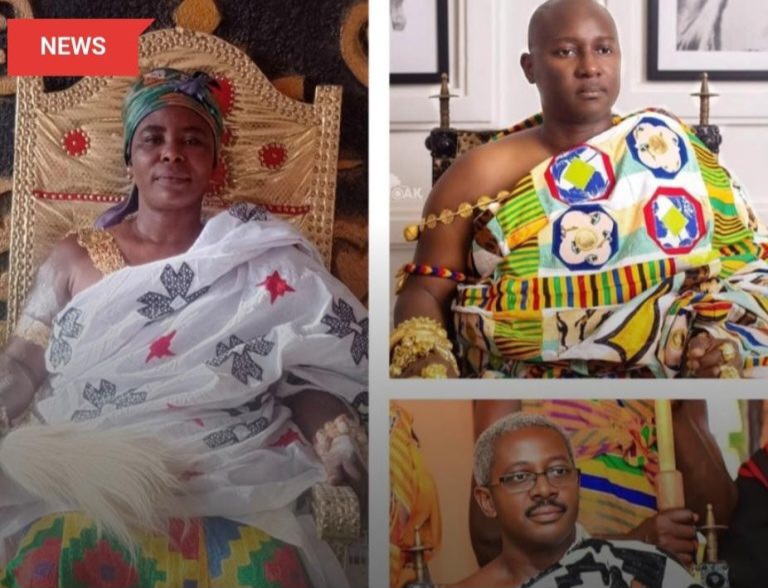
The Kwahu Traditional Area, in the Eastern Region, known for its deep cultural heritage and vibrant festivals, is now at the heart of an intensifying
The Kwahu Traditional Area, in the Eastern Region, known for its deep cultural heritage and vibrant festivals, is now at the heart of an intensifying chieftaincy crisis.
What began as a routine traditional succession has evolved into a legal, spiritual, and political quagmire, threatening the stability of one of the most prominent traditional kingdoms.
At the center of the controversy is the legitimacy of the Kwahu paramount stool and its rightful custodian.
Tensions reached a breaking point in June 2025 when the Eastern Regional House of Chiefs issued an interlocutory injunction restraining Daasebre Akuamoah Boateng III from presenting himself as the Omanhene of the Kwahu Traditional Area.
The decision also affected six other individuals supporting Baffour Akoto Osei’s claim to the stool.
The ruling was a significant blow to Akuamoah Boateng III, who had been installed barely five months ago.
According to the judicial committee, Boateng III must cease using the title and performing any functions associated with the paramountcy.
Meanwhile, Daasebre Akuamoah Agyapong II, who remains the gazetted and officially recognized Omanhene of Kwahu, continues to hold the legal mandate.
The injunction reflects deeper fissures within Kwahu’s traditional system—tensions not just rooted in legal technicalities but in historical grievances and competing narratives over lineage and legitimacy.
The Kwaafo Royal Family’s Historic Claim
Amid the legal wrangling, the voice of Ohemaa Akosua Asantewaa, queenmother of the Kwaafo Royal Family, has grown louder and more resolute.
She contends that the core of the Kwahu chieftaincy crisis lies in a long-standing disregard for the custodial role of the Kwaafo clan—widely believed to be the original owners of the Kwahu stool.
In a widely circulated public statement and an earlier interview with MyJoyOnline in March 2025, Ohemaa Asantewaa declared, “Kwahu has an owner, and I, Ohemaa Akosua Asantewaa, am the Kwahuwura.”
She insists that both the current and former Abene chiefs, including Akuamoah Agyapong II and Akuamoah Boateng III, while recognized locally, do not represent the legitimate royal authority over the Kwahu Kingdom.
According to her, the Kwaafo stool was placed in the care of seven “great sons of Anantuo Frimpong” during the family’s absence from the kingdom.
Now that the royal line has returned, she argues, it is only proper—by tradition and by spirit—that the stool be returned.
Spiritual Warnings and Rejected Peace Offers
Far from issuing political ultimatum, Ohemaa Asantewaa’s assertions come with spiritual undertones.
She warned that the continued sidelining of the Kwaafo lineage could result in spiritual consequences.
“When the stool begins to strike, no one can suppress it,” she warned, emphasizing that her call is rooted in divine and ancestral authority.
She has also lamented the lack of cooperation from key traditional actors.
Invitations extended to the Kwahu Traditional Council to engage in peace talks—including a proposed “Mo Ne Yɛ” dialogue—were reportedly ignored, further entrenching divisions and mistrust.
Despite these challenges, she maintains that her goal is not to depose any chief or lay claim to lands, but to correct what she calls a historical wrong, restore spiritual balance, and pave the way for peace and development.
The Cost of Denial and Disunity
The current impasse, according to many local observers, is more than a family feud or traditional power struggle—it represents a larger threat to the unity, image, and development of the Kwahu area.
In her latest comments, Ohemaa Asantewaa criticized the selfishness and pride that she believes have poisoned the leadership space in Kwahu.
“This is why Kwahu is not respected or developed like its contemporaries such as the Ashantis,” she stated, highlighting the stagnation caused by internal wrangling.
Indeed, chieftaincy litigation and confusion have delayed major development projects, discouraged investor confidence, and disrupted the social cohesion that the Kwahu region once enjoyed.
Once a symbol of unity, especially during the annual Easter festivities, Kwahu’s traditional authority is now viewed by some as fragmented and politically compromised.
Calls for Government and National House of Chiefs Intervention
With the crisis deepening, voices across the nation are calling for timely intervention from the Ministry of Chieftaincy and Religious Affairs, the National House of Chiefs, and members of the Kwahu Parliamentary Caucus.
The situation, many argue, can no longer be treated as an internal matter.
Traditional governance, especially in historically significant areas like Kwahu, plays a vital role in community development, land administration, and cultural preservation.
Leaving the dispute to fester could erode public trust in the chieftaincy institution altogether.
Any credible resolution, however, must include all key players—especially Ohemaa Akosua Asantewaa, whose historical claims and spiritual insights make her a central figure in this unfolding drama.

COMMENTS