
The government of Côte d’Ivoire has moved swiftly to provide humanitarian relief to thousands of Ghanaians who have fled across the border after deadl
The government of Côte d’Ivoire has moved swiftly to provide humanitarian relief to thousands of Ghanaians who have fled across the border after deadly clashes in Gbiniyiri, Savannah Region, left dozens dead and tens of thousands displaced.
The conflict, which erupted on August 24, 2025, in the Sawla-Tuna-Kalba District, was triggered by a long-standing land dispute that escalated into violent inter-communal confrontations.
According to the Interior Minister, Mubarak Mohammed Muntaka, at least 31 people have been killed, though local residents claim the toll could be far higher.
The National Disaster Management Organisation (NADMO) estimates that more than 48,000 people have been affected across 12 communities, with thousands losing homes, farms, and livestock.
Many fled on foot, abandoning their livelihoods.
Muntaka has warned that the mass displacement threatens food security in the region if the conflict is not resolved quickly.
Refugees Cross Borders
Out of those displaced, at least 13,253 Ghanaians are confirmed to have crossed into Côte d’Ivoire, while another 14,000 have sought refuge in Burkina Faso and other areas, according to joint figures verified by both Ghanaian and Ivorian authorities.
Tragically, some fleeing families drowned while attempting to cross the Black Volta River, deepening the humanitarian crisis.
Others are now in makeshift camps in Sawla under the care of NADMO and the Ghana Red Cross.
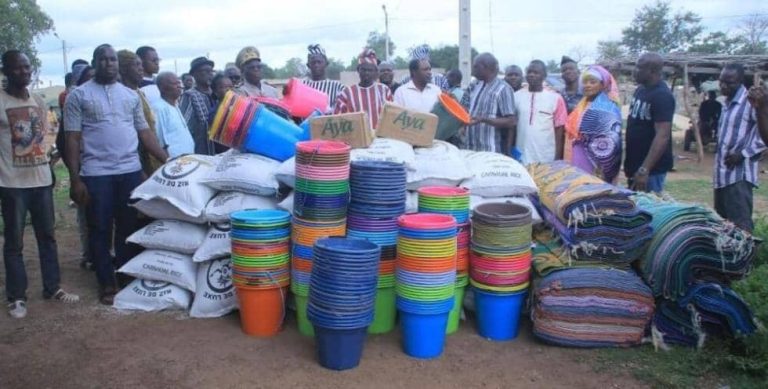
On August 31, 2025, Côte d’Ivoire’s Minister of Economy and Planning, Nialé Kaba, dispatched aid to the northeastern Bounkani region, where Ghanaian refugees have settled in towns such as Vonkoro and Massioutéon.
Relief supplies included three tons of rice, 100 mats, 260 buckets, and cartons of cooking oil to support both displaced families and host communities.
At a ceremony attended by local officials, Minister Kaba commended Ivorians for their generosity and described the assistance as a continuation of Côte d’Ivoire’s tradition of hospitality.
“This is not only an act of compassion but a reflection of our commitment to peace and regional stability,” she said.
Security and Mediation Efforts
Back in Ghana, the government has deployed over 700 military and police personnel to restore calm in the conflict zone.
The Interior Minister assured that the situation is “largely under control,” though security agencies remain on high alert.
A high-level delegation of Gonjaland traditional leaders is currently meeting with the Yagbonwura under the guidance of the National Peace Council, with plans to establish a committee to investigate the root causes of the clashes and recommend long-term solutions.
A Troubling Pattern
This is not the first time Ghana has witnessed mass displacement of its citizens due to conflict.
Between 2010 and 2014, during John Mahama’s earlier administration, ethnic violence and land disputes in the Northern Region forced thousands of Ghanaians into neighbouring Togo.
Observers note a worrying trend: under National Democratic Congress (NDC) governments, outbreaks of insecurity have repeatedly forced Ghanaians to seek safety abroad.
Critics argue that the state is losing control over internal security, pointing to the protracted Bawku conflict and a rise in armed robbery and communal clashes across the country.
Regional Implication
For Côte d’Ivoire—once ravaged by its own civil conflicts—the influx of Ghanaian refugees is a reminder of how fragile peace in West Africa can be.
Officials stress that supporting displaced Ghanaians is not only a humanitarian duty but also a measure to prevent instability from spilling across borders.

COMMENTS