
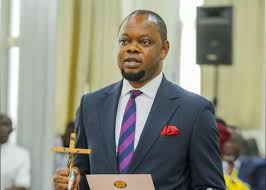
Deputy Attorney-General, Dr. Justice Srem Sai, has sought to calm growing public frustration over the perceived slow pace of prosecutions under the go
Deputy Attorney-General, Dr. Justice Srem Sai, has sought to calm growing public frustration over the perceived slow pace of prosecutions under the government’s flagship anti-corruption drive, Operation Recover All Loots (ORAL), stressing that due process cannot be compromised in the name of speed.
In an interview with TV3’s Joseph Ackah-Blay on Wednesday, September 3, Dr. Srem Sai explained that while many Ghanaians are anxious to see quick convictions, the law does not permit shortcuts.
“We just can’t bundle people based on complaints and throw them into jail. Someone said eight months down the line, and nobody is in jail, but there is no law that says if you are being prosecuted, you are guilty,” he stated.
Background Of ORAL
Operation Recover All Loots (ORAL) was launched in December 2024 by the Mahama administration as a bold anti-graft campaign to trace, retrieve, and prosecute corruption cases linked to the immediate past government.
The ORAL Committee was tasked with receiving and screening complaints before forwarding credible cases to the Attorney-General’s office for prosecution.
According to government data, 25,000 complaints were filed, of which 2,500 were formally processed, and only 280 cases were considered to have merit.
Since then, 65 individuals have been investigated, with some facing arrests, bail, or ongoing trials.
Progress In High-Profile Cases
Dr. Srem Sai disclosed that progress has been made in several cases, including that of Kwabena Adu Boahene, former Director General of the National Signals Bureau, and his wife, who are facing trial for alleged embezzlement.
He revealed that the trial had already covered “one-third” of the proceedings before the annual judicial vacation stalled hearings for two months.
“If not for the legal vacation, we would probably have concluded our case and the defense would have opened,” he noted, adding that hearings will resume in October.
Other notable prosecutions involve Professor Christopher Ameyaw-Akumfi, a former Minister of Ports, Harbours and Railways and Chairman of Ghana Infrastructure Investment Fund (GIIF) and Solomon Asamoah, ex-CEO of GIIF, who are facing charges related to the failed Accra Sky Train Project.
Voluntary Returns Of Loot
Interestingly, Dr. Srem Sai confirmed that some accused persons have voluntarily offered to return assets they unlawfully acquired.
Others, he said, have even expressed readiness to serve as state witnesses against fellow accused individuals.
“There’s no better way of recovering the money than voluntary recovery. So, if the people are willing to give us what they looted, we will take it,” he emphasized.
Balancing Expectations And Reality
Despite these developments, civil society groups and opposition parties have criticized the initiative for what they describe as “snail-paced prosecutions” and over-reliance on public complaints that were often not backed by solid evidence.
Dr. Srem Sai admitted that some of the early allegations investigated under ORAL were based on hearsay, but maintained that the Attorney-General’s office is committed to building strong, evidence-based cases that can stand in court.
“The public will say they don’t see anything, but the point I am trying to make is that the expectation is legitimate because of what we have witnessed. The work we are doing is very thorough and vibrant. I hardly sleep,” he remarked.
Looking Ahead
With hearings set to resume in October after the legal vacation, the government insists that ORAL is on track and already yielding results through both voluntary returns and court prosecutions.
However, the true test of the initiative will lie not just in the number of convictions secured but also in the assets recovered and the precedent it sets for future accountability in the governance.

COMMENTS