
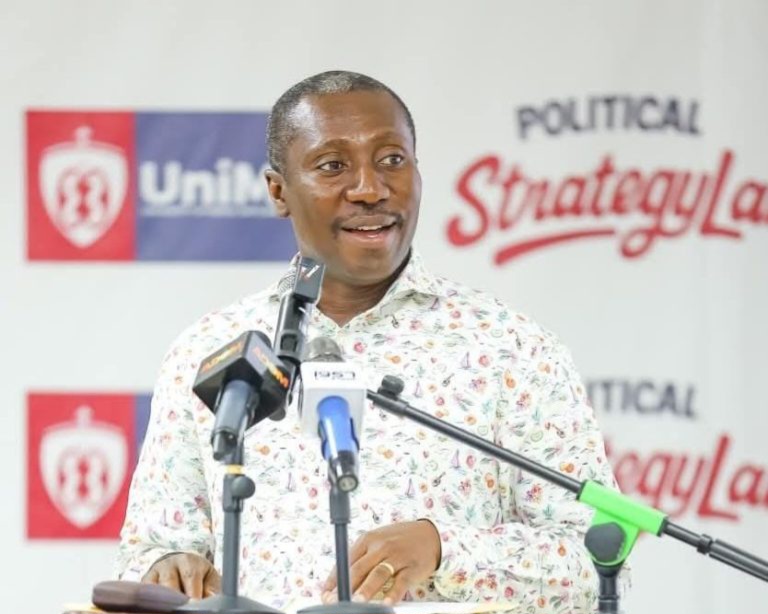
Minority Leader and Member of Parliament for Effutu, Alexander Afenyo-Markin, has described the decision to remand New Patriotic Party (NPP) Bono Regi
Minority Leader and Member of Parliament for Effutu, Alexander Afenyo-Markin, has described the decision to remand New Patriotic Party (NPP) Bono Regional Chairman, Kwame Baffoe, alias Abronye DC, as a “dangerous precedent” that threatens the foundations of Ghana’s democracy.
Speaking as lead counsel for Abronye during a forum at the University of Media, Arts and Communication (UniMAC) in Dzorwulu, Afenyo-Markin openly criticized the court’s ruling and the reasoning behind it.
“In court, I brought the ruling of the judge. I was the lead counsel for Abronye. And because we are in an academic environment, though you are not lawyers, I want you to just Google after here, the case of Tagor v. Republic. It’s a Court of Appeal decision,” he told the gathering.
According to him, “It was Dr. Ayeni who did a case on appeal, where the Court of Appeal said that the fact that a case gains notoriety in public space, it doesn’t whittle down the requirement to meet all the ingredients to be proven to find the person guilty. And that the prosecution must lead evidence.”
He stressed that mere discussions on social media cannot substitute for proof. “So you hear of a matter, it’s been discussed on social media, and we think it’s sufficient that the person is guilty. Tagor was freed by the Court of Appeal on those cocaine-related charges because the court felt that the prosecution could not do a good job.”
Afenyo-Markin argued that due process is paramount in every case. “So if somebody is alleged to have committed an offence, what the police are supposed to do is to have all the patience to investigate and follow due process.”
“Ladies and gentlemen, sometimes we get impatient. But the best way to sustain democracy is to ensure that institutions work. And they work for the good of all.”
He went further to detail how the judge handled the matter. “Yesterday, a judge received a warning. Earlier in the week, the police went to him. The prosecutor said to the judge, ‘I want you to remand him till Friday,’ and he granted it. Yesterday we were in court. This is what the judge said. Listen to him.”
Quoting directly from the ruling, Afenyo-Markin explained: “The judge said, ‘Accused person before the court is facing two charges of misdemeanour. A misdemeanour is a lesser offence. An offense that means nothing, really. If you are convicted, it’s a fine, then you go home.’”
He continued: “He said, however, in this instant case, the court will not look at only the charges being misdemeanour, but will extend it to the position of the IGP, to the country.”
“That is the head of the police service. The words which came from the accused person are likely to put the security of the nation into disrepute.”
According to the Minority Leader, the judge went even further. “He says, it is always said that all persons are equal. But in practice, it is not so. He quotes George Orwell’s Animal Farm.”
“One of the commandments is that all men are equal, but some are more equal than others. Translated into this case, all men are equal, but some are more equal than others.”
On this basis, Afenyo-Markin concluded that the ruling was deeply flawed. “If you are a judge and you are remanding somebody into custody, what you are basically saying is that if the person is granted bail, he may not come to court for trial, or he would interfere in the investigation.”
“The judge did not say this in his ruling. He says that the matter involves the IGP. And all men are not equal. They are all the same. So, if you are involved in a matter with somebody who is considered a big person in society, you go to jail. Such a dangerous precedent. If we don’t talk about it, where would our democracy be?”
Beyond the court matter, the Minority Leader reflected on Ghana’s democratic standing in the sub-region.
“Ladies and gentlemen, I am privileged to have been part of the ECOWAS Parliament. I have roamed through the sub-region. Ghana stands tall, but we can make it better. So, I would want to encourage our friends in government today: let’s not create too much space for excesses of governance. Let us push away the extremists, out of the fray. Let’s take them away and allow the moderates to take charge.”
He reminded both political parties of the need for dialogue. “Both sides, NPP, NDC. I recall, for the eight years of our administration, some of us took it upon ourselves to create that bridge—behind-the-scenes engagement to ensure that the temperature was brought down, especially when it comes to dealing with opponents.”
“Colleagues in Parliament would attest to this. I wouldn’t go into details. I am saddened by some of the things that I see.”
Turning to President Mahama’s administration, Afenyo-Markin advised restraint. “And if our friends really want to give a certain lasting image to Mr. President, especially so when this is his last term, and they want a legacy for him, they would advise the hardliners to get off the stage.
“Maybe now they are not feeling it. Though it would be to their political disadvantage, it affects the image of the country and all of us.”
He concluded with an appeal to the government: “So, I would plead with governments—be measured, be humane, let’s focus on the deliverables that will transform our people.”
“Of course, that is not to say that there should be no accountability. After all, when you get into public office, you should have at the back of your mind that someday you would have to account.”

COMMENTS