
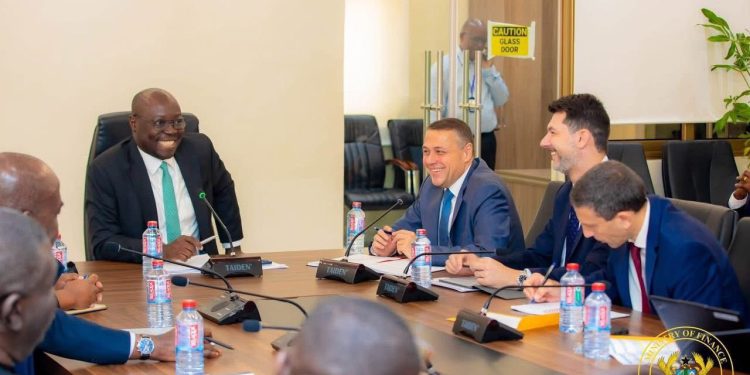
The crucial economic reform programme under the International Monetary Fund (IMF) has entered another decisive phase, as the Fund’s mission team arriv
The crucial economic reform programme under the International Monetary Fund (IMF) has entered another decisive phase, as the Fund’s mission team arrived in Accra on Monday to begin the fifth review of the $3 billion Extended Credit Facility (ECF) programme.
The mission, led by Dr. Ruben Atoyan, will over the next two weeks assess Ghana’s performance against agreed targets covering fiscal management, inflation, debt sustainability, and financial sector stability.
The Finance Minister Dr. Cassiel Ato Forson, welcoming the team, described the review as “a critical checkpoint in Ghana’s economic recovery journey.”
The IMF Deal
Ghana signed onto the IMF’s $3 billion bailout package in December 2022 after years of fiscal slippages, ballooning debt, and a sharp depreciation of the cedi pushed the economy into its worst crisis in two decades.
The programme, scheduled to conclude in May 2026, was designed to restore macroeconomic stability through expenditure controls, domestic revenue mobilisation, debt restructuring, and structural reforms.
So far, Ghana has successfully completed four programme reviews, unlocking over $1.5 billion in disbursements.
Each review has been tied to meeting strict performance benchmarks. The fifth review, now underway, is particularly important as it will determine the release of about $360 million in October—funds the government says are critical for maintaining stability in the face of external shocks.
Government’s Position
At the opening session, Ato Forson stressed that despite starting 2025 with “significant fiscal and structural challenges,” the government’s policy interventions had helped to stabilise the economy.
Inflation, which hit 54.1 percent in December 2022, has since been halved, while the cedi has recorded relative stability in recent months.
“The review is not just a formality—it is about refining our policy direction and ensuring that we align with the IMF’s recommendations to sustain growth and protect livelihoods,” the minister told participants.
IMF’s Expectations
Dr. Atoyan, speaking on behalf of the Fund, noted that his team would engage in “constructive discussions” with Ghanaian authorities, focusing on fiscal discipline, effective revenue mobilisation, and safeguarding the financial sector.
He added that the IMF is keen to ensure reforms deliver long-term benefits rather than short-term fixes.
Key Stakeholders Present
The meeting was attended by top government and central bank officials, including Bank of Ghana Governor Dr. Johnson Asiama, First Deputy Governor Dr. Zakari Mumuni, Deputy Finance Minister Thomas Nyarko Ampem, and Chief Director of the Finance Ministry Patrick Nomo.
Their presence underscored the joint role of fiscal and monetary authorities in steering Ghana’s economic reforms.
Looking Ahead
If Ghana successfully passes the review, the country will secure its next tranche of funding in October.

COMMENTS