
The Minority in Parliament has launched a scathing attack on President John Mahama’s administration over what it describes as the unconstitutional and
The Minority in Parliament has launched a scathing attack on President John Mahama’s administration over what it describes as the unconstitutional and politically motivated removal of Chief Justice Gertrude Araba Esaaba Sackey Torkornoo.
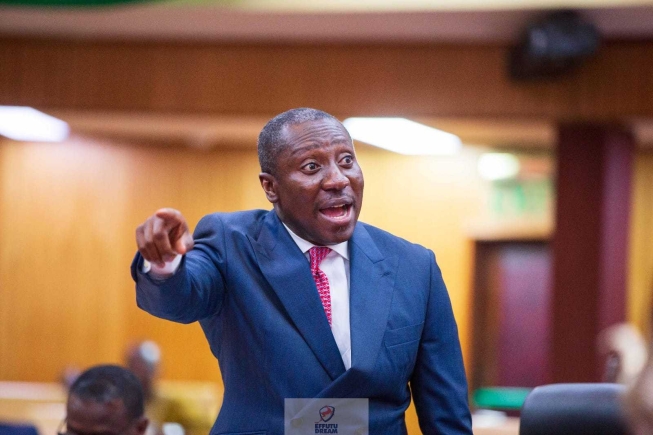
Addressing Parliament at the opening of the Third Meeting of the First Session of the Ninth Parliament, Minority Leader Alexander Afenyo-Markin accused the government of undermining judicial independence and setting a dangerous precedent that could destabilize Ghana’s democratic framework.
In his opening remarks, Afenyo-Markin extended condolences to the families of late public officials, including the late Tamale Central MP and Environment Minister, Dr. Ibrahim Murtala Mohammed, and former Defence Minister, Dr. Edward Omane Boamah.
He also welcomed two new MPs to the House but quickly turned attention to what he called “the troubling state of governance under the Mahama administration.”
Judiciary Under Attack
Central to the Minority Leader’s address was the dismissal of Chief Justice Torkornoo, which he claimed was carried out in clear violation of constitutional provisions. Afenyo-Markin revealed that three petitions were initially sent to the Pwamang Committee, but only one was heard before the Committee abruptly submitted a report on September 1 — two weeks ahead of its announced adjournment date.
“Without notice to any party, the Committee suddenly submitted its report, and within two hours, the Chief Justice’s removal was announced,” Afenyo-Markin disclosed.
He questioned the credibility of the process, describing it as a “deception and a violation of due process.”
He further accused the government of concealing the so-called Pwamang Report, which supposedly served as the basis for the Chief Justice’s dismissal.
“The warrant of suspension claimed to have made a prima facie determination, but to date, no one has seen any such document,” he stated, demanding transparency and immediate publication of the report.
The Minority warned that the move could open the floodgates for similar politically driven purges in other independent state institutions.
“If this false and irregular process succeeds, it endangers every independent constitutional body,” Afenyo-Markin said, citing the Auditor-General, Electoral Commission, and Public Services Commission as potential next targets.
Governance, Freedom, And the Rule of Law
Beyond the judiciary, the Minority Leader accused the Mahama government of presiding over a climate of fear, intolerance, and selective justice.
He condemned what he called “politically motivated arrests” of journalists, opposition members, and ordinary citizens critical of government policy.
He cited the case of social media commentator David Afful Kwodwo Prah, also known as Kwame Nkrumah II, who was sentenced to seven months in prison for a livestream, while ruling party affiliates who made inflammatory statements remained untouched. “Justice cannot be harsh on critics and lenient on those close to power,” he remarked.
Afenyo-Markin also raised concerns over the recent judgment delivered in the case involving Bono Regional NPP Chairman Kwame Baffoe (Abronye DC), where the presiding judge referenced George Orwell’s Animal Farm and Robert Mugabe’s infamous line about freedom of speech.
“Such judicial rhetoric signals a troubling erosion of constitutional guarantees,” he warned, urging a return to fairness and true judicial independence.
Economic and Labour Frustrations
The Minority Leader painted a bleak picture of the economy under Mahama’s early months in office, lamenting that recent economic stabilization figures have not translated into relief for ordinary Ghanaians.
“Stabilization means little if the youth remain unemployed and families still struggle with the cost of living,” he stressed.
He condemned what he called “mass dismissals” across key public institutions, describing them as politically motivated and unconstitutional.
According to him, these actions have “undermined professionalism and weakened public confidence in governance.”
Labour unrest, Afenyo-Markin said, has reached alarming levels, with over 200 junior doctors working for ten months without pay and more than 800 yet to be posted. Newly trained teachers and nurses have also gone months without salaries.
“A government that fails to pay its frontline workers cannot claim to care for its people,” he asserted.
The Galamsey Crisis Deepens
Touching on the worsening menace of illegal mining (galamsey), Afenyo-Markin reminded the House of past warnings, including investigative journalist Anas Aremeyaw Anas’s 2010 exposé and subsequent reports linking galamsey to declining cocoa yields.
He said the current administration’s failure to act decisively has led to severe environmental degradation.
Citing a recent study by Pure Earth and the Environmental Protection Agency (EPA), he revealed that mercury levels in some mining communities were 134 times above safe limits, while arsenic levels were 4,000% higher than the WHO’s safety standards.
“Children are now developing kidney problems and even undergoing dialysis due to mercury poisoning,” he lamented.
He called for an immediate national consensus to combat galamsey, warning that “if we fail to protect our rivers and lands, we risk failing an entire generation.
Foreign Policy And Sovereignty Concerns
The Minority Leader also touched on a recent bilateral agreement between Ghana and the United States involving the acceptance of deportees.
He insisted that such an agreement required parliamentary scrutiny under Article 75 of the Constitution and must not be implemented in secrecy.
“Ghana’s foreign policy must never compromise our sovereignty for expediency,” he warned.
A Call for Accountability and Hope
In his concluding remarks, Afenyo-Markin contrasted what he called the “visionary achievements” of the previous NPP administration — including Free SHS, One District One Factory, STEM and TVET investments, and major infrastructure projects — with what he described as the current government’s “lack of transparency and direction.”
He reaffirmed the Minority’s commitment to holding the Mahama administration accountable: “We will continue to be the voice and shield of the people in this House. We will speak truth to power and defend the principles of democracy.”
Echoing former President Akufo-Addo’s famous words, he urged all Ghanaians to be “citizens, not spectators,” saying, “Our nation has weathered many storms, and we will emerge stronger — but only if we protect our institutions and the rule of law.”

COMMENTS