
The European Union (EU) has issued a stern warning to Ghana over the continued environmental destruction caused by illegal mining, popularly known as
The European Union (EU) has issued a stern warning to Ghana over the continued environmental destruction caused by illegal mining, popularly known as galamsey, cautioning that the country’s agricultural exports could soon face restrictions if mercury contamination persists.
Speaking on the Joy Super Morning Show on Tuesday, October 21, 2025, the EU Ambassador to Ghana, Rune Skinnebach, expressed deep concern about the potential impact of illegal mining on the export credibility and consumer safety.
He warned that food products tainted with toxic chemicals like mercury could be rejected in European markets — a development that would severely hurt Ghana’s economy and international reputation.
“I wouldn’t want any consumer to have polluted goods or farm products. I wouldn’t get Ghanaian or European consumers to eat sweet potatoes with mercury residues in them,” Ambassador Skinnebach said. “So yes, it will impact your exports.”
According to him, while the EU is ready to assist Ghana with technology, policy support, and environmental protection frameworks, the crisis cannot be solved without strong political will and a coordinated national strategy. “We’re willing to help, but first and foremost, a political solution is required. Once we have that solution, we are ready to assist — be it with technology, regulatory frameworks, or other support,” he stressed.
A Mounting Environmental Crisis
The warning from the EU comes at a time when the illegal mining crisis has reached alarming proportions.
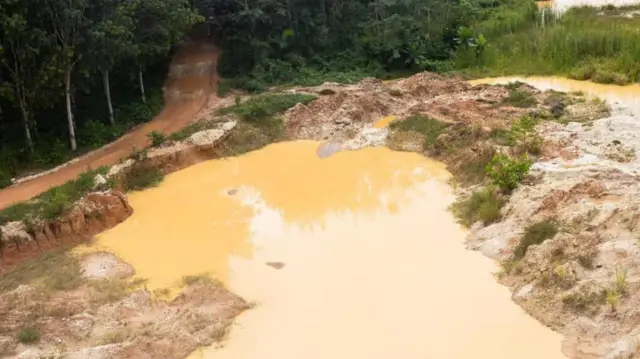
Rivers such as the Pra, Ankobra, and Offin have turned brown from heavy sedimentation, and vast stretches of farmlands have been rendered infertile due to the widespread use of mercury and cyanide in gold extraction.
The issue has become both an environmental and a public health emergency. Experts warn that mercury — a neurotoxic chemical — is entering the food chain through contaminated water used for irrigation, threatening not only Ghana’s agricultural exports but also domestic food safety.
Government Under Fire
President John Dramani Mahama’s administration has come under increasing criticism for what many describe as a “soft-handed” approach to tackling the galamsey menace.
Speaking at the Jubilee House last month, the President admitted that the illegal mining situation has deteriorated over the years but argued that drastic crackdowns could worsen unemployment and social instability.
“I’ve never deluded myself that the fight against illegal gold mining would be a one-off event,” Mahama said. “The decay has eaten so much over the last eight years, and it’s going to take a lot of work.”
Despite acknowledging the environmental toll, the President signaled that his administration is prioritizing livelihoods over enforcement, citing the estimated four million Ghanaians who depend directly or indirectly on small-scale mining for survival.
His stance, however, has drawn backlash from environmentalists and opposition figures who believe the government’s leniency has emboldened illegal miners.
Controversial Policy on Gold Trading
Further controversy has emerged around the government’s proposal to allow the newly reformed Ghana Gold Board (GoldBod) to purchase gold from all miners — including those operating illegally — to boost the nation’s reserves.
Critics argue that this policy risks legitimizing galamsey operations.
Former Tourism Minister Andrew Egyapa Mercer lambasted the proposal, stating, “If the President himself says government should buy gold from illegal miners, what signal are we sending? That it’s acceptable to destroy our water bodies and farmlands so long as the state can buy the gold? This undermines everything we have done to fight galamsey.”
Mounting Pressure from Civil Society and the Church
Civil society groups, the Ghana Catholic Bishops’ Conference (GCBC), and the University Teachers Association of Ghana (UTAG) have joined calls for decisive action. In a joint statement on September 15, the Bishops described galamsey as “one of the gravest afflictions of our time,” warning that Ghana stands “at the brink of destruction.”
UTAG’s General Secretary, Dr. Jerry Joe Harrison, painted a grim picture of the health implications during a Channel One interview, saying, “If we don’t do what we are supposed to do now, we will all die.”
He linked galamsey pollution to rising cases of cancers and neurological diseases caused by mercury-laced water.
EU’s Strategic Interests and the Bigger Picture
For the European Union, Ghana’s illegal mining crisis is not only a domestic concern but also a trade and food security issue.
The EU remains one of the Country’s largest export destinations for products like cocoa, pineapples, mangoes, and sweet potatoes.
However, continued contamination could prompt stringent border checks or outright bans on Ghanaian agricultural goods.
The EU’s caution also aligns with its Green Deal policy, which prioritizes sustainability and environmental compliance in international trade.
Ambassador Skinnebach reaffirmed the EU’s commitment to Ghana’s development but emphasized that partnership must go hand in hand with environmental responsibility.
“We acknowledge the seriousness of the issue for Ghana and, as a long-standing partner, we are eager to help,” he reiterated.

COMMENTS