
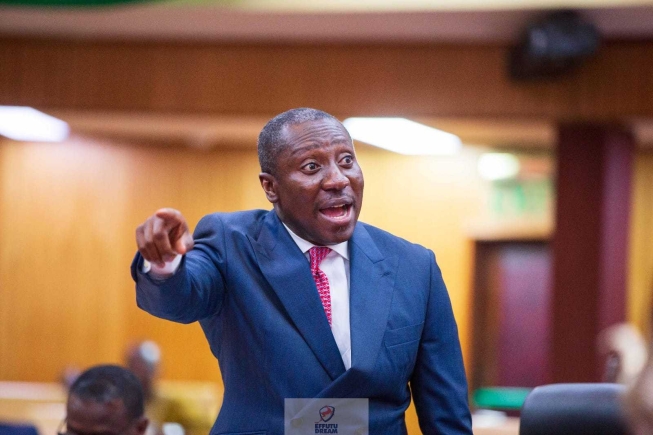
Minority Leader in Parliament, Alexander Afenyo-Markin, has raised serious concerns over what he describes as the Mahama administration’s persistent f
Minority Leader in Parliament, Alexander Afenyo-Markin, has raised serious concerns over what he describes as the Mahama administration’s persistent failure to provide Parliament with the necessary documentation on its flagship policy initiatives, months after their public launch.
Speaking at a press conference in Parliament on Wednesday, October 22, Afenyo-Markin revealed that despite multiple announcements and significant budgetary allocations for programmes such as the 24-Hour Economy, Big Push, Feed Ghana, National Apprenticeship Programme, One Million Coders, and Youth Export Committee, Parliament has yet to receive official documents outlining the implementation plans, cost breakdowns, and measurable targets of these initiatives.
According to him, the absence of such critical documentation undermines the very essence of parliamentary oversight and transparency.
“Since the swearing-in of the Mahama administration, Parliament has approved billions of cedis for various ministries to implement these flagship programmes. However, not a single comprehensive policy document has been laid before the House for review,” the Minority Leader lamented.
He noted that the 24-Hour Economy, a cornerstone of President Mahama’s 2024 campaign and one of the administration’s most publicized initiatives, continues to operate without clear guidelines being made available to lawmakers.
The programme, which seeks to boost employment and productivity by ensuring continuous economic activity round the clock, has faced repeated calls for clarity on its cost structure and implementation strategy.
Afenyo-Markin stressed that while the policy ideas themselves were promising, the government’s unwillingness to subject them to legislative scrutiny raised red flags about transparency and accountability.
“Oversight cannot take place when basic programme documents are unavailable. Parliament’s responsibility is to ensure that public funds are spent efficiently, but we cannot perform this duty if the executive withholds vital information,” he said.
He further pointed out that the situation extended beyond the 24-Hour Economy initiative.
Other major programmes, including the Agri-for-Economic Transformation and the Labour Export Programme, which also received substantial public funding, have not been formally documented before Parliament.
“This deliberate delay or neglect by the executive to submit relevant policy papers for parliamentary review is troubling,” Afenyo-Markin added.
“We are talking about projects financed by taxpayers’ money—money approved by Parliament. The least the government can do is show transparency in how these funds are being used.”
The Minority Leader cautioned that the legislature would not relent in demanding accountability from the Mahama-led government, insisting that Parliament would continue to push for the submission of all policy documents related to these flagship programmes.
He concluded by calling on civil society organizations and the media to join the demand for transparency and ensure that the government’s ambitious policy promises are matched with concrete, verifiable action.
The 24-Hour Economy policy, first announced by President John Dramani Mahama in his 2024 election campaign, aims to reposition the economy through round-the-clock business operations, job creation, and infrastructure development.
However, nearly a year after the government’s assumption of office, critics argue that the absence of clear documentation and measurable indicators has cast doubt on the programme’s practical viability.
Meanwhile, sources within the Majority Caucus have hinted that internal consultations are ongoing to expedite the submission of the required documents to Parliament, though no official timeline has been provided.

COMMENTS