
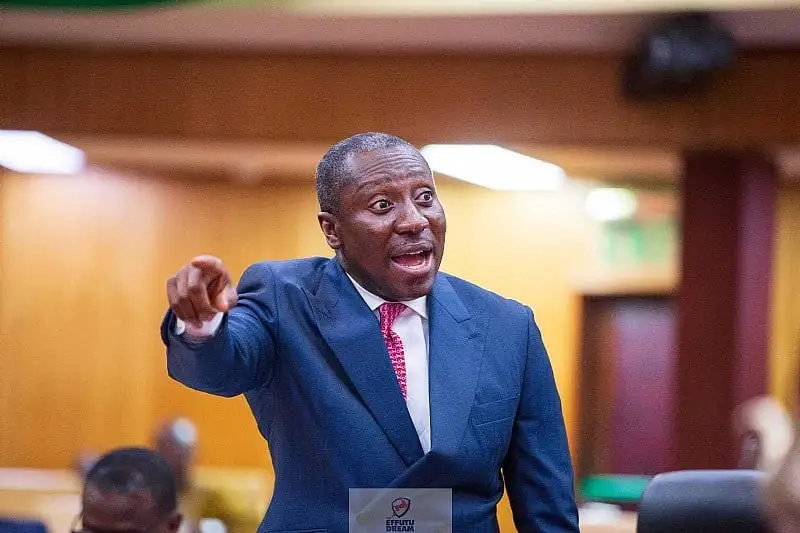
Minority Leader and Member of Parliament for Effutu, Alexander Afenyo-Markin, has disclosed that although he has a “horse in the race” in the New Patr
Minority Leader and Member of Parliament for Effutu, Alexander Afenyo-Markin, has disclosed that although he has a “horse in the race” in the New Patriotic Party’s (NPP) upcoming flagbearer contest, his leadership role in Parliament prevents him from publicly declaring support for any candidate.
He made the admission on JoyNews’ PM Express programme on Monday, October 27, where he also reflected on the economic challenges and drew lessons from the National Democratic Congress (NDC)’s recovery after losing power in 2000.
Afenyo-Markin acknowledged that as a senior figure in Parliament, maintaining neutrality is key to preserving credibility and party unity after the primaries.
“I cannot publicly say I am going to campaign for this person,” he said. “Because of where I sit, I have to remain neutral. I have a role to play in reconciling the factions after the flagbearer is chosen.”
The Effutu MP explained that any public declaration of support could make it difficult for him to serve as a trusted mediator in the aftermath of the contest.
He praised all five aspirants for their courage and commitment to lead the party into the 2028 general election, insisting that the race demonstrates the NPP’s internal strength and democratic maturity.
Afenyo-Markin, who became Minority Leader following the NPP’s loss of parliamentary majority in the 2024 elections, has been consistent in calling for restraint and decency among MPs who support different flagbearer hopefuls.
“Those who have declared have done so decently, without creating disunity. That is commendable,” he noted.
Addressing fears that divisions within the NPP could deepen as the primaries draw closer, Afenyo-Markin urged parliamentary leaders to “be very neutral” so that they could act as credible referees once the contest concludes.
“A party that has no future will not have people contesting to use its brand. The fact that our members are eager to lead is a sign of hope,” he said.
He also reflected on the NPP’s performance in government, acknowledging that while major policy interventions such as Free Senior High School (Free SHS) and One District, One Factory (1D1F) have been transformative, the party paid a steep political price for the tough economic measures implemented during the crisis years.
“We lost the middle class, our own base—the businessmen, pensioners, and educated people—because of the financial sector haircut and austerity measures,” Afenyo-Markin admitted.
“To the extent that a former Chief Justice, appointed by our own administration, was on the streets fighting for her pension—it’s understandable.”
He noted that the government’s difficult choices were made amid global financial turmoil following the COVID-19 pandemic.
“We were faced with huge challenges. We tried, but we were not too successful. In stabilising the economy, hard decisions had to be taken,” he said.
Despite these challenges, Afenyo-Markin defended the NPP’s record on social interventions, arguing that its legacy of pro-poor and educational reforms remains unmatched.
“Recently in Parliament, I challenged the Majority Leader to name one social intervention the NDC has initiated and implemented successfully since 1992. They have zero,” he said confidently.
He cited his own experience as a beneficiary of educational support to highlight the life-changing impact of such policies.
“I nearly dropped out of St. Augustine’s College until I won a bursary introduced by Dr Paa Kwesi Nduom. But for that, I would have dropped out. That’s why I value Free SHS—it gives many others a chance to succeed,” he added.
Drawing from political history, Afenyo-Markin referenced how Speaker Alban Bagbin led the NDC Minority after its loss in 2000, gradually rebuilding the party’s image and confidence.
“Kufuor enjoyed huge goodwill. In 2001, nobody wanted to hear the NDC. But they regrouped. By 2004, they had momentum. By 2008, they surprised the nation,” he said, noting that the NPP must now follow a similar path of renewal and introspection.
While admitting the party made mistakes—particularly in managing galamsey, stabilising the cedi, and protecting livelihoods—he believes those experiences have strengthened his political resolve.
“As a politician, you shouldn’t be shy of your weaknesses. You learn from both success and failure,” he observed.
Afenyo-Markin concluded that the NPP’s post-election rebuilding process will begin in earnest once the flagbearer is chosen early next year.
“By January 31, 2026, we’ll have a new leader. Then the proper rebranding starts,” he said with optimism.

COMMENTS