
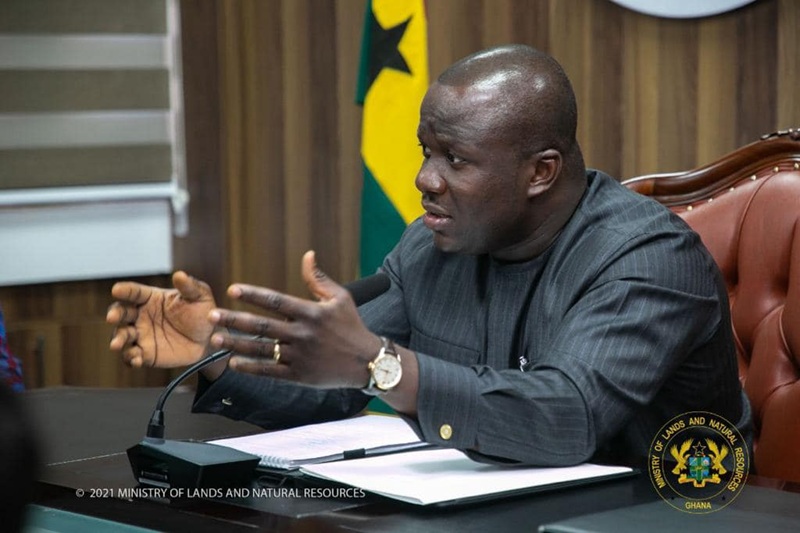
Former Minister for Lands and Natural Resources and Member of Parliament for Damongo, Samuel Abu Jinapor, has raised concerns over what he describes a
Former Minister for Lands and Natural Resources and Member of Parliament for Damongo, Samuel Abu Jinapor, has raised concerns over what he describes as the “ballooning” compensation of staff at Jubilee House under the administration of President John Mahama.
Speaking on Good Evening Ghana during a discussion on the 2026 budget, Abu Jinapor highlighted the sharp increase in salaries and emoluments for presidential staffers and ministers compared to previous administrations.
According to Abu Jinapor, in 2024, the government spent GHS 326 million on compensation for the Office of Government Machinery—the office that oversees the presidency and executive staff and other agencies. By 2025, this figure had risen sharply to GHS 540 million, representing a roughly 50 percent increase on the 2024 compensation.
In the 2026 budget Government Machinery has been allocated with over GHS1.36billion, more than double of the 2025 allocation.
He attributed this surge to the large number of appointments made by the Mahama administration, despite promises to maintain a leaner government.
“The increase in compensation does not reflect more personnel in the traditional sense, but rather the proliferation of high-ranking presidential aides, envoys, and staffers,” Abu Jinapor said.
Abu Jinapor, a former Deputy Chief of Staff, emphasized that many of these appointees are equivalent in rank and emoluments to ministers or even cabinet ministers, despite not holding ministerial portfolios.
Jinapor cited examples such as the appointment of 16 presidential staffers in charge of the country’s 16 regions, arguing that their remuneration exceeds what would be required if they were deputy regional ministers. The 16 presidential staffers are all NDC regional organisers.
He stressed that these appointments, while labeled as “staffers” or “advisors,” come with full ministerial perks, including salaries, benefits, and allowances.
Reflecting on the broader implications for the national economy, Abu Jinapor warned that the steep rise in compensation amid revenue shortfalls could hinder the government’s ability to meet program expenditures.
He noted that while the 2025 budget projected GHS 207 billion in program expenditure for the first three quarters, actual spending reached only GHS 175 billion, indicating a 15 percent shortfall.
According to him, this mismatch directly affects the private sector, the real economy, and employment creation.
The former minister also referenced his prior criticisms of President Mahama’s ministerial appointments. In March 2025, he publicly expressed concern that the President had appointed 100 ministers and deputy ministers—well above the promised 60—arguing that the decision was costly, inefficient, and potentially unsustainable.
He warned that the duplication of roles among ministers, senior advisors, and presidential envoys exacerbates government expenditure without necessarily improving service delivery.
Abu Jinapor concluded by questioning the administration’s priorities, suggesting that the government’s focus on expanding its payroll has overshadowed more pressing national issues, including unemployment and efficient public service delivery.
“These are not partisan observations; these are facts grounded in budget analysis and firsthand experience from my time as Deputy Chief of Staff,” he stated.

COMMENTS