
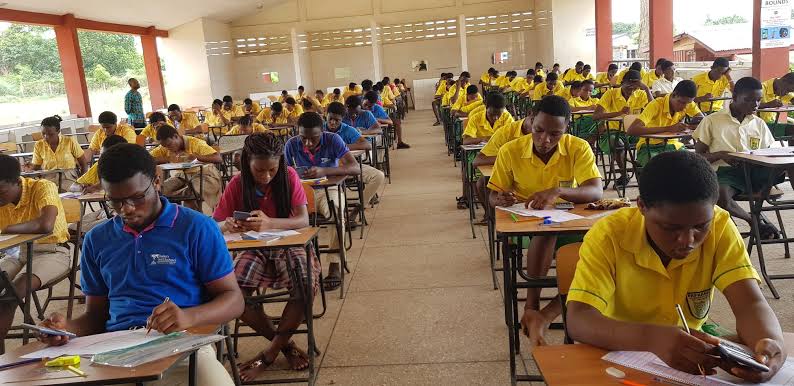
The education sector is once again under the spotlight following the release of the 2025 West African Senior School Certificate Examination (WASSCE) r
The education sector is once again under the spotlight following the release of the 2025 West African Senior School Certificate Examination (WASSCE) results, which show a sharp decline in performance across nearly all core subjects.
The statistics, released by the West African Examinations Council (WAEC), paint a troubling picture of an education system struggling to deliver foundational learning outcomes — a crisis that many education analysts say has been worsening for nearly a decade.
For years, concerns about the quality of teaching and learning at the pre-tertiary level have dominated public debate, but the 2025 results appear to confirm fears that the system is no longer merely weakening but is now edging toward collapse.
The introduction of the Free Senior High School (Free SHS) policy in 2017 expanded enrolment dramatically, but persistent issues such as overcrowded classrooms, inadequate learning resources, and uneven academic preparedness continue to undermine its long-term impact.
This year’s performance decline is particularly alarming given that the 2025 cohort represents students who entered SHS under the expanded admission bracket in 2022 and 2023 — groups admitted with wider grade margins under the computer placement system.
Education experts have long warned that unless quality improves at both JHS and SHS levels, mass enrolment alone cannot guarantee equitable learning outcomes.
Mathematics Records a Historic Drop
Core Mathematics — traditionally one of the most challenging subjects — suffered the steepest decline. After showing improvement in 2024 when 66.86% of candidates earned credit passes (A1–C6), the 2025 results show only 48.73% passed. This represents over 50-percentage-point decline within a single year, the sharpest in recent WASSCE history.
WAEC reports that 114,872 candidates (26.77%) failed outright with F9, while thousands more performed poorly, raising urgent questions about the quality of instruction in mathematics and the availability of remedial support in schools.
Integrated Science Continues Its Downward Slide
Integrated Science — foundational for STEM pathways — continued its multi-year decline.
66.82% passed in 2023
58.77% passed in 2024
Only 57.74% secured credit passes in 2025
A total of 161,606 candidates (39.87%) failed the subject this year. Without strong science performance at SHS level, the ambitions for STEM-focused national development face a significant setback.
Social Studies Sees the Most Dramatic Two-Year Decline
Social Studies, which teaches civic responsibility and societal awareness, recorded one of the most dramatic drops.
From 76.76% pass in 2023 to 71.53% in 2024, the figure has now plummeted to 55.82% in 2025.
This means 122,449 candidates (27.50%) failed the subject in 2025 alone, a worrying pattern that suggests deep learning gaps in reading comprehension, critical thinking, and applied knowledge.
English Language Remains Stable but Not Improving
English Language was the only core subject that did not decline significantly, maintaining a credit pass rate of 69.00%, similar to last year’s 69.52%. Still, 131,097 candidates (30.27%) failed the subject — a critical barrier for tertiary education entry.
Half of Candidates Cannot Progress to Tertiary Education
Overall, more than 50% of candidates who sat for the 2025 WASSCE failed at least one core subject required for tertiary admission. This means tens of thousands of students will either need to re-sit their exams or abandon their academic aspirations entirely.
These outcomes raise broader questions about equity under the Free SHS policy. While the policy has increased access, the rising failure rates imply that access has not translated into learning for a significant portion of students.
Examination Malpractice Still a Persistent Challenge
The 2025 examination cycle also saw widespread irregularities. WAEC’s Examinations Committee approved the following sanctions:
6,295 candidates had their subject results cancelled for bringing unauthorized materials into exam halls.
653 candidates had their entire results cancelled for possessing mobile phones.
908 subject results and 158 entire results were withheld pending investigations.
Results of candidates from 185 schools were withheld over alleged collusion.
35 individuals, including 19 teachers, were implicated in examination malpractices; several have already been convicted in court.
These persistent issues not only undermine public confidence but also raise doubts about the authenticity of the results of many candidates who pass.
A Systemic Crisis, Not A Student Problem
Education analysts warn that the trends reveal systemic weaknesses rather than student failure. Declining performances across four consecutive years suggest underlying issues involving: quality of teaching, insufficient instructional materials, weak supervision, overcrowded classrooms, inadequate practical learning environments, and repeated disruptions to academic calendars.
Many argue that unless the roots of the problem are addressed, annual public debates over discipline, school uniforms, and moral training will do little to reverse the downward trajectory.
Experts Recommend A National Rescue Plan
Policy experts and education think tanks are calling for a nationwide “Learning Recovery Programme” to address the crisis. Key recommendations include:
1. Urgent retraining of teachers, especially in mathematics, science, and literacy pedagogy.
2. Early assessments to identify learning gaps before students reach SHS3.
3. Reducing class sizes to make teaching more effective.
4. Restoring lost instructional hours by tightening school management systems.
5. Investing in laboratories, textbooks, and digital tools that support practical learning.
6. Improving accountability from school level to national oversight bodies.
7. Expanding remedial support and after-school tutoring nationwide.
8. Training teachers to integrate technology meaningfully in the classroom
9. Reforming the curriculum to prioritise mastery of core concepts over memorization.
10. Engaging parents and communities as active partners in learning.
The 2025 WASSCE results are a wake-up call for Ghana’s education system. With every core subject except English showing significant declines — including a historic crash in mathematics — the numbers point unmistakably to a system in distress. Until teaching quality, supervision, learning resources, and curriculum delivery are strengthened, Ghana risks graduating students who are unprepared for tertiary education, the workforce, and national development.

COMMENTS