
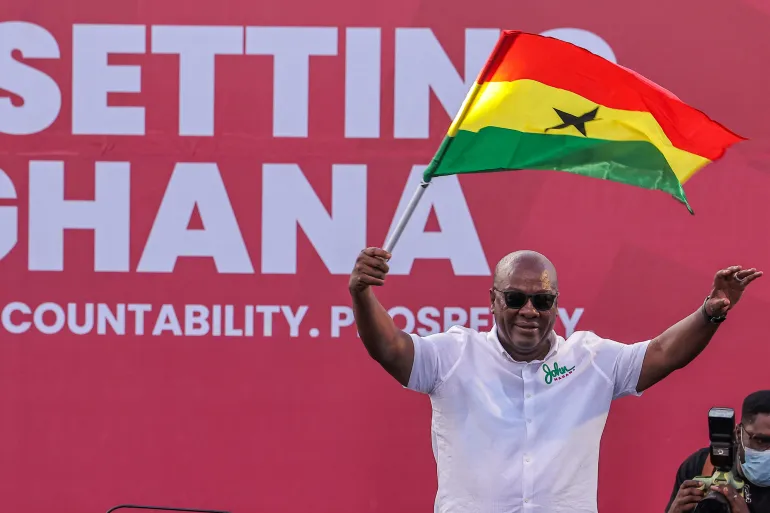
The debate over whether President John Dramani Mahama could or should pursue a historic third presidential term is escalating into one of the most con
The debate over whether President John Dramani Mahama could or should pursue a historic third presidential term is escalating into one of the most contentious political flashpoints of 2025.
What began as scattered speculation among party supporters has grown into a divisive national conversation involving NDC insiders, religious leaders, civil society groups, constitutional scholars, and even Parliament itself.
Despite John Dramani Mahama’s own repeated public assurances that he will retire in January 2029, a powerful current within the National Democratic Congress (NDC) continues to push the idea of extending his stay in office—either through constitutional amendment or re-interpretation of the two-term limit.
A Constitution Designed To Prevent Entrenched Leadership
The 1992 Constitution is explicit: “A person shall not hold office as President of Ghana for more than two terms.”
The clause was deliberately written in simple, unambiguous language after years of military rule and fears of executive overstay. Constitutional experts, including Prof. H. Kwasi Prempeh, insist that the phrase “more than two terms” applies regardless of whether those terms are consecutive.
John Dramani Mahama, who governed from 2012 to 2016 and returned in 2025 after winning the 2024 election, would have served eight years by the end of his current tenure, excluding the unexpired period of President John Evans Atta Mills he spent.
Religious Leaders Enter the Arena
Adding fuel to the simmering debate is the open endorsement from certain pastors and religious figures, who claim Mahama holds a “divine mandate” to continue leading Ghana beyond 2029.
Some clergy have publicly declared that God is “not finished with Mahama,” statements that have gone viral across churches and social media.
Their pronouncements have emboldened grassroots supporters of NDC who insist Ghana must not “interrupt God’s work” by restricting Mahama to only two terms.
Adu Asare Sparks New Controversy
The most direct political endorsement of a third term came from Kojo Adu Asare, a former Adentan NDC MP, who appears on Asempa FM. Adu Asare praised Mahama’s leadership and declared that if Ghanaians want him to continue, “why not?”
He went further, suggesting that Ghana’s constitutional term limit could be “tested.”
These remarks infuriated critics, who warned that such language signaled a coordinated attempt by pro-Mahama factions to push the boundaries of the Constitution.
Internal NDC Rift: Ambition vs Loyalty
Behind the scenes, the third-term narrative has exposed a growing split within the NDC.
The Pro-Mahama Camp: Party elders who view Mahama as the party’s “most marketable” figure, influential pastors and civil society voices supportive of Mahama, strategists who fear the NDC lacks a suitable successor, the Anti-Third-Term Camp, Young NDC politicians eyeing future presidential bids, Senior figures who argue that extending Mahama’s tenure risks national instability and the members who insist the Constitution must remain untouched.
Some within the party privately accuse pro-Mahama forces of suppressing internal competition by artificially extending his dominance.
Mahama’s Mixed Signals And “Inconsistencies”
Although John Dramani Mahama has denied any intention to seek a third term, critics point to certain actions they say contradict his earlier commitments.
Examples include: John Mahama in April this issued a statement and vowed not to extend post-retirement contracts of public servants, yet he recently renewed the IGP’s Christian Tetteh Yohuno’s contract for two years. The policy inconsistencies are legendary.
His administration has overseen what critics describe as rapid judicial appointments, raising fears of an attempt to “pack” the courts.
Also, his opponents argue these actions create conditions that could make a constitutional challenge or amendment more feasible.
NDC Majority In Parliament
The NDC’s strengthened parliamentary numbers have also become a point of debate.
Some critics warn that a determined majority could push through constitutional amendments to extend presidential tenure—especially if backed by religious and grassroots pressure of the party.
Minority Leader Alexander Afenyo-Markin has repeatedly accused the NDC of plotting a constitutional manipulation scheme, especially after Mahama nominated seven new justices to the Supreme Court—a move he described as “the first step of a rehearsed third-term agenda.”
The NDC strongly denies the allegation. Majority Leader Mahama Ayariga calls it “baseless fearmongering.”
Civil Society Raises Red Flag
In a strongly worded statement, the Anchoring Democracy Advocacy Movement Ghana (ADAM-GH) warned political actors against pressuring Mahama to seek a third term.
Executive Secretary Azubila Emmanuel Salam described the third-term agitation as “dangerous, selfish, and destabilizing.”
He cited examples from Guinea, Gabon, and Niger, where attempts to extend presidential rule triggered military coups.
ADAM-GH insists that Mahama’s own public rejection of a third term must be respected.
Legal Experts
Constitutional scholars—including Prof. Kwasi Prempeh—say the argument for a third term is legally impossible.
They insist: the Constitution does not distinguish between consecutive and non-consecutive terms, the Supreme Court cannot “reinterpret” the clause because it contains no ambiguity, and only a constitutional amendment could change the limit—but such a move would require overwhelming national consensus and a referendum.
They also warn that Ghana must not follow nations where leaders effectively wrote their own tenure rules.
Constitutional commentator and broadcast journalist, Richard Dela Sky has also warned that any attempt to reinterpret or “test” the clause would be unconstitutional and amount to an attack on the democratic order.
According to Dela Sky, it would set Ghana on a path toward instability and undermine international confidence in the nation’s governance system.
However, while Mahama has publicly stated he will step down in 2029, his supporters—political, religious, and grassroots—continue to push the idea of a historic third term.

COMMENTS