
A renewed call for stronger Ghana–Israel collaboration in the fight against violent extremism has been amplified by the Israeli Ambassador to Ghana, R
A renewed call for stronger Ghana–Israel collaboration in the fight against violent extremism has been amplified by the Israeli Ambassador to Ghana, Roey Gilad, who says the evolving threat landscape in West Africa demands deeper, coordinated international action.
His remarks come at a time when the region has seen an unprecedented surge in extremist violence, especially in countries bordering Ghana, raising concerns about potential spillover.
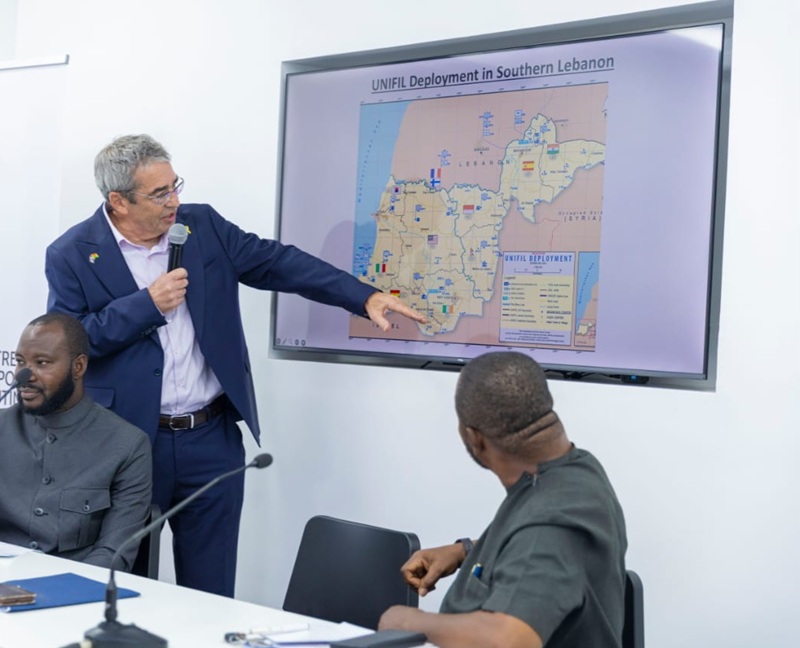
Ambassador Gilad delivered the message on Tuesday, December 2, 2025, in Accra during a high-level dialogue organised by the Centre for Policy Scrutiny (CPS) on the theme “Fighting Terrorism in the Middle East and Africa.”
The forum assembled diplomats, academics, security analysts and policymakers, including international relations expert, Dr. Vladimir Antwi-Danso, Ofoase-Ayirebi MP, Kojo Oppong Nkrumah, and Akim Oda MP, Alexander Akwasi Acquah.
The ambassador’s comments draw from a broader historical context: for over two decades, West Africa has been steadily transformed by the spread of extremist violence emanating from the Sahel.
After the collapse of Libya in 2011, armed groups and sophisticated weapons filtered southward, accelerating radicalisation and insurgency in Mali, Niger and Burkina Faso.
By the mid-2020s, Burkina Faso had become one of the world’s most violent hotspots, placing Ghana — its southern neighbour — at significant risk despite its long-standing reputation as a stable democracy.
Addressing participants, Ambassador Gilad cautioned that the extremist groups operating across the Sahel today are far more advanced than earlier jihadist movements. He noted that these networks are increasingly decentralised, technologically savvy and highly mobile, enabling them to exploit governance gaps and porous borders.
“Terrorist networks today are mobile, flexible and constantly searching for weak spots,” he said. “No country can fight this threat alone. Ghana and Israel must continue strengthening our security partnership through intelligence cooperation, technology and capacity-building.”
He underscored Israel’s decades-long experience confronting extremist threats and expressed readiness to support Ghana with specialised training, intelligence-sharing platforms and modern counterterrorism tools.
Ambassador Gilad stressed that Ghana must not wait for an attack before acting, especially given the rapid deterioration of security conditions in northern Burkina Faso.
Providing a deeper analytical perspective, Dr. Vladimir Antwi-Danso warned that West Africa now accounts for the highest concentration of global terrorist activity.
Citing a 2024 United Nations report, he revealed that 56% of worldwide terror incidents occur in the Sahara region, with 70% of all attacks recorded between 2016 and 2024 happening in West Africa alone.
According to him, the fall of ISIS strongholds in Syria and Iraq did not eliminate jihadist influence; instead, it caused extremist fighters to disperse and embed themselves within new territories.
“We may think ISIS has been defeated, but it has only been diffused,” Dr. Antwi-Danso explained. “They no longer operate with a strict hierarchy, making them far more difficult to trace and eliminate.”
He traced the rise of Sahelian terrorism to long-standing governance failures, exclusionary politics, poverty and vast ungoverned spaces — factors that extremist groups exploit to gain influence. Local grievances, he noted, have become fertile grounds for recruitment as communities increasingly feel marginalised and abandoned by central governments.
“When people feel abandoned or marginalised, extremist ideologies become alternatives,” he said. “This is why terrorism is both a security problem and a governance problem.”

COMMENTS