
The 2025 National Farmers’ Day celebration, held across the country on December 5, has been overshadowed by growing public debate and allegations of p
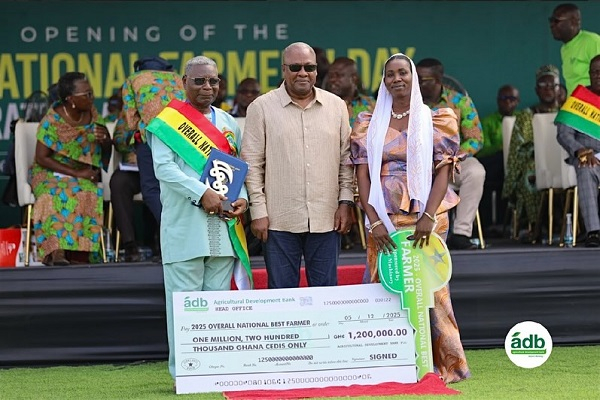
The 2025 National Farmers’ Day celebration, held across the country on December 5, has been overshadowed by growing public debate and allegations of political favouritism, after multiple high-profile members and sympathisers of the ruling National Democratic Congress (NDC) emerged as major award winners.
While government officials insist the winners were selected strictly on merit, critics say the pattern raises troubling questions about political influence in what is supposed to be a non-partisan national event.
A National Celebration Marked by Controversy
Farmers’ Day—established in 1985 after a devastating drought and famine—has long been regarded as a unifying day dedicated to honouring the men and women who fuel the food economy.
Over the decades, the event has evolved into one of the country’s biggest national award ceremonies, with recipients receiving cash, house, equipment, and other agric-related incentives.
However, this year’s 41st edition, held in Ho in the Volta Region, has sparked debate after several awardees were found to have strong political links to the ruling NDC—leading some Ghanaians to accuse the government of turning the national celebration into a reward scheme for party loyalists.
National Best Farmer: Prominent NDC-Aligned Cleric Wins Top Prize
The most attention-grabbing award went to 82-year-old Opanin Abraham Kwaku Adusei, a seasoned farmer from Kwahu Afram Plains and Head of the Saviour Church of Ghana, and a friend to current President John Dramani Mahama. He was appointed a member of the Council of State in John Mahama first term in office.
Aside from his decades-long agricultural contribution, Opanin Adusei is widely known for his close association with the NDC.
Members of his own congregation have previously described him as “more NDC than JJ Rawlings,” underscoring the widely-held perception of his political leanings.
His church—one of the largest indigenous spiritual denominations—is said to have over 90% of its membership identifying with the NDC.
Opanin Adusei, a former member of the Council of State, walked away with one of the biggest prize packages in the history of Farmers’ Day: GH¢1.2 million cash, a brand-new tractor with full implements, Modern mechanisation tools and agro-inputs and commemorative plaque.
Government officials, however, insist his recognition is based purely on merit, highlighting his climate-smart farming techniques, massive scale of production, and contributions to rural development—including the construction of schools and hospitals.
Ashanti Region: Minister’s Brother Named Municipal Best Farmer
In the Ashanti Region, political controversy deepened when the elder brother of the Ashanti Regional Minister, Frank Amoakohene crowned the Municipal Best Farmer in Asante Mampong.
Opposition voices have questioned the transparency of the selection process, arguing that awarding a minister’s family member risks eroding public trust. Local agricultural officers, however, maintain that he met all the criteria and deserved the honour.
North East Region: NDC Regional Chairman Wins Top Award
Another flashpoint emerged in Chereponi, where Alhaji Ibrahim Abdul Rauf Tanko—the North East Regional Chairman of the NDC and Chairman of the Hajj Board—was adjudged the Overall Regional Best Farmer.
Rauf Tanko, a large-scale rice and livestock farmer, received a tricycle, farm tools, and assorted inputs. His win divided public opinion instantly.
While his supporters insist he is one of the region’s most successful farmers, critics argue that awarding a top party executive risks politicising an event historically aimed at celebrating ordinary farmers.
Regional Minister Rejects Accusations of Bias
The North East Regional Minister, Tia Ibrahim, strongly rejected claims of political favouritism: “In the whole of the northern sector, there is nobody who can farm rice more than him. This is not politics. This is about rewarding people who deserve it. I challenge anyone to bring evidence of undeserving awardees.”
He also announced new initiatives, including agricultural service centres in Yunyoo and Mamprugu-Moaduri, market centres for surplus food storage, and renewed campaigns against bushfires.
Farmers Raise Concerns Despite Celebrations
Despite the pomp, many farmers expressed frustration over persistent challenges:
Poor feeder roads, hindering access to markets
Lack of ready markets, especially for rice and sesame
Border restrictions, which have slowed cross-border trade with Togo
These concerns, farmers argue, are more pressing than award controversies.
Mixed Reactions Across the Country
Public sentiment remains sharply divided.
Supporters of the awardees say the winners have long histories of impactful agricultural work and deserve recognition.
Critics argue that awarding multiple politically exposed persons—within the same year—undermines the credibility of the awards.
For many, the recurring question is not whether the winners farm, but whether the selection process was insulated from politics.
At this year’s farmers’ days celebration, the awards given to some of the farmers were not encouraging at all.

COMMENTS