
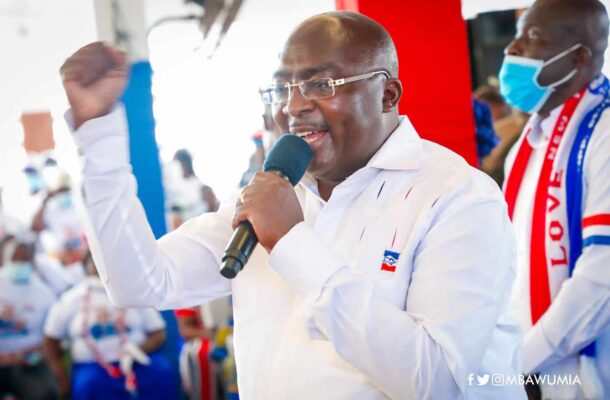
A comprehensive nationwide survey conducted by the Konrad Adenauer Stiftung (KAS) Ghana has revealed a clear preference for Dr. Mahamudu Bawumia as th
A comprehensive nationwide survey conducted by the Konrad Adenauer Stiftung (KAS) Ghana has revealed a clear preference for Dr. Mahamudu Bawumia as the leading candidate for the New Patriotic Party’s (NPP) 2026 presidential primary scheduled for January 31, 2026.
Over two-thirds of the delegates prefer former Vice President Dr Bawumia as the candidate to lead the party into the 2028 presidential election.
“Who is best suited to be flagbearer?
Delegates: Dr Mahamudu Bawumia – 67.8%; Hon. Kennedy Agyapong – 21.3%; Dr Bryan Acheampong – 6.6%; Others – < 5%
Non-delegates: Dr Mahamudu Bawumia – 50.6%; Hon. Kennedy Agyapong – 29.8%; Dr Bryan Acheampong – 8.7%; Others – small single digits
Delegates’ preferences are decisive: Bawumia leads by a 3:1 margin, currently positioning him as the overwhelming favourite if the primaries were held today”, statement issued in Accra by the organisers said.
The respondents also settled on Dr Bawumia’s leadership qualities for the party ahead of the primary.
“Which personalities possess the required leadership qualities?
Delegates: Dr Mahamudu Bawumia – 69.7%; Hon. Kennedy Agyapong – 22.5%;
Dr Bryan Acheampong – 6.0%; Others – <1% each
Non-delegates: Dr Mahamudu Bawumia – 52.9%; Hon. Kennedy Agyapong – 31.2%; Dr
Bryan Acheampong – 7.9%; Others – small single digits
Across both groups, Mahamadu Bawumia is viewed as the political figure who most clearly represents the preferred leadership qualities, though Kennedy Agyapong enjoys a stronger popularity among non-delegates,” the statement indicated.
The survey, which collected responses from over 18,000 Ghanaians—including more than 5,000 NPP delegates—highlights widespread expectations for competent, ethical, and development-focused leadership.
Nationwide Representation
The survey covered all 16 regions of Ghana, ensuring representation from urban, peri-urban, and rural areas, as well as across different age groups, educational backgrounds, religions, and ethnicities.
Among delegates, 66.8% were male, indicating a male-dominated political leadership structure, while females represented 33.2% of the sample.
The majority of delegates fell between the ages of 36–45 (41.6%) and 46–55 (25.1%), suggesting that the party’s core leadership is concentrated among mid-career professionals.
Educational attainment among delegates was notably high, with 41.4% holding secondary education and 23.3% tertiary qualifications.
Economically, 58.8% of delegates were self-employed, highlighting the influence of entrepreneurial and informal sector actors within the party’s internal structures. Geographically, rural delegates formed the largest group (39.8%), followed by urban (35.3%) and peri-urban (24.9%) representatives, indicating strong grassroots engagement.
Christian delegates accounted for 76.4% of respondents, while Muslims made up 20.3%, reflecting the party’s diverse religious composition.
The ethnically, the Akan group was the largest at 49.3%, with significant representation from Mole-Dagomba (13.6%), Ewe (8.5%), Ga-Dangme (5.8%), and other minority groups.
Leadership Qualities In Focus
When asked about the character and leadership qualities necessary to strengthen and rebuild the NPP for electoral competitiveness, Dr. Mahamudu Bawumia emerged overwhelmingly as the preferred choice.
Among delegates, 69.8% identified him as possessing the leadership qualities required, followed by Kennedy Agyapong at 22.5% and Dr. Bryan Acheampong at 6%. Non-delegates also ranked Dr. Bawumia highest (52.9%), though Kennedy Agyapong enjoyed stronger popularity among this group (31.2%).
The survey identified competence (24.9%), experience (20.3%), vision (16.9%), grassroots accessibility (14.1%), and charisma (8.5%) as the most sought-after qualities in a presidential candidate.
Factors such as age, gender, religion, or ethnicity collectively accounted for less than 1% of responses, suggesting that Ghanaians are prioritizing professional capability over identity-based considerations.
Regional Breakdown
Support for Dr. Bawumia was consistently strong across all regions. In the Northern, Savannah, and North East regions, his support among delegates exceeded 90%, while in Bono East, Bono, and Greater Accra regions, he captured between 65% and 76% of delegate preference.
Kennedy Agyapong was a notable second choice in the Central and Ahafo regions, while Dr. Bryan Acheampong, Dr. Yaw Osei Adutwum, and Kwabena Agyepong received minimal support across the country.
Best-Suited Candidate
When asked directly who is best suited to lead the NPP into the next general elections, Dr. Bawumia again dominated with 67.9% support among delegates, with Kennedy Agyapong trailing at 21.3%.
This trend was consistent across both delegates and non-delegates, reflecting a broad-based consensus around Dr. Bawumia’s leadership capabilities.
Interestingly, 58.9% of delegates indicated that religion, ethnicity, or regionalism did not influence their voting decisions, emphasizing an emphasis on merit-based leadership.
However, 25.2% acknowledged that identity factors played a role, indicating some residual influence of demographic considerations in internal party politics.
Implications For NPP’s Flagbearer Race
The survey results signal a strong preference for experienced, competent, and ethical leadership ahead of the 2026 elections, with Dr. Bawumia emerging as the frontrunner across diverse regions and demographic groups.
Party strategists are likely to view these findings as a clear mandate to consolidate support around a candidate who embodies both competence and national appeal, while also addressing the expectations of grassroots delegates and citizens.

COMMENTS