
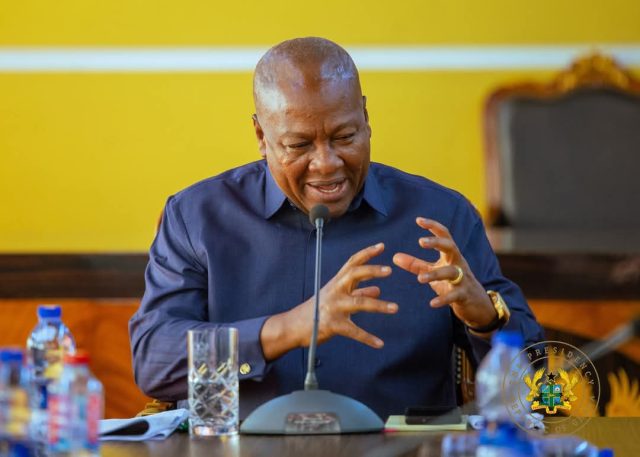
One year after President John Dramani Mahama was sworn into office on January 7, 2025, the Centre for Democratic Movement (CDM) has issued a detailed
One year after President John Dramani Mahama was sworn into office on January 7, 2025, the Centre for Democratic Movement (CDM) has issued a detailed and critical assessment of his administration, raising fundamental questions about governance outcomes, institutional independence, economic hardship and national security.
In its January 2026 review, the civil society organisation argues that while the Mahama government returned to office on a platform of experience, stability and democratic renewal, the realities of governance over the past 12 months point instead to missed opportunities and deepening public frustration.
CDM situates its assessment within Ghana’s broader democratic history, noting that President Mahama’s comeback followed widespread dissatisfaction with the previous administration and high public expectations that lessons from his earlier 2012–2017 tenure would translate into firmer leadership, stronger institutions and better protection of livelihoods.
However, the group insists that governance must be measured by tangible results rather than political messaging, and that for many ordinary Ghanaians, daily life has become more precarious rather than more secure.
At the centre of CDM’s criticism is the illegal mining menace, popularly known as galamsey, which the group describes as a national emergency that has been allowed to fester.
Despite years of bipartisan rhetoric and repeated pledges by successive governments, CDM says the problem has visibly worsened under the current administration.
Major rivers that serve as sources of drinking water for millions are increasingly polluted, while scientific and anecdotal evidence points to heavy metal contamination of farmlands and food produce.
According to the group, this not only threatens public health but also undermines long-term food security, exposing a failure of leadership in protecting the natural resources.
The assessment also condemns what CDM describes as widespread dismissals in the public sector over the past year.
While acknowledging that efficiency reforms are necessary in any administration, the group argues that job terminations carried out without transparency, due process or adequate social protection have deepened unemployment and inflicted hardship on families.
In its view, the dismissals have eroded confidence in the public service and contributed to a sense of economic insecurity at a time when households are already under pressure.
On the economy, CDM highlights a growing disconnect between macroeconomic indicators and lived realities.
Although the cedi has remained relatively stable, trading around GH¢10.60 to the US dollar, the group notes that stability has not translated into relief for consumers.
Utility tariffs have continued to rise, food prices remain volatile and transport costs continue to eat into disposable incomes.
CDM argues that economic management cannot be considered successful when citizens are forced to make painful choices between basic necessities such as electricity, healthcare, education and food.
The education sector features prominently in the assessment, with CDM tracing current challenges back to policy and administrative failures.
Particular concern is raised about the Computerized School Selection and Placement System (CSSPS), which the group says malfunctioned badly during the most recent placement cycle, leaving thousands of qualified students stranded or wrongly placed.
This, CDM argues, undermines the principles of fairness and merit that underpinned the Free Senior High School policy.
At the same time, poor performance in the latest WASSCE examinations is attributed to overcrowded classrooms, inadequate learning materials, exhausted teachers and policy inconsistency.
At the tertiary level, rising university fees are said to be placing higher education beyond the reach of students from low-income backgrounds, contradicting promises of expanded access and social mobility.
Perhaps the most politically sensitive issue raised by CDM is the removal of the Chief Justice, which the group characterises as a direct attack on judicial independence.
Drawing on the constitutional tradition of separation of powers, CDM warns that any perception of executive interference in the judiciary weakens public confidence in the justice system and sets a dangerous precedent for democratic governance.
In its view, no democracy can thrive when a co-equal arm of government appears vulnerable to political pressure.
Beyond the judiciary, CDM points to broader concerns about the rule of law, citing the frequent use of nolle prosequi and the selective discontinuation of high-profile cases.
According to the group, such practices have fuelled perceptions of impunity and selective accountability, further eroding public trust in state institutions.
Security and the protection of life also come under sharp scrutiny. CDM grounds its argument in the 1992 Constitution, particularly the rights to life and property, and the obligations under international instruments such as the African Charter on Human and Peoples’ Rights.
The group singles out the protracted conflict in Bawku, marked by recurring violence, deaths, displacement and destruction of property, as evidence of the state’s struggle to meet its constitutional duty to protect citizens.
It adds that rising violent crime and general insecurity nationwide have weakened confidence in law enforcement and strained the social contract between the state and the governed.
Persistent insecurity, CDM argues, raises serious questions about the effectiveness of intelligence, coordination and resource allocation within Ghana’s national security architecture.
In the interest of balance, CDM acknowledges some positive elements of the administration’s first year, including relative exchange rate stability, efforts at policy communication and dialogue, and renewed emphasis on long-term infrastructure planning.
However, the group maintains that these gains are modest and insufficient to offset what it describes as widespread governance deficits.
In its conclusion, CDM characterises President Mahama’s first year back in office as one defined by unfulfilled promise. Rising living costs, environmental degradation, job insecurity, weakened institutions and declining educational outcomes, it argues, have combined to create a troubling national pictures.
The group calls on the President to reset his governance approach, recommit to institutional independence, protect livelihoods, decisively confront illegal mining and place the welfare of ordinary Ghanaians at the centre of policy decisions.
“History will not judge intentions,” the statement concludes. “It will judge outcomes.”

COMMENTS