
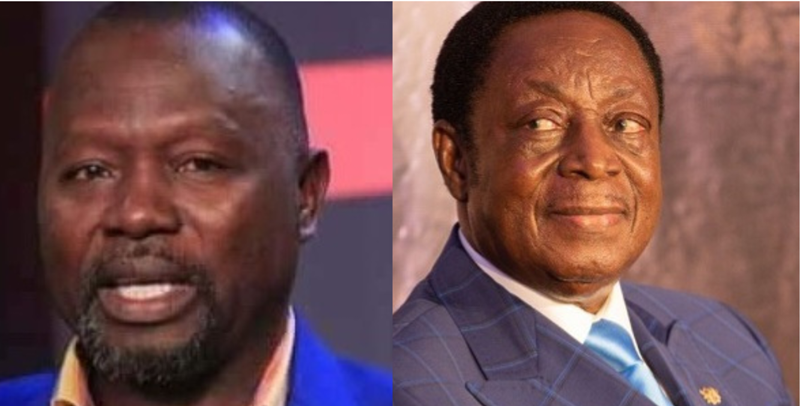
Attorney-General and Minister for Justice, Dr Dominic Akuritinga Ayine, has offered explanation for the state’s decision to withdraw criminal charges
Attorney-General and Minister for Justice, Dr Dominic Akuritinga Ayine, has offered explanation for the state’s decision to withdraw criminal charges against former Finance Minister Dr Kwabena Duffour and other directors of the defunct Unibank Ghana Limited, insisting that investigations failed to establish theft, fraud, or personal enrichment.
Dominic Ayine’s clarification comes against the backdrop of the controversial financial sector clean-up, which began in 2017 and culminated in the revocation of licences of several banks and financial institutions deemed insolvent by the Bank of Ghana. Unibank, founded by Dr Duffour and linked to the Duffour family, was among the high-profile institutions affected, sparking intense public debate and political controversy.
Speaking on Starr Chat with Bola Ray, the Attorney-General said public perception of the Unibank case had been heavily influenced by the prominence of the bank’s owners rather than by the strict evidential standards required under criminal law.
According to Ayine who acted as a lawyer for Dr Duffour in the Unibank case, when his office undertook a review of cases arising from the banking sector reforms, it became apparent that Unibank’s circumstances were materially different from others where criminal prosecutions were justified and successfully pursued.
To underscore the distinction, Dr Ayine referenced the Capital Bank case, which resulted in criminal convictions.
In that matter, he said investigators uncovered clear and direct evidence of dishonest appropriation of funds by senior management.
“In the Capital Bank trial, there was evidence that whenever liquidity support was given by the Bank of Ghana, the former managing director dishonestly appropriated those funds,” Dr Ayine explained.
He added that prosecutors were able to trace how portions of the liquidity support were physically diverted for private use.
According to the Attorney-General, evidence before the court showed that cash meant to stabilise the bank was transported in a vehicle to a private garage at the managing director’s residence, supported by geographic tracking data.
“That is pure stealing,” he stressed, noting that such evidence made criminal prosecution both appropriate and sustainable.
By contrast, Dominic Ayine said investigations into Unibank did not reveal any comparable acts of theft or diversion of funds for personal gain. He cautioned against the tendency to criminalise bank failure, particularly where liquidity support is applied through established banking processes.
“If liquidity support is applied in accordance with normal banking rules and the bank still collapses, you cannot criminalise the conduct of the owners or directors simply because the risk did not pay off,” he said.
The Attorney-General noted that risk-taking is intrinsic to banking and financial intermediation, and that loan defaults or business failure, while damaging, do not in themselves constitute criminal offences.
“You cannot turn around and say that because a bank received liquidity support and later failed, its directors must be prosecuted for causing financial loss to the state. It doesn’t happen anywhere,” he added.
Addressing persistent claims that Unibank’s owners looted depositors’ funds, Dr Ayine was unequivocal.
“There was no evidence that the Duffours stole money,” he said, emphasising that criminal law requires proof of dishonesty, fraud, or theft beyond reasonable doubt.
He also dismissed allegations of fraudulent breach of trust, explaining that under Ghanaian law, the relationship between a bank and its customers is contractual, not fiduciary.
As such, he argued, losses arising from failed loans cannot automatically be framed as criminal breaches of trust.
“That is a fundamental principle of law. You cannot say there is a fraudulent breach of trust simply because depositors placed money in a bank and the bank extended loans that later failed,” he explained.
On criticisms that Unibank granted loans to related or affiliated companies linked to its shareholders, the Attorney-General acknowledged that such practices may raise serious regulatory or corporate governance concerns.
However, he stressed that related-party transactions only attract criminal liability where there is evidence of dishonesty, diversion of funds, or personal enrichment.
Dr Ayine said these legal considerations ultimately informed the state’s decision to discontinue the criminal proceedings against Dr Duffour and other Unibank directors.
He maintained that pursuing the case to trial would likely have resulted in acquittals due to the absence of incriminating evidence.
“I said they could either offer assets to cover part of the liability or go and stand trial. But I knew that eventually they would be acquitted because the evidence simply was not there,” he stated.
The Attorney-General was careful to add that the withdrawal of criminal charges does not amount to a complete absolution of responsibility.
Civil actions initiated by the bank’s receiver remain ongoing, and asset recovery processes continue as part of efforts to minimise losses to the state.
Dr Ayine reaffirmed that the Unibank case was never about theft or personal enrichment, a position he said he continues to defend despite sustained public criticism.

COMMENTS