
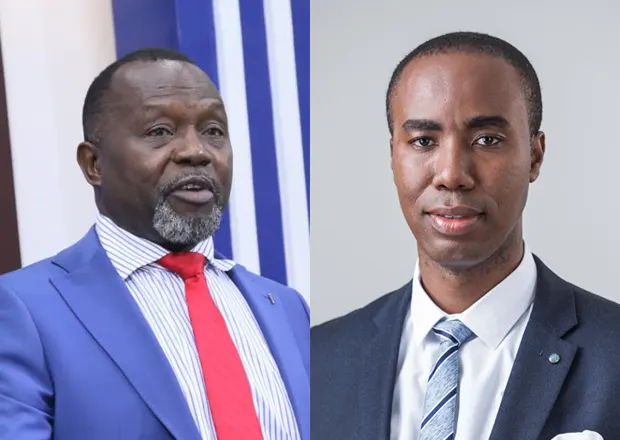
The Supreme Court has, by a 6–1 majority decision, dismissed an application filed by the Attorney-General seeking a review of its earlier ruling on cr
The Supreme Court has, by a 6–1 majority decision, dismissed an application filed by the Attorney-General seeking a review of its earlier ruling on criminal disclosure obligations in the ongoing trial of former National Signals Bureau Director-General, Kwabena Adu-Boahene, and his wife.
Justice Yonny Kulendi delivered the lone dissenting opinion.
The couple is facing charges including stealing, money laundering, and the use of public office for private gain. In a previous application, they had asked the Supreme Court to restrain the High Court judge presiding over their case — a request the apex court rejected.
However, in the same ruling, the Supreme Court revised its Practice Direction on Further Disclosures, holding that prosecutors are required to disclose only materials in their possession that are connected to the case, rather than all documents broadly described as “relevant.”
It was this clarification on disclosure that prompted the Attorney-General to invoke the Court’s review jurisdiction.
Arguing through Deputy Attorney-General Dr Justice Srem-Sai, the state contended that the Supreme Court had effectively removed the concept of “relevance” from criminal disclosure without replacing it with an equivalent legal standard. The Attorney-General warned that the decision risked narrowing prosecutors’ disclosure obligations to mere possession of documents, regardless of their significance to the issues before the court.
He urged the justices to either restore the word “relevance” in its ordinary legal sense or substitute it with clearer language such as “connected with the matter before the court,” to maintain fairness and transparency in criminal trials.
According to the Attorney-General, failure to clarify the standard could undermine fair trial rights by limiting access to materials that, while not directly in the prosecution’s hands, may substantially affect the defence.
The Supreme Court, however, rejected the arguments and declined to review its earlier decision.
The Court has announced that its full, reasoned judgment will be delivered on February 4.
The seven-member panel was presided over by Justice Lovelace Johnson and included Justices Amadu Tanko, Yonny Kulendi, Senyo Dzamefe, Richard Adjei-Frimpong, Sir Dennis Agyei, and Kwaku Tawiah Ackaah-Boafo.

COMMENTS