
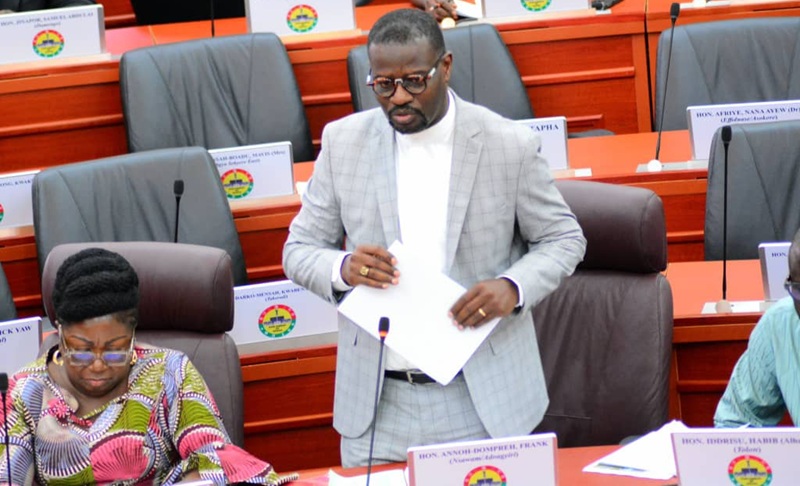
Tensions rose on the floor of Parliament on Friday when the Minority Chief Whip and Member of Parliament for Nsawam-Adoagyiri, Frank Annoh-Dompreh, la
Tensions rose on the floor of Parliament on Friday when the Minority Chief Whip and Member of Parliament for Nsawam-Adoagyiri, Frank Annoh-Dompreh, launched a fierce critique of what he described as growing institutional disregard for parliamentary oversight and procedure.
His intervention came during deliberations on parliamentary business programming, where he accused the executive arm of undermining Parliament’s authority through poor scheduling, ministerial absenteeism, and administrative inefficiencies.
Raising concerns about unresolved national policy matters, Annoh-Dompreh drew attention to critical issues such as the Ghana Education Trust Fund (GETFund) formula, noting that Parliament has a constitutional mandate to address such matters but has failed to do so due to poor programming.
He called on the Leader of Government Business, also Majority Leader, Mahama Ayariga, to urgently schedule these issues for debate, insisting that Parliament cannot continue postponing its core responsibilities while key national development and financing frameworks remain unresolved.
The Minority Chief Whip further expressed alarm over the growing backlog of parliamentary questions, revealing that over 300 questions are currently pending, yet only 34 have been programmed for the coming week.
He described this as unacceptable, especially considering that Parliament has traditionally processed between 70 and 75 questions weekly. With the State of the Nation Address (SONA) scheduled for Friday, 27th, followed by a two-week debate period and an approaching recess, he questioned how Parliament intends to clear the massive backlog of unanswered questions before the House rises.
Annoh-Dompreh traced the crisis to procedural changes in how questions are processed and communicated to ministers. Traditionally, once questions were admitted by the Speaker and approved through the Business Statement, they were formally communicated to sector ministers for appearance and response.
However, he noted that the new practice allows ministers’ availability to determine scheduling, a situation he described as deeply flawed and unconstitutional in spirit.
According to him, this has led to a system where ministers choose when to appear before Parliament, rather than Parliament exercising its authority to summon them.
He condemned the increasing number of formal letters from ministers declining to appear before the House, citing excuses such as conferences and other engagements, and described the trend as dangerous to democratic accountability.
Annoh-Dompreh warned that many parliamentary questions are now losing relevance due to delays, while Members of Parliament are unable to make statements or perform their oversight functions effectively.
In an emotionally charged address, the Minority Chief Whip insisted that Parliament’s oversight role must not be weakened by executive convenience.
He demanded a return to strict institutional discipline, where ministers are formally scheduled by Parliament and required to appear, and where any inability to attend must be justified through official written communication to the House.
He singled out the Roads Minister as an example of respect for parliamentary authority, urging other ministers to emulate that conduct.
Concluding his address, Annoh-Dompreh issued a firm warning to the Majority leadership, stating that Parliament would now place “an eagle eye” on ministerial conduct and availability.
He stressed that Parliament must be taken seriously as the supreme legislative and oversight body of the Republic, declaring that “enough is enough” and that the culture of casual disrespect toward parliamentary processes must end.

COMMENTS