
Ghana must move beyond short-term, transactional trade and adopt a bold, long-term strategy to fully capitalise on its growing economic relationship w
Ghana must move beyond short-term, transactional trade and adopt a bold, long-term strategy to fully capitalise on its growing economic relationship with China, business leaders have urged.
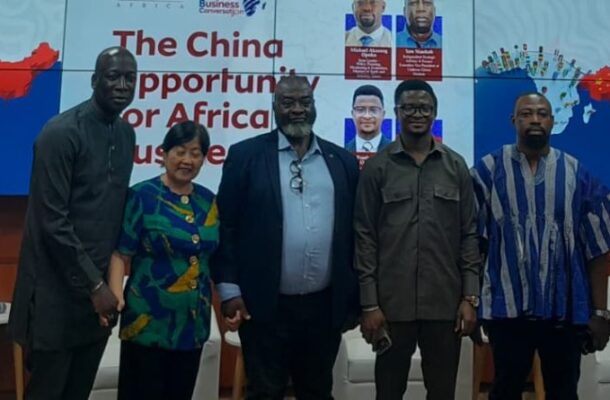
Speaking at the China Opportunity for Africa Businesses Forum, organised by AB & David Africa on Wednesday, February 25, 2026, Independent Strategic Advisor and former Executive Vice President of Unilever Global Markets, Yaw Oduro Nsarkoh, cautioned that without a clear national framework, Ghana risks remaining in ad-hoc trade arrangements rather than achieving structural economic transformation.
Acknowledging China’s status as one of the world’s most influential economies with an expanding footprint across Africa, Nsarkoh stressed that Ghana must engage strategically rather than relying on goodwill or sentiment.
“We must be strategic and long-term in our thinking. How do we transform our society? We must understand that China is not coming to develop our country for us. The real question is how we learn from them, combine that with what we know locally and from other markets, and deliberately chart our own development path,” he said.
The call for a shift in approach extended to the private sector. Michael Akurang Opoku, Team Lead for Policy Planning, Monitoring and Evaluation at the Ministry of Trade, Agribusiness and Industry, encouraged Ghanaian businesses to view partnerships as tools for growth rather than insisting on full ownership at all costs.
“Sometimes it is worrying. You speak to one African counterpart here and another there, yet collaboration becomes difficult. We must find more constructive ways to work together,” he noted.
David Ofosu-Dorte, Senior Partner at AB & David Africa, emphasised that competitiveness in the Chinese market will depend on value addition and strong branding. He warned that continued reliance on raw commodity exports will limit Ghana’s gains.
“Shea butter and cocoa for export must be value-added. Exporting raw commodities will not give us the competitive advantage we need. If we build technology, improve production and create finished products, we will not only meet the high standards of the Chinese market but also create real wealth,” he advised.
Practical considerations also featured prominently. Dr. Frank Adzeba Owusu, Chief Executive Officer of Yihunyanong Logistics Co. Ltd, highlighted language as a critical — and often overlooked — trade enabler.
“Language is a major barrier. If you go to Guangzhou and speak even basic Chinese, the dynamic changes. They feel more comfortable and more willing to do business with you,” he said.
Adding an international perspective, Anna X.M. Shao, Executive Vice President of the China Association for the Promotion of International Economic and Technical Cooperation, encouraged Ghanaian businesses to engage with openness and a genuine readiness to cooperate.
With China remaining one of Africa’s largest trading partners and a key source of infrastructure and industrial investment, speakers agreed that Ghana’s opportunity lies not merely in increasing trade volumes but in restructuring engagement — moving from raw commodity exports to value-driven partnerships capable of delivering long-term economic transformation.

COMMENTS