
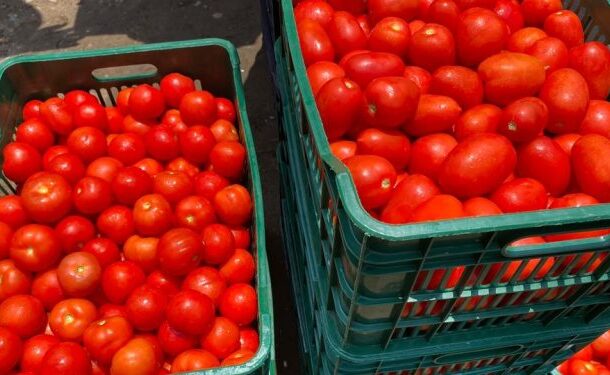
The government is facing increasing pressure to accelerate efforts toward tomato self-sufficiency, as traders at Agbogbloshie Market struggle with ris
The government is facing increasing pressure to accelerate efforts toward tomato self-sufficiency, as traders at Agbogbloshie Market struggle with rising prices that are steadily reducing consumers’ purchasing power.
The situation has been worsened by Burkina Faso’s ban on tomato exports, which has caused supply shortages and sharp price increases across Ghana’s major markets.
Traders say the surge in tomato prices is already affecting sales, with many households cutting back on consumption or turning to alternative ingredients. Some retailers report that the cost of a crate of tomatoes has more than doubled in recent weeks, making it difficult to maintain stable prices for customers.
Patience Nyarko, a tomato trader, expressed concern over the unexpected spike. “At a time like this, tomato prices should not be rising so sharply. Ideally, prices would range between GH₵18 and GH₵22, but tomatoes are now being sold for GH₵32, GH₵38, and even GH₵40,” she said. She attributed the surge largely to the export ban, noting that Burkina Faso normally supplies Ghana for up to six months during its peak season. The disruption, she explained, has significantly reduced availability and driven up prices.
Ama Agyeiwaa, a trader with 25 years of experience, described the situation as worrying for market women, many of whom rely entirely on tomato sales for their livelihoods. She urged authorities to take proactive measures to address the supply gap.
“We urge officials from the Ministry of Food and Agriculture to visit Burkina Faso and study how they manage irrigation to sustain tomato production. Learning from their methods could help improve local farming practices here in Ghana, especially during the dry season,” she said.
Abena Agyeiwaa, another trader with six years of experience, added that locally grown tomatoes are significantly more affordable when available. She noted that a bucket of local tomatoes can cost around GH₵200, compared to higher prices for imported ones, which are affected by transportation costs and other risks.
In response, the Minister for Food and Agriculture, Eric Opoku, announced plans to boost domestic tomato production, aiming to increase yields from 8 metric tonnes per hectare to 15 metric tonnes per hectare. The West Africa Centre for Crop Improvement has been tasked with coordinating agricultural research institutions to develop improved tomato varieties by August 2026.

COMMENTS