
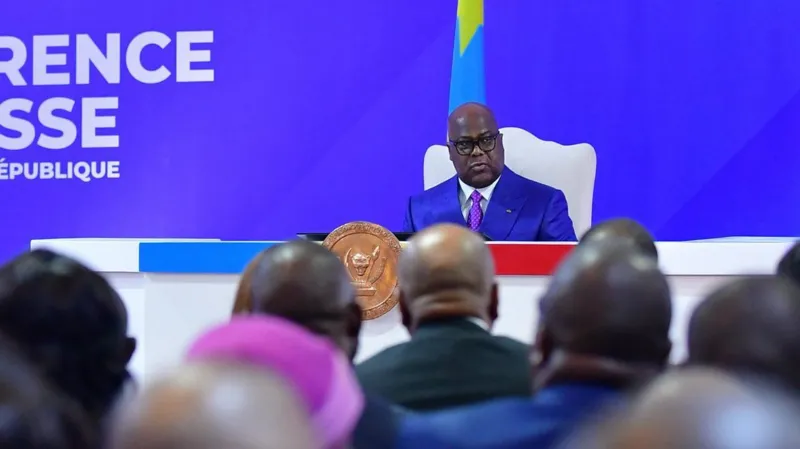
President Félix Tshisekedi of the Democratic Republic of Congo (DRC) has signalled that he may seek a third term and potentially delay the 2028 electi
President Félix Tshisekedi of the Democratic Republic of Congo (DRC) has signalled that he may seek a third term and potentially delay the 2028 elections, citing the ongoing conflict in the country’s eastern provinces.
During a press conference in May 2026, Tshisekedi stated that while he has not explicitly requested an extension, he would “accept” a third term if “the people want” it, which would require a constitutional amendment through a national referendum.
Currently, the DRC constitution limits presidents to two five-year terms, and Tshisekedi’s second mandate is set to expire in December 2028.
The president also warned that the scheduled 2028 polls might be postponed if the war against the Rwanda-backed M23 rebels is not resolved.
He emphasised that holding elections would be impossible without the participation of North Kivu and South Kivu, two populous eastern provinces where rebels have seized significant territory.
Although he insisted the government has the financial resources to organise the vote, he made the timing conditional on restoring peace, arguing that he cannot leave millions of citizens disenfranchised by the conflict.
Opposition leaders and civil society groups have swiftly condemned these remarks, describing them as a “constitutional coup” and a calculated manoeuvre to maintain power.
Critics argue that the president is using the security crisis as a pretext to bypass democratic term limits.
The tension is further fueled by a bill recently submitted to parliament that outlines the process for a referendum, which supporters claim will strengthen democracy but opponents fear is the first step toward a permanent term-limit revision.

COMMENTS