

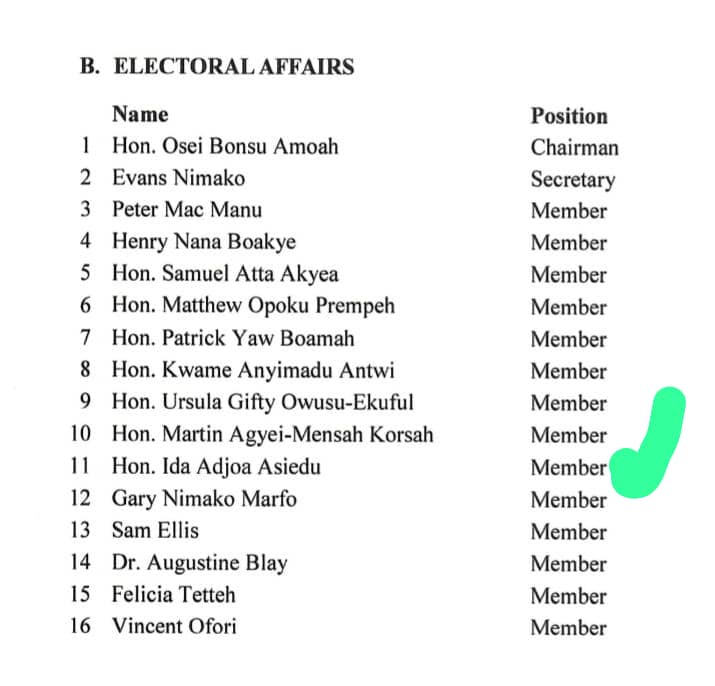
Member of Parliament for Ayensuano Constituency, Ida Adjoa Asiedu, has secured a strategic appointment as a member of the Electoral Affairs Committee
Member of Parliament for Ayensuano Constituency, Ida Adjoa Asiedu, has secured a strategic appointment as a member of the Electoral Affairs Committee of the opposition New Patriotic Party (NPP) following the party’s latest internal reorganization exercise aimed at rebuilding and strengthening its structures ahead of the 2028 general elections.
Her appointment forms part of the newly constituted Standing and Sector Committees announced by the party after a meeting of the National Executive Committee and National Council held on Thursday, May 7, 2026.
The reorganization is widely seen as a major effort by the NPP leadership to reposition the party, strengthen internal coordination, and bring experienced and emerging political figures into strategic decision-making roles.
Party supporters and political observers are interpreting Ida Adjoa Asiedu’s inclusion in the influential Electoral Affairs Committee as recognition of her growing role within the NPP and the Minority Caucus in Parliament, particularly at a time when female representation within the opposition ranks remains limited.
The Ayensuano legislator made history after becoming the first female Member of Parliament for the constituency, a political milestone that significantly raised her profile within the Eastern Region and the wider NPP political structure.
Her election was viewed by many within the party as part of a gradual shift toward increasing female participation and leadership in a political environment that had traditionally been dominated by male politicians.
Within Parliament, Ida Adjoa Asiedu has also emerged as one of the notable female voices in the Minority Caucus following the reorganization of parliamentary leadership and committee representation after the 2024 elections.
Out of the 87 Minority Members of Parliament currently representing the NPP in Parliament, only 10 are women, making female representation within the caucus relatively small.
However, during the recent parliamentary restructuring and committee reassignments, six of the 10 female Minority MPs were selected to serve in strategic parliamentary and party-related roles, a development that has been interpreted as an attempt by the party leadership to increase female visibility and participation within its internal governance structures.
Ida Adjoa Asiedu’s latest appointment places her among a new generation of female politicians gradually gaining influence within the NPP’s organizational framework.
Her role on the Electoral Affairs Committee is expected to involve electoral strategy discussions, campaign planning, party electoral reforms, grassroots coordination, and preparations toward future elections.
The Electoral Affairs Committee itself is one of the most significant standing committees within the NPP because of its responsibility for overseeing electoral planning, campaign coordination, polling strategies, and constituency mobilization.
The committee is chaired by former Deputy Local Government Minister Hon. Osei Bonsu Amoah, with Evans Nimako serving as Secretary.
Other members of the committee include senior party figures such as Peter Mac Manu, Henry Nana Boakye, Samuel Atta Akyea, Dr. Matthew Opoku Prempeh, Patrick Yaw Boamah, Ursula Gifty Owusu-Ekuful, Martin Agyei-Mensah Korsah, Gary Nimako Marfo, Sam Ellis, Dr. Augustine Blay, Felicia Tetteh, and Vincent Ofori.
Observers believe the inclusion of younger and emerging politicians like Ida Adjoa Asiedu reflects the party’s broader strategy to blend experienced political actors with fresh parliamentary voices as it prepares for long-term political rebuilding after its defeat in the 2024 elections.
The NPP’s reorganization exercise comes amid increasing internal discussions about party restructuring, grassroots revitalization, and preparations toward the 2028 general elections.
Party executives have repeatedly indicated that the newly constituted committees will be tasked with strengthening stakeholder engagement, policy coordination, electoral preparedness, and organizational discipline.

COMMENTS