
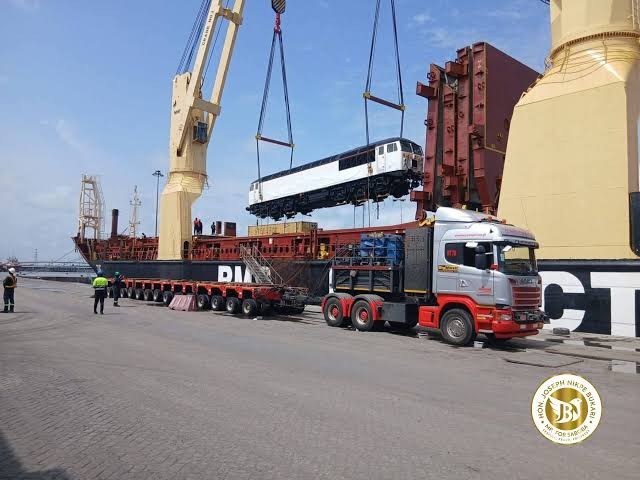
The New Patriotic Party (NPP) has launched a scathing attack on the Mahama administration over the recent acquisition of two refurbished diesel locomo
The New Patriotic Party (NPP) has launched a scathing attack on the Mahama administration over the recent acquisition of two refurbished diesel locomotives and 20 freight wagons, questioning why Ghana is celebrating what it describes as the arrival of “1970s-era” or “Margaret Thatcher-era” railway technology while key questions about cost, maintenance, operational readiness and long-term value remain unanswered.
In a statement issued by the party’s Transport Sector Committee, the NPP said although it supports every genuine effort to revive Ghana’s struggling railway sector and improve freight transportation, the government owes Ghanaians a full explanation regarding the condition, age, acquisition terms and sustainability of the locomotives before presenting the development as a major achievement.
According to the NPP, available information indicates that the locomotives are refurbished British Rail Class 56 diesel-electric locomotives, originally manufactured in the United Kingdom between 1976 and 1983, during the era of former British Prime Minister Margaret Thatcher.
The party noted that although about 135 units of the Class 56 locomotives were originally built, fewer than 15 reportedly remain in active service today, raising legitimate concerns about their remaining lifespan, efficiency and maintenance requirements.
The party argued that while refurbished locomotives can continue to provide useful service if properly maintained, Ghanaians deserve complete transparency regarding the locomotives’ operational history, the extent of refurbishment undertaken, their expected remaining service life, lifecycle costs and whether they represent the most cost-effective investment for Ghana’s railway modernisation agenda.
The statement explained that although the British Rail Class 56 locomotives were originally designed as powerful heavy freight engines capable of hauling substantial loads, they were built more than four decades ago and belong to an earlier generation of railway engineering.
The NPP said the locomotives rely on older mechanical systems, require more intensive maintenance interventions, and generally incur higher operating costs compared to modern freight locomotives that benefit from advances in fuel efficiency, digital diagnostics, and reliability.
Beyond the age of the rolling stock, the party also questioned the government’s preparedness to sustain the locomotives over the long term. It warned that because the Class 56 fleet has largely been withdrawn from mainstream operations across many countries, sourcing spare parts could become increasingly difficult and expensive.
The NPP therefore called on the government to disclose the long-term maintenance strategy for the locomotives, including whether critical spare parts have already been secured, whether technical support agreements exist with the refurbishment contractor, what technology transfer arrangements have been made, and how Ghana intends to build local technical capacity to maintain the equipment.
Drawing comparisons with the previous New Patriotic Party administration, the committee recalled that the Diesel Multiple Units (DMUs) procured from PESA of Poland were supplied as newly manufactured trains and accompanied by a structured five-year maintenance programme and technical support package designed to guarantee reliability while transferring maintenance skills to Ghanaian engineers.
According to the party, the success of any railway investment should not be measured simply by the arrival of locomotives but by the availability of comprehensive maintenance arrangements, local technical expertise and long-term operational sustainability.
The statement also raised questions about whether the Tema-Mpakadan Railway is adequately equipped to support the intended freight operations.
The NPP argued that locomotives alone cannot guarantee a successful railway system without the supporting logistics infrastructure needed to facilitate cargo movement between rail and the Volta Lake transport system.
It therefore asked the government to explain whether critical equipment such as mobile harbour cranes, reach stackers, container handling systems, bulk cargo loading facilities, and other intermodal logistics infrastructure have been installed and commissioned at Mpakadan to enable efficient freight operations.
The party further questioned the commercial viability of the railway project, stressing that rail transport cannot be sustained without guaranteed cargo volumes. It called on the government to disclose whether freight demand studies have been conducted, projected annual cargo volumes, signed haulage agreements with major shippers, expected revenue projections and the operational arrangements following the closure of Ghana Railway Company Limited.
NDC Promise on Railway Devt
The NPP also turned its attention to the government’s broader railway development promises, recalling that during the 2024 election campaign the National Democratic Congress pledged to aggressively expand the railway network, including completing the Western Railway Line to facilitate the transportation of manganese, bauxite and other bulk commodities while reducing pressure on the country’s roads.
However, the party argued that those promises appear inconsistent with what it described as the relatively modest budgetary allocation made to the railway sector in the 2026 Budget.
It questioned how the government intends to finance the completion of strategic railway corridors, the timelines for implementation, funding sources, and when outstanding obligations owed to railway workers will be settled.
While reaffirming its support for investments aimed at strengthening Ghana’s rail transport sector, the NPP maintained that transparency, accountability, and commercial sustainability must guide every railway investment. It insisted that the acquisition of refurbished locomotives built nearly half a century ago should not be presented as a symbolic achievement without full disclosure of their technical condition, acquisition cost, maintenance arrangements, spare parts availability, and long-term operational viability.
The party concluded that the true measure of success in revitalising the railway sector would not be the arrival of locomotives and freight wagons, but the establishment of a modern, reliable, commercially viable, and sustainable rail transport system capable of driving national economic growth and supporting industrial development.

COMMENTS