
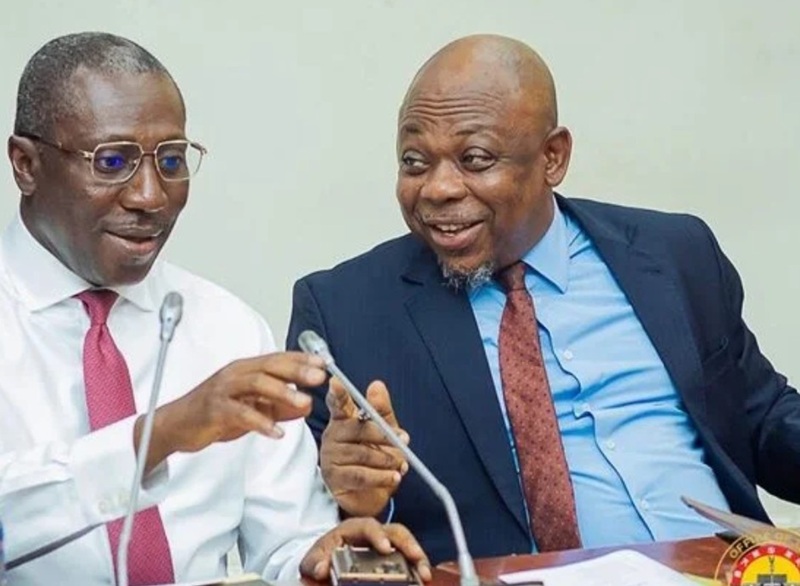
The Majority Leader, James Agalga, appears to have fallen too quickly for the political game of the Minority Leader, Alexander Afenyo-Markin. The s
The Majority Leader, James Agalga, appears to have fallen too quickly for the political game of the Minority Leader, Alexander Afenyo-Markin.
The strategy deployed by the Minority Leader to engage the new Majority Leader worked almost to precision at the very beginning of the Third Meeting of the Ninth Parliament.
What was supposed to be a leadership engagement with the media at the commencement of the meeting was turned into a political banter between the Majority and Minority Leaders last Tuesday. The essence of the encounter was almost completely drowned by accusations and counter-accusations between the leaders of the two largest political parties in Parliament.
The agenda was set by the Minority Leader when he took his turn to address the media ahead of the Majority Leader.
He deliberately touched on the political nerves of the Majority Leader, who is himself known to be a firebrand politician and one who is unlikely to let political jabs against his party go unanswered.
When Agalga eventually took his turn, he fell squarely into the trap. Rather than using the opportunity to outline Parliament’s legislative priorities and the government’s agenda for the Third Meeting, he devoted a considerable portion of his time responding to allegations of galamsey, drug trafficking scandals, the World Cup visa controversy and other issues raised by the Minority Leader.
In effect, the Majority Leader surrendered the opportunity to set the parliamentary agenda and instead allowed the Minority Leader to determine the subject of the engagement.
This is particularly significant because Agalga is not only the Majority Leader but also the Leader of Government Business in Parliament. His primary responsibility in that capacity is to provide strategic leadership in ensuring that government business is successfully prosecuted on the floor of the House.
The Minority, on the other hand, has very little to lose if government business is delayed or fails to receive the necessary parliamentary attention. Indeed, it could be the ultimate political beneficiary of such a situation.
The more Parliament becomes consumed by heated political exchanges, the greater the opportunity for the Minority to dominate public discourse, mobilise its political base and position itself as an effective opposition holding the government accountable.
That is precisely why the Minority Leader’s strategy deserves closer attention.
After successfully setting the tone for the engagement, Afenyo-Markin left the scene, allowing the First Deputy Minority Whip, Habib Iddrissu, to continue the attack. Meanwhile, the Majority Leadership found itself responding to the allegations rather than communicating its legislative priorities.
The Majority Chief Whip, Rockson-Nelson Dafeamekpor, also joined his Leader in defending the government against the Minority’s allegations.
The result was an engagement in which the Majority Leadership spent much of its time explaining and defending itself instead of telling Ghanaians what Parliament intended to accomplish during the meeting.
This should be a source of concern for the new Majority Leadership.
The Majority must understand that it does not have to respond to every political provocation from the Minority.
There is a fundamental difference between holding the government accountable and allowing political exchanges to derail the business of Parliament. The Minority Leader is expected to challenge the government, expose weaknesses in its policies and demand answers. That is the essence of parliamentary opposition.
However, the Majority must equally understand that its responsibility goes beyond defending the government against political attacks. It must demonstrate leadership, provide direction and ensure that the people’s mandate translates into tangible legislative and policy outcomes.
If the new Majority Leadership, headed by James Agalga, is to succeed in prosecuting its agenda, it must develop a deliberate strategy that balances the government’s legislative priorities with the inevitable political contestation in Parliament.
It is not enough to possess the numbers in the House. The Majority must also demonstrate the strategic discipline required to deploy those numbers effectively.
Afenyo-Markin’s performance during the first week of the Third Meeting suggests that he understands the political value of controlling public narratives.
In the first week following Parliament’s resumption, the Minority Leader demonstrated considerable political astuteness in positioning his Caucus at the centre of public attention. He has effectively used the opportunity to put the government on its toes while energising the political base of his party, which suffered a significant electoral defeat in December 2024.
This is a strategy the Majority must learn to manage.
The Majority Leader should therefore convene his Caucus Leadership to develop a carefully considered political and parliamentary communication strategy. Such a strategy must ensure that the government business agenda is not sacrificed on the altar of political point-scoring.
The Majority must learn when to respond, when to ignore political provocations and, more importantly, when to redirect public attention to the business of Parliament.
It must also appreciate that political communication is not simply about defending the government. It is equally about communicating achievements, explaining policies, outlining legislative priorities and demonstrating how parliamentary decisions will improve the lives of ordinary Ghanaians.
Ultimately, the electorate is watching.
Ghanaians did not give the governing party an overwhelming parliamentary majority merely to witness endless political exchanges between the Majority and Minority. They expect that electoral mandate to translate into effective governance, responsive legislation, stronger oversight and tangible improvements in their lives.
Afenyo-Markin may have mastered the art of putting the Majority on the defensive. But James Agalga must not allow that to become the defining feature of his leadership.
The Majority has the numbers. It must now demonstrate that it also has the strategy, discipline and political intelligence to lead.
The overwhelming majority must be justified.

COMMENTS