
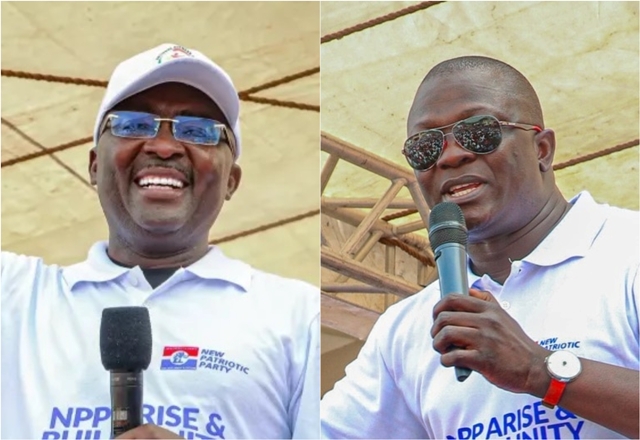
Former Vice President and 2024 presidential candidate of the New Patriotic Party (NPP), Dr. Mahamudu Bawumia, has launched a blistering response to su
Former Vice President and 2024 presidential candidate of the New Patriotic Party (NPP), Dr. Mahamudu Bawumia, has launched a blistering response to suggestions by Abetifi MP and flagbearer hopeful, Dr. Bryan Acheampong, that his ethnicity contributed to the party’s crushing defeat in the last general election.
Speaking at an NPP conference in New York over the weekend, Dr. Bawumia said he was “deeply troubled” by what he described as the dangerous use of tribal and religious propaganda by some presidential aspirants seeking to advance their political ambitions.
“I am very concerned that some of our aspirants have embarked on religious and tribal bigotry in a desperate attempt to win votes. They completely ignore the data and facts about why we lost the 2024 elections,” Dr. Bawumia told the gathering.
Bryan Acheampong’s Controversial Remarks
The controversy erupted after Dr. Bryan Acheampong, a key contender for the NPP flagbearership, told party members at his Rock City Hotel in Kwahu Nkwatia on August 23, 2025, that the NPP’s defeat was partly due to Dr. Bawumia’s Mamprusi ethnic background.
According to Acheampong, the long-standing tribal tensions between Mamprusis and Kusasis in the Upper East region undermined Dr Bawumia’s chances at the polls, particularly in northern constituencies, Oti, and Bono East.
“President Kufuor won all NPP votes in Kusasi and President Akufo-Addo also did the same. But because the fight is between Mamprusis and Kusasis, and we elected a flagbearer from one of them, we lost the north, Oti, and Bono East,” Dr. Acheampong argued.
He, however, added that the defeat was “not about Bawumia’s competence but timing and circumstance.”
Bawumia Counters With Data
Dr. Bawumia rejected that assertion outright, describing it as both false and misleading.
He stressed that the NPP’s struggles in the Bawku zone and Kusasi-dominated constituencies predate his political career.
Providing a breakdown of electoral results since 1965, he reminded delegates that the NPP (and its antecedent parties) had consistently failed to make significant inroads in the area, winning no seats in six out of 11 parliamentary elections.
“In 1965, we had zero seats. In 1969, two seats. In 1979, under Kusasi leadership, zero seats. In 1996, zero again. In 2000, one seat. In 2004, zero. In 2008, one seat. In 2012, zero. In 2016, two seats. In 2020, one seat. And in 2024, zero. So the idea that my candidacy caused the loss is simply not supported by history,” Bawumia said.
He further emphasized that the NPP’s loss in 2024 was not determined by votes in Bawku or Kusasi areas, noting that the party’s deficit in the entire Bawku zone amounted to just 30,000 votes.
“That cannot explain why we lost the national election,” he argued.
Historical Context: NPP And Northern Ghana
The NPP has historically faced challenges in northern constituencies, particularly in Kusasi-dominated areas like Bawku Central, Zebilla, Tempane, Garu, Pusiga, and Binduri. Data from the Electoral Commission confirms that since the return to multi-party democracy in 1992, the party has rarely secured more than one seat in the area.
Even under former President John Agyekum Kufuor in 2004 and Nana Akufo-Addo in 2012, the party performed poorly in the Kusasi belt.
Indeed, critics point out that Bryan Acheampong’s claim that Kufuor and Akufo-Addo “won all Kusasi votes” is not borne out by the numbers.
On the contrary, Dr. Bawumia’s 2024 campaign marked a breakthrough, securing over 13,000 votes in Bawku Central — the highest ever for the NPP in that volatile constituency. For the first time, the party even fielded a Kusasi parliamentary candidate, signaling efforts at bridging ethnic divides.
Party Backlash And Counter-Claims
Dr. Bawumia’s supporters have strongly condemned Bryan Acheampong’s comments, accusing him of deliberately stoking ethnic divisions within the party.
Many argue that the NPP’s loss had more to do with national economic hardship, voter discontent, and unfulfilled promises than with ethnic considerations.
“This either reflects Bryan’s ignorance or a calculated attempt to weaponize tribal sentiments for political gain,” one activist fumed on social media.
In a quick response, the Acheampong campaign issued a statement through spokesperson Pius Enam Hadzide, insisting that his remarks were misinterpreted.
The statement stressed that Bryan Acheampong never blamed Bawumia but rather highlighted how the NPP’s opponents exploited ethnic rivalries to the party’s disadvantage.
“Dr. Acheampong described Bawumia as a ‘victim of circumstance’ and has always expressed respect for him. His call is for unity and strategy, not division,” the statement said.
With the party still reeling from its 2024 defeat to the NDC, the debate over whether ethnicity, leadership, or economic management cost the NPP power is now dominating internal conversations.
For Dr. Bawumia, the tribal card is not only an attack on his candidacy but a dangerous precedent that could damage the NPP’s unity ahead of 2028.
For Bryan Acheampong, the episode is a test of how far his message of “regional consolidation” can resonate in a fractured party.

COMMENTS