
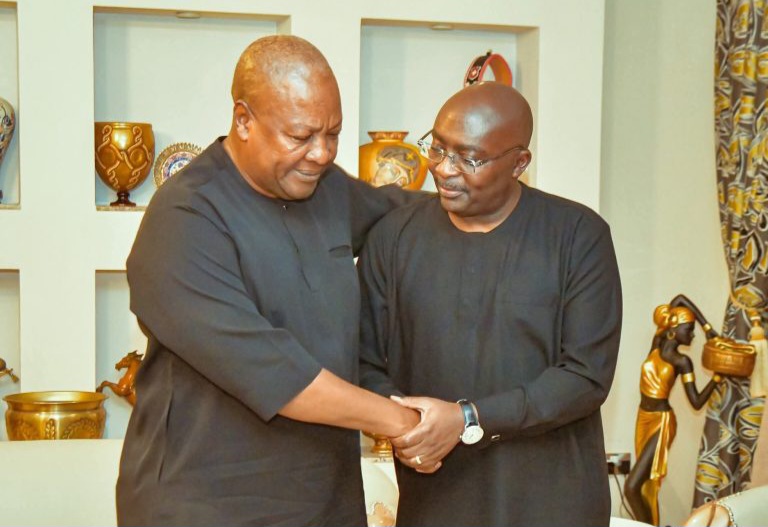
Former Vice President Dr. Mahamudu Bawumia’s recent gesture of visiting President John Dramani Mahama to commiserate with him over the August 6 milita
Former Vice President Dr. Mahamudu Bawumia’s recent gesture of visiting President John Dramani Mahama to commiserate with him over the August 6 military helicopter crash has sparked nationwide admiration, with many Ghanaians likening his conduct to the late President John Evans Atta Mills’ renowned “Asomdwehene” (King of Peace) legacy.
The visit took place on Saturday, August 9, just three days after the crash claimed eight lives, including senior military officers, in one of the country’s most devastating aviation tragedies in recent years.
Dr. Bawumia, accompanied by aides, called on President Mahama at his residence, offering condolences and solidarity in a moment of national mourning.
The act, seen against Ghana’s often heated political backdrop, resonated deeply with citizens who recall Prof. Atta Mills’ governance style — one marked by calm diplomacy, humility, and a deliberate avoidance of divisive political rhetoric.
Prof. John Evans Atta Mills, who passed away in office in July 2012, was widely revered for prioritising consensus-building over political confrontation, earning him the title “Asomdwehene.”
Civil society leaders, political commentators, and ordinary Ghanaians took to social media and radio platforms to applaud the Vice President’s statesmanship.
Many noted that in an era when partisan differences frequently overshadow acts of compassion, Dr. Bawumia’s visit demonstrated the kind of unity and maturity the nation needs in times of crisis.
Vice President of IMANI Africa, Kofi Bentil, in a widely circulated social media post, described both Dr. Bawumia and President Mahama as “among the finest politicians in the whole world,” praising them for rising above political rivalry to set an example of national cohesion.
He contrasted their conduct with leaders in other countries, where political opponents often allow disputes to deepen divisions during national tragedies.
“This is the kind of leadership we must cherish — temperate, considerate, calm-mannered, yet capable men who can guide the country through both triumph and tragedy,” Bentil remarked, urging Ghanaians not to take such qualities for granted.
The helicopter crash, which is under investigation by the Ghana Armed Forces and independent aviation experts, has united the political class in grief.
Leaders across the divide, including ministers, MPs, and party executives, have joined in mourning the victims.
The fallen men included two Muslims buried on August 10 in line with Islamic rites, and six others who will receive full military honours later this week.
For many observers, Dr. Bawumia’s outreach to Mahama signals a rare moment where political differences fade in the face of shared humanity — echoing the very principles Atta Mills embodied.
It is a reminder that Ghana’s progress depends not on “slashing and condemning” opponents, but on fostering respect and working collectively toward national healing and development.

COMMENTS