
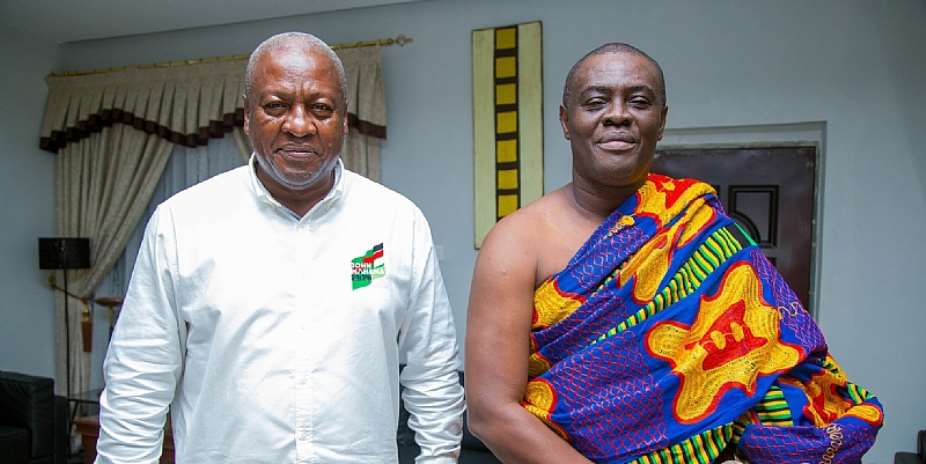
A sod-cutting ceremony intended to highlight the rollout of President John Dramani Mahama’s proposed 24-hour economy initiative in Dormaa took an unex
A sod-cutting ceremony intended to highlight the rollout of President John Dramani Mahama’s proposed 24-hour economy initiative in Dormaa took an unexpected turn when the Dormaahene, a bossom friend of the president used the platform to question the relevance of the project and instead called for the completion of existing infrastructure began under former President Nana Addo Dankwa Akufo-Addo.
President John Mahama, who was in Dormaa as part of efforts to promote his administration’s flagship economic policy, had arrived to cut sod for the start of a night market—an initiative designed to stimulate local commerce and extend trading hours in line with the broader 24-hour economy agenda.
The event, held at a durbar ground with traditional leaders, government officials, and party supporters in attendance, was expected to follow the usual ceremonial pattern of speeches and endorsements.
However, the tone of the event shifted during remarks by the Dormaahene, Osagyefo Oseadeeyo Agyemang Badu II who, after observing customary courtesies, drew attention to the existence of a modern market facility already serving the area.
He noted that the facility was constructed during the tenure of former President Akufo-Addo and commended the quality and impact of that project on the local economy.
The chief’s comments subtly introduced a contrast between ongoing government initiatives and previously completed infrastructure, raising questions about the necessity of embarking on new projects when existing ones could be expanded or better utilized.
More pointedly, the Dormaahene urged the Mahama administration to prioritise the completion of unfinished projects inherited from the previous government. He specifically referenced the Agenda 111 hospital project at Amasu, which remains incomplete despite nearing completion under the Akufo-Addo administration.
Agenda 111, launched to address gaps in healthcare infrastructure across Ghana, has seen several facilities at various stages of completion nationwide.
According to the Dormaahene, completing such projects would have a more immediate and meaningful impact on the lives of residents than initiating new developments.
His remarks underscored a broader national conversation about continuity in governance and the efficient use of public resources.
The intervention, though delivered in a measured and respectful tone, shifted attention from the intended focus of the event. Instead of solely highlighting the government’s new policy direction, the ceremony also became a platform for reflecting on uncompleted state projects and the importance of finishing what has already been started.
While the sod-cutting proceeded as planned, the Dormaahene’s remarks left a lasting impression, reinforcing the message that sustainable development is not only measured by new projects, but also by the completion and functionality of ongoing ones.

COMMENTS