
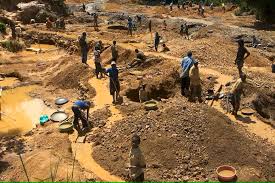
The worsening illegal mining (galamsey) crisis in Ghana has sparked nationwide condemnation, with growing concerns over environmental destruction, pub
The worsening illegal mining (galamsey) crisis in Ghana has sparked nationwide condemnation, with growing concerns over environmental destruction, public health risks, and perceived state complicity under the current National Democratic Congress (NDC) government.
A strongly-worded statement issued by the Ranking Member on the Lands and Natural Resources Committee, Kwaku Ampratwum-Sarpong, described the situation as a “full-blown national emergency” and accused the NDC of hypocrisy and failure to fulfill its promises to end the menace.
The NDC, which assumed power just six months ago, had campaigned on the back of strong criticism of the previous New Patriotic Party (NPP) government’s handling of galamsey.
He said the NDC in opposition vowed to end illegal mining and restore Ghana’s forests and water bodies within days, but the situation has escalated including the spread to President John Maahama’s hometown of Bole.
However, critics now say the situation has worsened dramatically under their leadership, despite a significant budgetary allocation.
According to the statement, Parliament this year approved GHC 50 million for anti-galamsey operations—five times more than the GHC 10 million allocated by the previous government.
Yet, observers and stakeholders say this increased funding has not translated into meaningful action or results.
One of the most alarming revelations in the statement is that illegal mining activities are reportedly rampant in President John Mahama’s hometown of Bole Bamboi, particularly in the Tumtumba area.
The Yonkamba stream, a crucial tributary of the Black Volta, has been polluted by galamsey operations allegedly ongoing with little resistance or state intervention.
“This government cannot even protect the rivers in the President’s own backyard,” Ampratwum-Sarpong stated. “What hope is there for the rest of Ghana?”
Civil society groups and labour unions have begun to raise red flags. On May Day, the Trades Union Congress (TUC) publicly criticised the government for its “half-hearted” approach to fighting galamsey.
Their statement was met with political backlash from government sympathisers, who accused the union of partisanship—a move the Ranking Member condemned as “an insult to the struggle for environmental justice.”
More recently, the University Teachers Association of Ghana (UTAG) joined the growing outcry, issuing an ultimatum to government.
The association is threatening strike action if President Mahama’s pre-election anti-galamsey pledge—signed in 2024 with UTAG and the Ghana Coalition Against Galamsey—is not honoured.
UTAG’s demands are clear: declare galamsey a national emergency, publicly denounce the practice, repeal Legislative Instrument (L.I.) 2462, prosecute complicit government officials, and enforce the law without fear or favour.
Their warning is that the consequences of inaction will not only be ecological but generational, affecting unborn Ghanaians.
While UTAG and TUC have maintained that their criticism is based on national interest, their statements have reportedly been politicised by elements within the ruling party, further deepening tensions between civil society and government.
The statement also lamented the perceived inaction of other Civil Society Organisations (CSOs), many of whom have gone quiet after years of vocal advocacy.
The media, once considered a key pillar in the anti-galamsey fight, is reportedly under pressure, with some journalists allegedly facing censorship or threats for exposing environmental crimes.
Further complicating matters are allegations of government complicity. In Suaman District, for instance, reports suggest that the District Chief Executive is personally supervising the use of DRIP machines—equipment originally intended for road construction—for illegal mining activities. Additionally, excavators seized during official crackdowns are said to have “vanished” under suspicious circumstances.
Ampratwum-Sarpong’s statement also singled out the government’s Goldbod initiative, a gold trading platform intended to sanitize the artisanal mining industry.
The programme, hailed as a major innovation, has come under fire from civil society actors who allege that Goldbod is purchasing gold sourced from galamsey operations—thereby indirectly supporting the very trade it was supposed to eliminate.
The Ranking Member warned of the long-term public health implications, citing recent medical reports from neurologists linking rising gallbladder-related conditions to toxins from illegal mining zones.
He also praised the work of investigative journalist Erastus Asare Donkor, whose exposés have revealed state-level interference in anti-galamsey operations and the silent destruction of forest reserves such as Jimira and Tano Anwia.
Despite the media attention, the NDC government has reportedly failed to act decisively on these revelations.
Ampratwum-Sarpong concluded with a stark warning: “Galamsey is not just an environmental issue. It is a governance issue. A test of leadership, of accountability, of moral responsibility. And the NDC is failing miserably.”

COMMENTS