
Minority Leader Alexander Afenyo-Markin has issued a strong warning that, despite government assurances of economic improvement, many ordinary Ghanaia
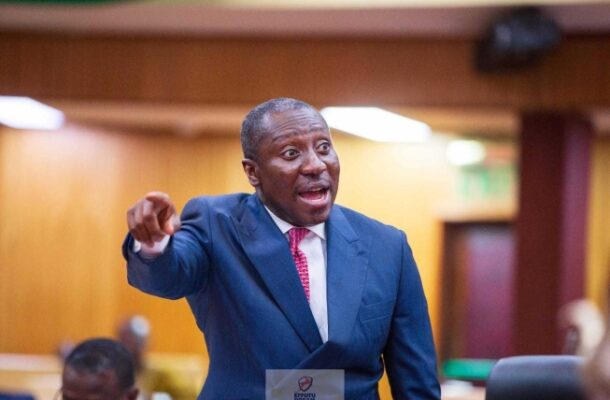
Minority Leader Alexander Afenyo-Markin has issued a strong warning that, despite government assurances of economic improvement, many ordinary Ghanaians continue to endure worsening living conditions under the John Mahama-led National Democratic Congress (NDC) administration.
Speaking at a Leaders’ Press Briefing on Tuesday as Parliament resumed sittings, the Effutu MP said the reality on the ground shows that families are still struggling with high costs, job losses, and growing economic burdens.
According to Afenyo-Markin, the Minority’s major concern is that the NDC majority in Parliament has focused its legislative agenda on rolling out new social intervention programmes while rushing critical bills through the House without adequate consultation.
He revealed that as many as 33 bills have been fast-tracked under Certificates of Urgency—a procedure traditionally reserved for emergencies.
The Minority Leader stated that this approach limits engagement and weakens the democratic process, emphasizing that the Minority expects assurances from the Majority Leader, Mahama Ayariga that Parliament will permit broader scrutiny and participation.
He also raised concerns about what he described as controversial omissions in the government’s legislative priorities, pointing particularly to the Anti-LGBTQ bill.
Afenyo-Markin noted that despite bipartisan public support and the NDC’s campaign stance, the bill was not brought to a final vote in 2025.
While the majority claims it is being properly handled through consultations, he accused the government of acting in bad faith, suggesting that the issue may have been used merely as an election tool and is now being delayed because of pressure from stakeholders.
Turning to governance and economic performance, the Minority Leader argued that the NDC, after one year in office, has failed to introduce major shifts in policy direction despite condemning the New Patriotic Party (NPP) record while in opposition.
He acknowledged that the establishment of the Gold Board has contributed to stabilising the cedi through the centralisation of gold and oil purchases.
However, he maintained that other key sectors, such as agriculture, have not received significant investment, and government promises remain largely unfulfilled.
Afenyo-Markin questioned the progress of the NDC’s flagship 24-hour economy programme, which was promoted as a major job-creation strategy based on a three-shift system.
He said there has been little evidence of implementation, adding that Ghanaians have yet to see tangible economic growth or new employment opportunities.
He further criticised the government’s handling of unemployment, particularly among the youth. Citing reports that youth unemployment currently stands at 34.4 per cent, he described the situation as unacceptable and asked where the promised jobs are, given the many programmes announced with fanfare, such as the National Apprenticeship Programme.
According to him, these remain largely paper promises with limited results.
The Minority Leader also condemned what he called widespread job losses in the public sector following a directive from the Chief of Staff.
While the directive was said to target individuals recruited after the 2024 elections, Afenyo-Markin claimed even workers employed as far back as 2017 were dismissed.
He disclosed that the Minority’s motion calling for a parliamentary investigation into the dismissals is still pending, and appealed to the Speaker to grant them an audience so that an independent body can be established to probe the matter.
On the economy, Afenyo-Markin acknowledged claims that inflation has dropped sharply but insisted that families are not experiencing real relief.
He pointed to the rising cost of utilities, noting that electricity tariffs have increased by as much as 27 per cent, placing additional strain on households.
He also criticised the government’s taxation measures, arguing that while the e-levy was repealed, it has effectively been replaced with new burdens such as what he termed the “dumsor levy.” Under this policy, motorists pay one Ghana cedi per litre of petrol purchased, which he said is costing citizens more than the levy the government removed.
The Minority Leader further accused the government of weakening private sector development by cancelling the One District, One Factory (1D1F) initiative without introducing any clear alternative.
He said he has not heard of any major private sector programme announced by the Trade and Industry Ministry to stimulate growth and job creation, describing its role in the 2026 budget as virtually non-existent.
Beyond economic issues, Afenyo-Markin expressed frustration with parliamentary procedures, claiming the Minority has often been prevented from properly advocating motions on the House floor.
He cited instances where motions were rejected at the last minute, calling the practice unfair and damaging to democracy.
Despite these criticisms, the Minority Leader maintained that his side has not been obstructive.
He noted that most ministerial nominees last year were approved by consensus and in record time, demonstrating the Minority’s willingness to cooperate for the sake of governance.
He said the Minority has supported bills that followed due process while remaining committed to its constitutional duty of holding government accountable.
“The honeymoon is over,” Afenyo-Markin declared, warning that Ghanaians continue to suffer under rising costs, unemployment, and unfulfilled promises.
He concluded that history will judge Parliament’s record, but the Minority will not abandon its responsibility to scrutinise government actions in the interest of democracy and the Ghanaian people.

COMMENTS