
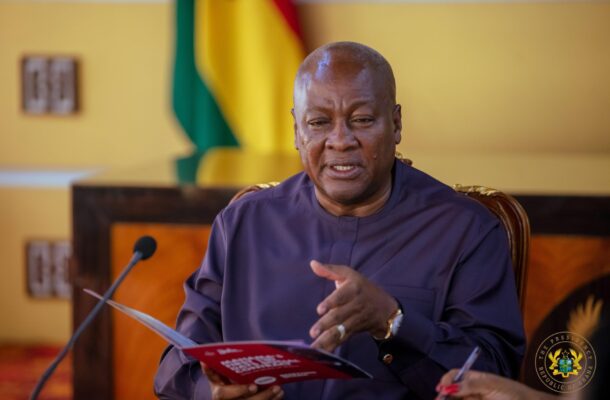
The debate over the lithium resources has resurfaced sharply, with critics accusing the John Mahama administration of inconsistency and betrayal follo
The debate over the lithium resources has resurfaced sharply, with critics accusing the John Mahama administration of inconsistency and betrayal following its decision to adopt a 5% royalty rate for the Ewoyaa Lithium Project—half of the 10% rate the National Democratic Congress (NDC) fiercely condemned while in opposition in 2023.
The growing controversy has revived earlier arguments about transparency, national interest, and the long-term value Ghana stands to gain from its green mineral deposits.
The current backlash stems from the Mahama government’s recent approval of a 5% royalty rate for Barari DV Ghana Limited, the company developing the first large-scale lithium mine at Ewoyaa in the Central Region.
Critics argue that the rate represents a significant climbdown from the government’s own earlier rhetoric and a reversal of the NDC’s historic criticism of the same deal.
In December 2023, when the Akufo-Addo administration signed the original lithium lease agreement with Barari DV Ghana Limited, the NDC openly rejected the terms, describing the 10% royalty rate, the state’s 13% free carried interest, and the overall structure of the agreement as a “poor deal” that failed to protect the economic interest.
The party, led then by opposition communicators including its National Communications Officer Sammy Gyamfi, warned Parliament not to ratify the lease agreement until more robust provisions were put in place to ensure local participation, transparent benefit-sharing and stronger national control over the lithium value chain.
In that 2023 statement, the NDC argued that the existing mining laws had long failed to secure optimal returns for the country and urgently required review—especially for critical minerals such as lithium, which are central to global green energy transition.
The party advocated for new models such as joint ventures and service agreements that would give Ghana greater leverage and ensure equitable benefit distribution.
The NDC also faulted the Akufo-Addo administration for failing to undertake broad-based consultations with the affected Ewoyaa community and other key stakeholders in the extractive sector before concluding the deal.
It further criticised the non-mandatory requirement for a local chemical processing plant, which it said made the agreement weak and unlikely to guarantee long-term value addition within Ghana.
Fast forward to 2025, the Mahama government finds itself under scrutiny for adopting a royalty rate even lower than what it previously described as unacceptable.
The decision to reduce the rate to 5% reportedly followed an appeal by the mining company based on declining global lithium prices, but the move has sparked outrage among analysts, civil society groups and local residents.
Stakeholders argue that if the NDC believed a 10% royalty was inadequate in 2023, it is contradictory for the same party—now in government—to endorse a 5% rate without demonstrating major structural improvements in the value chain, local processing, or national participation.
The original Ewoyaa lease agreement was signed on October 19, 2023, by then-Lands Minister Samuel Abu Jinapor and Neil Herbert, Chairman of Lithium Atlantic, the Australian parent company of Barari DV Ghana Limited.
The $250 million project was expected to begin production in 2025, marking Ghana’s entry into the competitive global lithium market.
The Mahama administration has not yet issued a detailed response to the criticism, but pressure continues to mount from traditional leaders, civil society groups and policy observers who insist that the lithium must be negotiated with foresight, national interest and transparency at its core.
The lithium debate—revived by the government’s own prior words—now stands as one of the most contentious resource governance issues confronting the new administration.

COMMENTS