
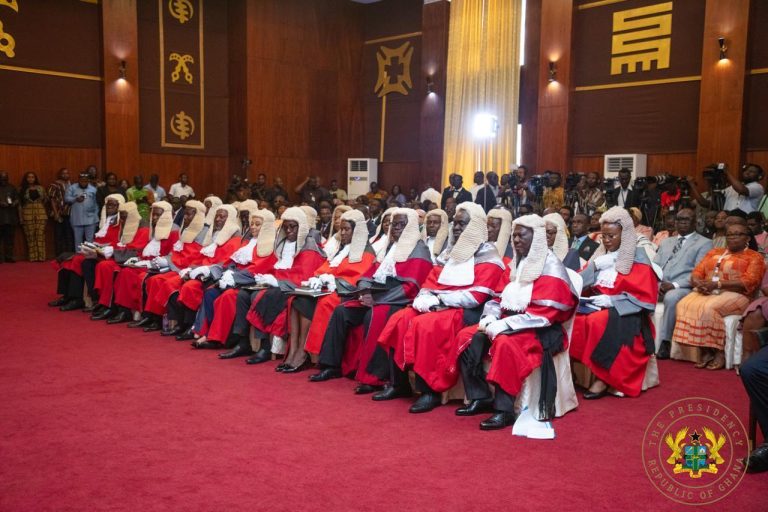
President John Dramani Mahama’s swift appointment of 69 judges to the Superior Courts within just 10 months in office has stirred intense national deb
President John Dramani Mahama’s swift appointment of 69 judges to the Superior Courts within just 10 months in office has stirred intense national debate over the growing politicization of the judiciary.
The move, which includes seven new Supreme Court Justices, 21 Court of Appeal Justices, and 41 High Court Justices, has reignited concerns about executive overreach and the erosion of judicial independence.
While the Presidency insists the appointments are part of a broader effort to “enhance efficiency and access to justice,” critics see a calculated attempt to reshape the judiciary along political lines — a fear fueled by Mahama’s own past comments.
Mahama’s Earlier Remarks Resurface
During a 2023 meeting with a group of NDC lawyers in Akosombo — when he was still in opposition —Mahama openly declared his intention to “balance” the composition of the Supreme Court by appointing more judges aligned with the National Democratic Congress (NDC) once he returned to power.
At the time, his remarks drew applause from party loyalists but triggered alarm among legal professionals and civil society groups who viewed it as an explicit admission of political interference in the judiciary
“We will correct the imbalance at the Supreme Court,” Mahama reportedly told the gathering, suggesting that the judiciary had been “packed” by the previous Akufo-Addo administration.
Those comments, once dismissed as mere political rhetoric, are now being re-examined in light of his administration’s rapid reshaping of the judicial hierarchy.
A Record Number of Appointments
Since assuming office in January 2025, President Mahama has embarked on an unprecedented wave of judicial appointments.
In September alone, he swore in 21 new Court of Appeal Justices, and is set to appoint 41 new High Court Justices next week.
Animal Farm Judge
Among them is a controversial figure, dubbed the “Animal Farm Judge,” who is being elevated to the High Court after retiring from the Circuit Court — a move that has sparked public criticism.
Insiders at the Judicial Service say some of the new appointees are either on retirement or nearing it, yet are being recalled and promoted to higher courts.
This practice, critics argue, undermines merit-based advancement and entrenches political patronage within the judiciary.
From Chief Justice Suspension To Court Recomposition
The wave of appointments follows the controversial suspension of Chief Justice Gertrude Torkornoo earlier this year — a decision that many legal observers described as a politically motivated move to clear the path for a more compliant leadership of the judiciary.
Her replacement, the Acting Chief Justice — nicknamed #CoupCJ by detractors — has since overseen the selection and vetting of dozens of new judges.
Civil society organizations and opposition parties argue that the Acting CJ’s actions reflect a broader project to reconstruct the judiciary to serve the current administration’s interests.
“The rate at which promotions are being dished out is alarming,” said a senior judicial officer who requested anonymity. “It is beginning to look less like reform and more like replacement.”
Birth of A Parallel Legal Structure
Adding to the unease is the emergence of the Ghana Law Society, a new professional body of lawyers perceived to be politically aligned to the ruling NDC.
The association was formed earlier this year to rival the long-standing Ghana Bar Association (GBA), which has traditionally represented the country’s legal professionals.
Sources close to the society say its creation received tacit approval from high-ranking judicial officials.
This development, coupled with the ongoing judicial appointments, has led many to describe the situation as the formation of a “parallel legal system” — one loyal to the executive.
From Critic To Executor
Ironically, it was Mahama himself who, in 2020, accused then-President Akufo-Addo of “court packing,” claiming that the former government had filled the Supreme Court with politically friendly justices.
His promise to “restore balance” now appears to have evolved into an aggressive reshaping of the judiciary that surpasses what he once condemned.
Legal observers say that in less than a year, Mahama has made more Superior Court appointments than any Ghanaian president in the same period.
“What we are seeing is the fulfillment of his Akosombo declaration — he is indeed ‘balancing’ the courts, but in a way that threatens institutional neutrality,” said a former member of the Judicial Council.
A Democracy Under Strain
The mass appointments have sparked public anxiety about the separation of powers and the integrity of Ghana’s judicial system.
Some civil society groups have called for transparency in the appointment process and for parliamentary oversight to prevent abuse of presidential powers.
The Road Ahead
As Ghana navigates this contentious chapter, many fear that the institutional independence of the courts — hard-won through decades of democratic governance — is under serious threat.
While government officials defend the appointments as legitimate and constitutional, the pattern, pace, and politics surrounding them suggest a deeper agenda.
President Mahama’s vow to “balance” the judiciary may have resonated with party supporters in opposition.
But in power, it has raised a national question that cuts across political lines.

COMMENTS