
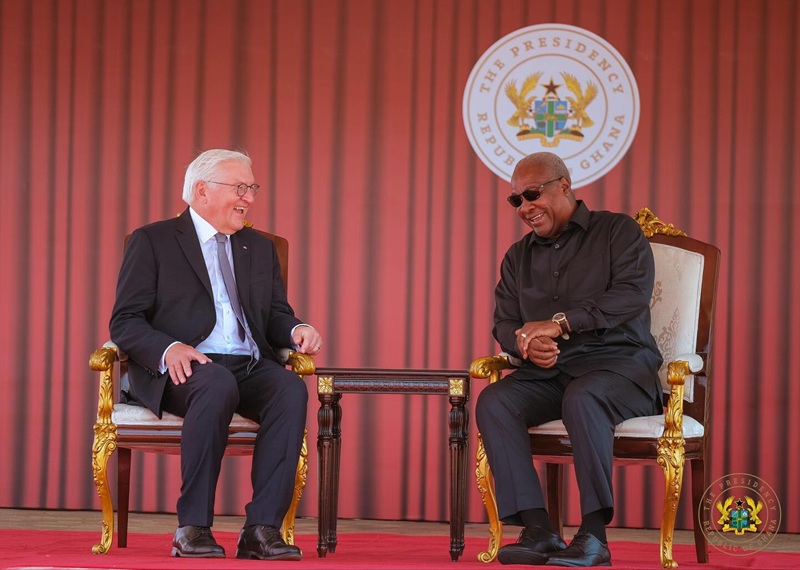
The Republic of Ghana return to constitutional democracy under President John Dramani Mahama’s second non-consecutive term is now under sharp internat
The Republic of Ghana return to constitutional democracy under President John Dramani Mahama’s second non-consecutive term is now under sharp international scrutiny, following strong allegations by British Telegraph newspaper that the West African nation is drifting into authoritarianism.
The report, published on November 2, 2025, claims that since President Mahama assumed office in January, Ghana has taken what it calls “a far-Leftward, anti-democratic turn.”
The newspaper accuses the Mahama administration of systematically undermining democratic institutions, weaponising state power against political opponents, and shielding allies accused of corruption.
Judiciary Under Siege
Central to the Telegraph’s revelations is the controversial dismissal of the Chief Justice, Her Ladyship Gertrude Torkornoo.
According to the report, the dismissal was orchestrated through a “petition” that has never been made public.
The opaque nature of the process, coupled with the president’s swift appointment of “half a dozen more compliant justices” to the Supreme Court, has raised serious questions about executive interference in the judiciary.
Observers fear that this move represents an attempt by the Mahama administration to weaken judicial independence and ensure loyalty within the country’s highest court.
Critics within the legal fraternity have expressed concern that the replacement of key justices could tilt the balance of the court in favour of political expediency rather than justice.
Protection for Allies, Persecution for Opponents
The Telegraph report further claims that the Mahama-led government has “bent the law to protect his own” while using legal processes to suppress opponents. It cites the sudden withdrawal of multiple corruption and fraud cases involving senior members of the ruling National Democratic Congress (NDC). Many of these cases stemmed from allegations linked to financial mismanagement and the collapse of local banks during Mahama’s previous tenure from 2012 to 2016.
At the same time, opposition figures — particularly those associated with the former administration — have reportedly faced targeted investigations and arrests.
The most high-profile case is that of former Finance Minister Ken Ofori-Atta, who, according to earlier Telegraph reports, has been the subject of what many consider politically motivated accusations. His home was raided, and his reputation tarnished despite the absence of formal charges or any substantiated evidence of wrongdoing.
A Shift Toward Authoritarianism
The newspaper argues that these developments are part of a broader pattern of “lawfare” — the use of legal instruments to neutralise political rivals. Since returning to power, President Mahama has been accused of consolidating control over state institutions, including the judiciary, prosecution agencies, and security apparatus.
Political analysts both in Ghana and abroad say this pattern echoes the governance style of leftist populist regimes, where the lines between law enforcement and political control blur. The Telegraph highlights that this trend marks a serious regression for Ghana, long regarded as a model of democracy and rule of law in Africa.
Ideological Leanings and Foreign Relations
The report also draws attention to President Mahama’s ideological background, describing him as “a socialist and a Soviet sympathiser.” Mahama’s earlier studies in Russia and his decision to publish a Russian-language edition of his autobiography, My First Coup d’État, during his election campaign are cited as examples of his continued affinity for Moscow.
In addition, his recent international commentaries — including a Guardian op-ed attacking Western business figures like Elon Musk and Donald Trump — have been viewed as aligning Ghana with left-leaning, anti-Western rhetoric. These actions, coupled with Ghana’s growing debts to Western nations, have raised questions in diplomatic circles about where the country’s true loyalties lie.
Britain’s Costly Partnership
The Telegraph’s critique also extends to Britain’s financial relationship with Ghana. The paper reveals that the UK has quietly extended Ghana’s $256 million debt repayment by 15 years and approved new export credit guarantees for British companies undertaking infrastructure projects in the country.
Critics in London are questioning whether this financial lifeline is a wise investment, given the alleged erosion of democratic accountability in Accra.
“Every British government wants to support its businesses abroad,” the paper notes, “but there are fundamental questions about the rule of law, judicial independence, and the likelihood of repayment.”
Eroding Confidence and International Fallout
The Country’s international reputation as a stable democracy appears increasingly at risk. The alleged manipulation of the judiciary and the selective application of justice have unsettled foreign investors and development partners who once considered Ghana a safe and predictable environment.
The Telegraph warns that “the pillars of law and democracy on which Ghana’s good standing was built are being steadily demolished,” adding that Mahama’s governance style threatens to reverse decades of progress in democratic consolidation.

COMMENTS