
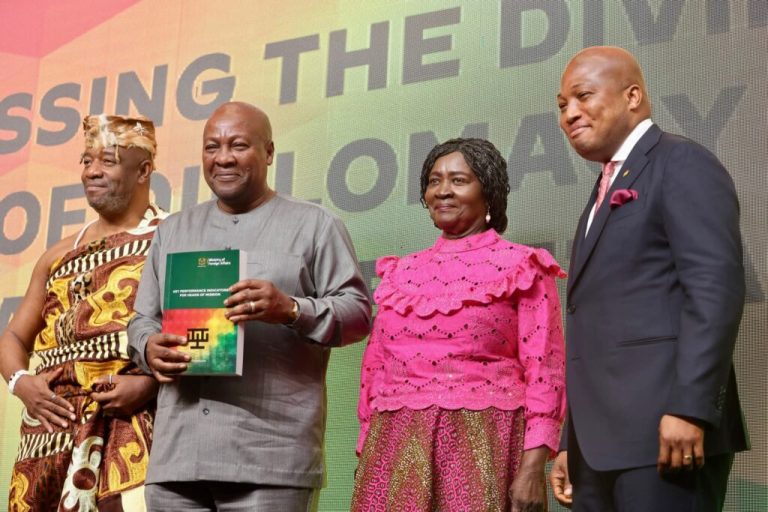
President John Dramani Mahama has taken a historic step in reshaping Ghana’s foreign service by launching the country’s first-ever Key Performance Ind
President John Dramani Mahama has taken a historic step in reshaping Ghana’s foreign service by launching the country’s first-ever Key Performance Indicators (KPIs) for ambassadors and envoys.
The initiative, unveiled at the Ambassadors’ Conference in Accra on Monday, September 1, 2025, marks a decisive shift in how Ghana measures the effectiveness of its missions abroad.
For decades, the diplomacy has been largely associated with ceremonial engagements, protocol duties, and traditional state-to-state relations.
However, John Mahama says this approach no longer serves the needs of a country striving to industrialize and create jobs.
“For far too long, diplomacy has been reduced to pomp and protocol. That era is over. From now on, our missions abroad will be assessed by the investments, trade, and opportunities they help secure for our people,” the President told diplomats gathered in Accra.
The newly introduced KPIs will measure envoys against eight benchmarks.
Among them are economic diplomacy, consular efficiency, diaspora engagement, financial accountability, and security compliance.
Reset Agenda
The new diplomatic framework is directly linked to John Mahama’s “Reset Agenda,” his administration’s blueprint for reviving the economy after years of instability.
Key pillars of the Reset Agenda include a 24-hour economy initiative, a Women’s Development Bank, a nationwide youth apprenticeship scheme, and the Agri-Reset programme to transform agriculture.
“The success of these programmes rests heavily on the partnerships you strike abroad. Deals signed in Washington, Brussels, or Beijing must translate into jobs and opportunities in Tamale, Kumasi, Ho, and Accra,” Mahama stressed.
Driving Investment and Exports
As part of their new mandate, envoys are being tasked to actively market Ghana as a destination for investment in renewable energy, agro-processing, industrialisation, infrastructure, tourism, and digital services. They are also expected to promote Ghanaian exports—ranging from processed cocoa and shea butter to textiles, crafts, and ICT innovations.
This export-driven approach is in line with Ghana’s long-standing goal of diversifying its economy beyond raw material exports. Mahama believes embassies and high commissions must become front-line agents of trade facilitation.
Anchored in Pan-Africanism
While the Reset Agenda focuses heavily on economic outcomes, the President reiterated that Ghana’s foreign policy will remain anchored in Pan-Africanism, climate diplomacy, and strong support for the African Continental Free Trade Area (AfCFTA).
“Economic diplomacy will be the anchor of Ghana’s engagement with the world,” Mahama emphasized, adding that the leadership role within Africa will be strengthened through solidarity and cooperation.
A New Era of Accountability
The introduction of KPIs for envoys is unprecedented in Ghana’s diplomatic history.
Traditionally, ambassadors were evaluated more on protocol observance and political loyalty than on measurable contributions to economic growth. By linking their performance to tangible outcomes, Mahama is signaling a new era of accountability in the foreign service.

COMMENTS