
President John Dramani Mahama is turning to Civil Society Organisations (CSOs) for fresh ideas in his government’s ongoing but controversial fight aga
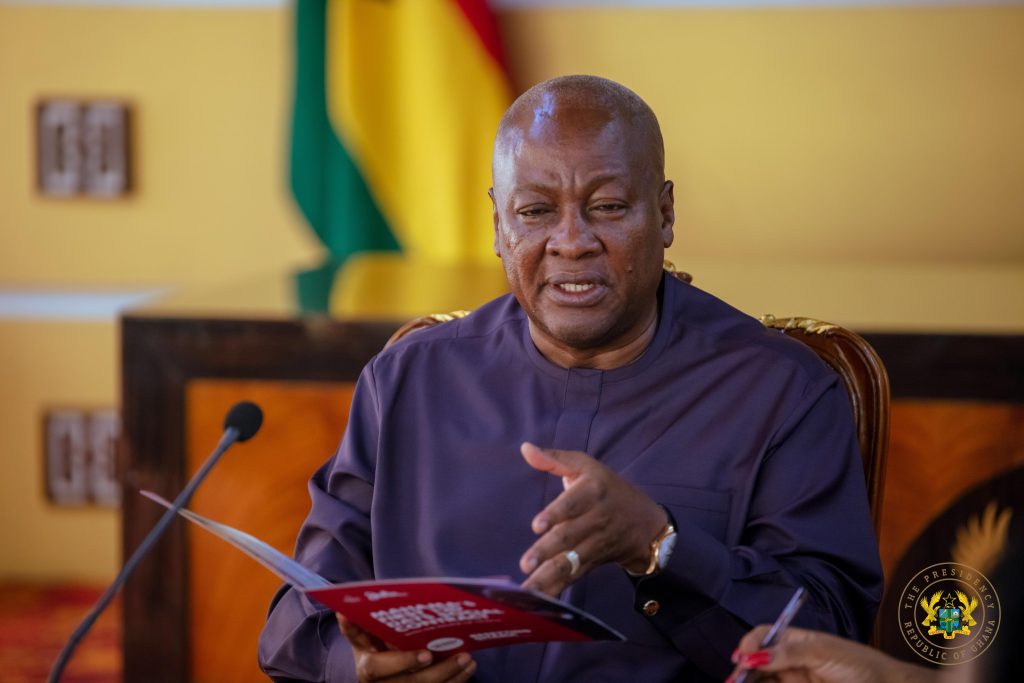
President John Dramani Mahama is turning to Civil Society Organisations (CSOs) for fresh ideas in his government’s ongoing but controversial fight against illegal mining, popularly known as galamsey.
The move comes amid mounting criticism of what many describe as his administration’s slow and ineffective approach to dealing with the crisis.
In an invitation letter issued from the Jubilee House and signed by Secretary to the President, Dr. Callistus Mahama, the Presidency has called over 50 civil society and professional groups to a stakeholder dialogue scheduled for Friday, October 3, 2025, at 12:00 noon. The meeting will take place at the Jubilee House, Accra.
Among the invited groups are the Ghana Catholic Bishops’ Conference, the Christian Council of Ghana, the Office of the Chief Imam, IMANI Ghana, the Centre for Democratic Development (CDD), the Ghana Journalists Association (GJA), Amnesty International, FixTheCountry, the Ghana Bar Association, the Africa Centre for Energy Policy, and the Media Coalition Against Illegal Mining.
According to the Presidency, the purpose of the engagement is to provide a platform for “frank and constructive dialogue” that will enable government and CSOs to exchange perspectives and identify solutions to one of Ghana’s most daunting environmental and social problems.
Why the Engagement Now?
President Mahama’s call for collaboration comes at a time when pressure is building from religious leaders, academics, and opposition figures, all demanding tougher measures against galamsey.
The Catholic Bishops’ Conference recently warned that Ghana was “at the brink of destruction” due to polluted rivers, poisoned soils, and destroyed forests.
The University Teachers’ Association of Ghana (UTAG) has also sounded the alarm, citing the long-term health risks of contaminated water supplies.
Dr. Jerry Joe Harrison, General Secretary of UTAG’s University of Ghana chapter, painted a grim picture in a recent interview, warning that failure to act decisively could result in widespread cancers and neurological disorders in mining-affected communities.
Mahama’s Balancing Act
Despite acknowledging the environmental devastation caused by illegal mining, President Mahama has been reluctant to declare a state of emergency in mining areas, as demanded by some CSOs and faith-based groups.
Instead, he argues that livelihoods must also be protected, pointing to the estimated four million Ghanaians who depend on small-scale mining.
“I’ve never deluded myself that the fight against illegal gold mining would be a one-off event. The decay has eaten so much over the last eight years, and it’s going to take a lot of work,” Mahama recently stated at a media briefing.
He has defended reforms at the Ghana Gold Board (GoldBod), which are meant to formalize gold trading. More controversially, he has proposed that GoldBod should be allowed to buy gold even from galamseyers—a move critics say risks legitimizing illegal mining.
Critics Push Back
Former Tourism Minister Andrew Egyapa Mercer has slammed the proposal, arguing that government endorsement of gold purchases from illegal miners would embolden offenders and undermine years of anti-galamsey campaigns.
“If the President himself says government should buy gold from illegal miners, what signal are we sending? That it is acceptable to destroy our water bodies and farmlands so long as the state can buy the gold?” Mercer questioned.
A Long-Running Crisis
Illegal mining has long plagued Ghana, with successive governments struggling to balance enforcement with the economic realities of rural communities.
Military-led crackdowns and taskforces have often failed to achieve lasting results, as communities dependent on artisanal mining resist heavy-handed measures.
Mahama, during his 2024 campaign, promised a more humane approach that would integrate small-scale miners into the formal economy.
Critics now argue that the promise has backfired, encouraging a surge in galamsey activity across the country.
What Next?
The October 3 engagement is therefore seen as Mahama’s attempt to tap into civil society expertise and regain public confidence.
The presence of faith leaders, academics, journalists, and advocacy groups suggests the meeting could set the stage for a more collaborative anti-galamsey strategy.

COMMENTS