
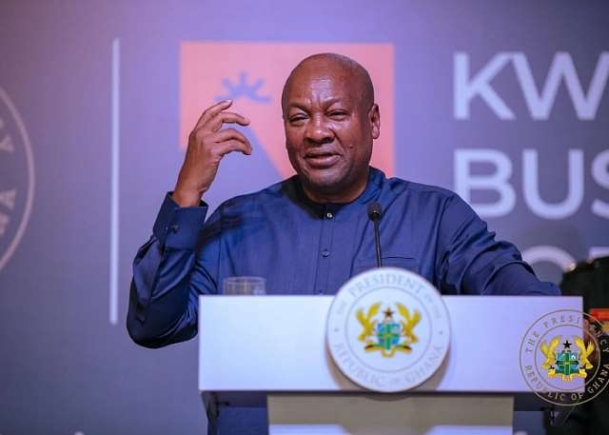
President John Dramani Mahama’s much-touted 24-Hour Economy and Accelerated Export Development Programme—a flagship campaign promise that powered his
President John Dramani Mahama’s much-touted 24-Hour Economy and Accelerated Export Development Programme—a flagship campaign promise that powered his return to power—has come under heavy scrutiny and public criticism following the release of an independent review by the Centre for Policy Scrutiny (CPS).
The comprehensive assessment, led by renowned economist Dr. Adu Owusu Sarkodie and researcher Stephanie Anokyewa Tawia, casts serious doubts on the feasibility, cost, and coherence of the 24-hour economy agenda, describing it as strategically ambitious but institutionally weak and fiscally unrealistic. 


A Promise To Reset Economy
When President Mahama launched the 24-Hour Economy and Accelerated Export Development Programme (24H+) on July 2, 2025, he described it as a “reset programme” — a bold strategy to transform Ghana from a raw-material-dependent economy into a diversified, value-added production hub that runs continuously through multi-shift operations.
The policy, which became the defining feature of Mahama’s 2024 campaign, was designed around eight integrated sub-programmes — GROW24, MAKE24, BUILD24, SHOW24, CONNECT24, FUND24, ASPIRE24, and GO24 — anchored on three pillars: production transformation, supply chain efficiency, and human capital development.
It promised the creation of over five million jobs by 2034, a 6% annual GDP growth rate, and new investments in agro-processing, manufacturing, housing, tourism, and digital services.
However, three months after its official unveiling, critics say the government has failed to move beyond rhetoric, with no clear implementation roadmap or financing plan in sight.
Key Findings of the CPS Review
Addressing a press conference in Accra, the CPS report acknowledges the strategic ambition of the 24H+ policy but raises serious concerns over its execution feasibility, fiscal sustainability, and institutional anchoring.
1. Weak Integration with National Development Planning
The report reveals that the 24H+ was designed outside Ghana’s official Medium-Term National Development Framework led by the National Development Planning Commission (NDPC).
This, the CPS warns, could lead to “duplication, inefficiencies, and poor budgetary integration,” making implementation difficult and financially unsustainable.
2. Fiscal Risks and Underestimated Costs
While government initially pegged the programme’s cost at US$4 billion, the CPS review describes this as grossly underestimated.
It argues that when all public infrastructure, tax incentives, and subsidies are factored in, the actual financial commitment could “far exceed” the stated amount.
The report further points out that with public investment currently averaging only 2.8% of GDP — and projected to fall — there is little fiscal room to deliver the ambitious infrastructure targets under the programme.
3. Lack of Project Appraisals and Financial Planning
CPS notes that many of the capital-intensive projects, including agro-industrial parks, inland ports, museums, and housing units, have been proposed without prior financial appraisals.
Without these, the report warns, Ghana risks repeating past mistakes of misallocated resources and stalled projects.
4. Tax Incentives Without Clear Economic Rationale
The report also questions proposed tax incentives under the policy, such as corporate income tax rebates of 25% and 50% for companies operating two or three shifts.
According to the reviewers, such incentives “lack clear links to productivity or employment outcomes” and could lead to unnecessary revenue losses.
5. Overlap with Existing Government Programmes
CPS highlights major overlaps between the 24H+ and ongoing national programmes like the Agriculture for Economic Transformation Agenda (AETA) and the Feed Ghana Programme, warning that the duplication could create confusion and weaken accountability.


Public And Policy Reactions
The release of the CPS report has ignited intense debate within policy circles and among opposition parties.
Critics accuse the Mahama administration of “overpromising and underdelivering,” noting that the 24-hour economy remains largely theoretical.
They say the administration has yet to articulate a credible roadmap, budget allocation, or institutional framework for execution.
Opposition MPs have also demanded a parliamentary briefing on the policy’s status and funding sources.
Historical Context
They note that Mahama’s 24-hour economy concept mirrors past industrialisation and export diversification efforts under successive governments — from Kwame Nkrumah’s state-led industrialisation in the 1960s, to Kufuor’s Golden Age of Business, Mills’ Better Ghana Agenda, and Akufo-Addo’s One District, One Factory (1D1F) initiative.
What distinguishes Mahama’s approach, according to the CPS report, is the proposed transformation of the Volta Basin Corridor into an agro-industrial hub with integrated transport and logistics infrastructure — a potentially game-changing but capital-intensive vision.
Recommendations from the CPS Review
The CPS team recommends a six-point reform agenda to salvage the 24H+ policy:
1. Integrate the 24H+ into Ghana’s Medium-Term Development Framework under NDPC supervision.
2. Publish transparent cost estimates and adopt phased fiscal planning aligned with available resources.
3. Conduct detailed project appraisals before rollout to attract credible investors.
4. Target tax incentives toward sectors with proven productivity and job-creation potential.
5. Increase public investment commitments to support infrastructure delivery.
6. Institutionalise lessons from past industrial and agricultural programmes to avoid repeating failures.

COMMENTS