
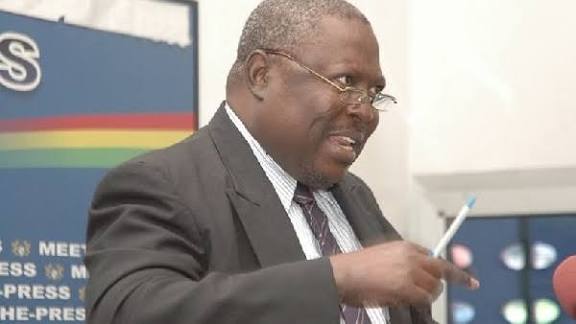
Former Special Prosecutor and one time Attorney-General, Martin A.B.K. Amidu, has launched an attack on Circuit Court Judge Samuel Bright Acquah, desc
Former Special Prosecutor and one time Attorney-General, Martin A.B.K. Amidu, has launched an attack on Circuit Court Judge Samuel Bright Acquah, describing him as a “canker on the legal profession and the Judicial Service of Ghana” following his ruling in the bail application of New Patriotic Party (NPP) Bono Regional Chairman, Kwame Baffoe, also known as Abronye DC.
Background
Abronye was brought before the Circuit Court on charges of publication of false news with intent to cause fear and panic under Section 208(1) of the Criminal Offences Act (Act 29) and offensive conduct conducive to breaches of the peace under Section 207 of the same Act.
He pleaded not guilty, but Judge Samuel Bright Acquah denied him bail and remanded him into custody, adjourning the case to September 19, 2025.
Amidu’s Outrage
In a strongly worded statement dated September 14, 2025, Amidu expressed shock at the ruling after studying the judge’s certified decision.
“I did not intend to write this article but for having read last night the ruling of one Samuel Bright Acquah who passes as a Circuit Court Judge and consequently a lawyer on the Roll of Lawyers in Ghana,” Amidu began.
He continued: “The published certified copy of the ruling of the person styled His Honour Samuel Bright Acquah in the case of The Republic v. Kwame Baffoe @ Abronye particularly from pages 8 to 10 of the ruling constitutes a disgrace to the legal profession and the Judicial Service of Ghana.
“The depth of research, learning, the language used, and the writing style are not only porous but unbefitting to be part of a long essay of a final year law student on the condition on which a court may grant or refuse bail to any suspect.”
Amidu questioned how Judge Acquah rose through the legal ranks: “The question that immediately came to my mind was whether Judge Samuel Bright Acquah was a fit and proper person to have been enrolled on the Roll of Lawyers in Ghana in the first place. How could such a person have passed through the legal education system and been called to the Bar? How did such a person become a Circuit Court judge in Ghana even if he slipped through the Roll of Lawyers?”
On Constitutional Rights And Bail
The former Special Prosecutor emphasized that even ordinary Ghanaians are taught basic principles of justice.
“Ordinary lay men are taught from elementary school about the presumption of innocence of suspects and the burden on the prosecution to prove its case beyond reasonable doubt at a fair trial before a court of law. The grounds on which a court may grant bail to suspects are well known to the general public with any basic education. It is trite that bail must not be punitive or excessive.
He cited constitutional provisions, adding: “Chapter Five of the 1992 Constitution spells out clearly the fundamental human rights and freedoms of the citizen, including the protection of personal liberty (Article 14), respect for human dignity (Article 15), equality and freedom from discrimination (Article 17), and a fair trial with the concomitant right to the presumption of innocence (Article 19). One does not need a law degree to know these rights of the citizen.”
According to Martin Amidu, Judge Acquah’s ruling showed incompetence unworthy of a circuit court judge:
“When I read the ruling of Judge Samuel Bright Acquah I had no doubt in my mind that he is a canker on both the legal profession and the Judicial Service of Ghana. A lay magistrate would not be expected to write such a ruling on bail, let alone a professional magistrate, and much more a circuit court judge who has been on that bench for years.”
Comparing The Ruling To Animal Farm
Martin Amidu also accused the judge of twisting constitutional principles to suit his personal opinions, likening it to George Orwell’s Animal Farm:
“Samuel Bright Acquah sought by his ruling to reduce the 1992 Constitution to the level of a dictatorship and authoritarian judicial autocracy in which a circuit court judge assumes the power to control the liberties of the citizen in a manner inconsistent with the Constitution and the due process of law. If the citizens of Ghana do not set restrictions for themselves, then the Court—meaning ‘Napoleon’ in Animal Farm sitting as Judge Samuel Bright Acquah—will do that for them.”
On the Judge’s Extra-Judicial Remarks
Amidu criticized Judge Acquah for turning a bail hearing into a political lecture: “Judge ‘Napoleon’ Samuel Bright Acquah had no business as a professional judge to lecture the suspect or Ghanaian citizens on their fundamental rights and their noses. He had no business pontificating about Animal Farm and on his personal opinions.
He accused the judge of weaponizing bail: “The fact that Judge ‘Napoleon’ Samuel Bright Acquah was using bail as a punishment despite the suspect’s presumption of innocence; and the fact that Judge ‘Napoleon’ Acquah had descended into the political arena between the governing NDC and the opposition NPP is amply demonstrated in his conclusions when he stated as follows:
‘‘Political parties should also introduce policies that will check that politics of insults and take it out of our society. So if parties engage themselves in such acts and they cannot solve it by themselves and bring it to the court, it is the duty of the court to also play its role in wiping out that politics of insults from society. The court therefore, remands the accused person into prison custody at NIB, counsel may repeat his application on the next adjourned day. Adjourned to 19th September 2025.’”
A Pattern of Abuse
Martin Amidu further argued that this was not the first time Judge Acquah abused his discretion: “A quick Google search on the name Judge Samuel Bright Acquah will disclose the consistent abuse of the rights of citizens to bail on extra-judicial grounds and as a punishment contrary to the citizen’s freedom and right to be presumed innocent.
“As Judge ‘Napoleon’ Acquah confesses in his ruling under reference in The Republic v. Raphael Okai Ankrah where the suspect was alleged to have insulted the then President Nana Akufo-Addo, he gave the suspect ‘2 weeks remand just to cool down tempers.’”
He added: “Judge ‘Napoleon’ Samuel Bright Acquah also confesses in the ruling under reference that, ‘just about 2 or 3 weeks ago another matter from Circuit Court 8 came before me—Rep v. Emmanuel Kwakye the journalist from Wontumi TV—and he was also remanded for same 2 weeks.’ The remand of these suspects who had pleaded not guilty to allegedly insulting the Presidents as preliminary punishment before trial constituted a blatant abuse of the fundamental rights and freedoms of the citizen.”
On the Attorney-General’s Role
Martin Amidu directed part of his criticism at Attorney-General Dr. Dominic Ayine, warning against prosecutorial complacency: “Please, Dr Dominic Akuritinga Ayine, so many unpleasant things are happening under your watch within the short period you have been the Attorney-General. Judge Samuel Bright Acquah has already done enormous damage to the image of the NDC government under your watch as the Attorney-General and nothing you do now can restore that abuse of the rights of the suspects he has denied bail on extra-judicial grounds because your office allowed them to happen without vigilance or on grounds of partisan political vindictiveness.”
Martin Amidu ended his statement with a stark warning: “The foregoing examination of the ruling of Judge Samuel Bright Acquah in the case of The Republic v. Kwame Baffoe @ Abronye exposes the judge as a danger to the legal profession, the Judicial Service as a circuit court judge, the fundamental rights and freedoms of the citizen guaranteed under the 1992 Constitution, and as a person unfit to be a judge of any circuit court in Ghana.
The Republic of Ghana under the 1992 Constitution is not Animal Farm in which ‘ALL ANIMALS ARE EQUAL BUT SOME ANIMALS ARE MORE EQUAL THAN OTHERS.’ I hope and pray to God that Animal Farm is not the country President John Dramani Mahama wants to leave for Ghana as his legacy under Superior Court Justices like Samuel Bright Acquah. Mr President listen to the elders in the room! God save Ghana and the 1992 Constitution!”

COMMENTS