
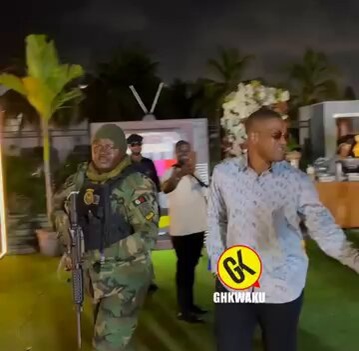
Images and video clips circulating on social media showing Sharaf Mahama, son of President John Dramani Mahama, moving in public under the protection
Images and video clips circulating on social media showing Sharaf Mahama, son of President John Dramani Mahama, moving in public under the protection of an armed military officer have ignited a nationwide debate over the appropriate use of state security resources and the constitutional boundaries that govern them.
The development has drawn sharp public scrutiny, not only because of the visible presence of a soldier escorting a private citizen, but also because of the broader political and legal context in which the incident has occurred.
At the centre of the debate is the 1992 Constitution, which clearly outlines the scope of presidential security.
Article 57 provides special protection to the President as an institution of the state, reflecting the symbolic and functional importance of the office.
However, constitutional scholars have long argued that this protection does not automatically extend to members of the President’s family, particularly adult children who hold no official government position or national security responsibility.
While it is acknowledged that, in exceptional circumstances, the state may extend security coverage to close relatives of a sitting president based on credible intelligence or threat assessments, such arrangements are expected to be discreet, proportionate and firmly grounded in law.
The deployment of heavily armed military personnel for routine public appearances by non-elected individuals has therefore raised questions about necessity, proportionality and institutional discipline, especially given the constitutional role of the Ghana Armed Forces as defenders of national security under civilian control, not personal escorts.
The controversy has been further amplified by recent political developments.
Against this backdrop, the emergence of footage showing the President’s son accompanied by a soldier has intensified perceptions of unequal standards.
Online commentators have questioned why a Chief Justice could face disciplinary action for being accompanied by a family member, while a president’s child appears to enjoy overt military protection without any publicly stated justification.
For many observers, the issue is not merely about one individual’s security detail, but about fairness, accountability and the equal application of rules.
Historically, the use of military or heavily armed security details for civilians has been a contentious issue in the democratic journey.
During previous administrations, including under the New Patriotic Party (NPP), the National Democratic Congress (NDC), then in opposition, strongly criticised state officials such as the Electoral Commission Chairperson, Jean Mensa and former Attorney-General Godfred Dame for using military or armed police protection.
At the time, the NDC described such practices as an abuse of state power and a worrying sign of creeping militarisation in civilian governance.
Those past positions have now resurfaced in public discourse, with some Ghanaians accusing the NDC and President Mahama of failing to uphold the same standards they once demanded.
The debate has taken on a broader political science dimension, touching on the principle of democratic restraint — the idea that power must be exercised with moderation, transparency and accountability, particularly in a constitutional democracy where all citizens are equal before the law.
Comparisons have also been drawn with practices in established democracies, where the families of political leaders are typically protected quietly and proportionately, often by specialised police units rather than uniformed soldiers carrying military-grade weapons.
Such approaches are designed to reduce the visibility of state power in civilian life and to prevent the perception that political families enjoy privileges beyond the reach of ordinary citizens.

COMMENTS