
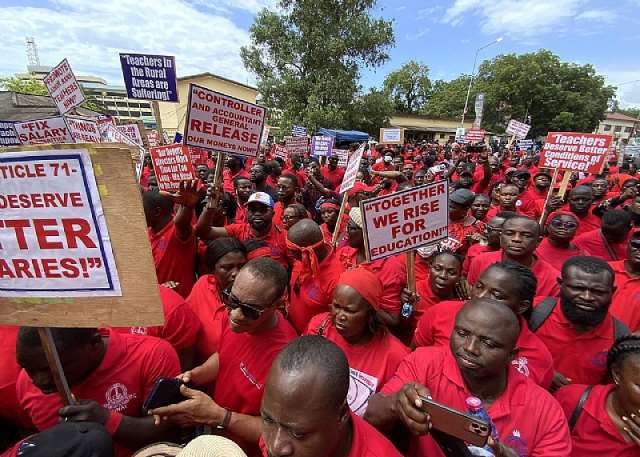
After nearly a year of working without pay, thousands of newly recruited teachers across Ghana can finally breathe a sigh of relief. The government
After nearly a year of working without pay, thousands of newly recruited teachers across Ghana can finally breathe a sigh of relief.
The government has announced plans to clear all outstanding salary arrears owed to over 3,200 teachers who have been rendering services since early 2024 without remuneration.
The Minister for Education, Haruna Iddrisu confirmed that Cabinet has given approval for the release of funds to pay the affected teachers, many of whom are graduates from Colleges of Education and universities.
Speaking at the launch of the ADEA Triennale on Education Conference, Iddrisu disclosed that about ₵1.1 billion has been earmarked to settle the salary arrears of both teachers and some health workers who were recently recruited but had not been put on government payroll.
“A few weeks ago, my office and the Chief Director received a petition from some teachers who were deeply unhappy about working for months without pay,” Iddrisu revealed. “Cabinet has since approved that 3,200 teachers be absorbed and paid their arrears. We will begin the process in due course, and they will be given back pay.”
Long-Standing Salary Delay Sparks Outrage
The announcement follows months of agitation from the Coalition of Unpaid Teachers, a group made up of recent graduates who have been teaching in various basic and secondary schools without salaries for over 10 months.
The coalition, on September 30, 2025, presented a petition to the Ministry of Education and the Ministry of Finance, demanding immediate payment of their salaries and formal absorption into the government payroll.
The affected teachers lamented that despite receiving appointment letters and assuming duty, bureaucratic bottlenecks at the Ministry of Finance and the Ghana Education Service (GES) had prevented their inclusion on the mechanized payroll.
Broader Reforms
Beyond addressing the salary crisis, the Education Minister outlined broader reforms aimed at improving equity and infrastructure in Ghana’s secondary education system.
He revealed that plans were underway to upgrade some Category B schools to Category A status, a move designed to reduce the placement gap that often disadvantages students during school selection.
According to him, there are currently 393,000 qualified students competing for only 76,000 senior high school vacancies, creating immense pressure on top schools.
To address this, the ministry intends to convert 10 Category C schools into Category B, and 10 Category B schools into Category A by 2026.
“The conversion will come with improved infrastructure — new classroom blocks, dormitories, and enhanced teaching and learning materials,” Iddrisu noted. “But we’ll need adequate budgetary support to make this vision a reality.”
Government’s Financial Commitment
The approval of the ₵1.1 billion budget signals a renewed government effort to address long-standing arrears in the education and health sectors, two areas that have faced repeated salary delays in recent years.
The initiative also reflects the administration’s attempt to restore confidence among newly trained professionals who feel neglected after years of service without compensation.

COMMENTS