
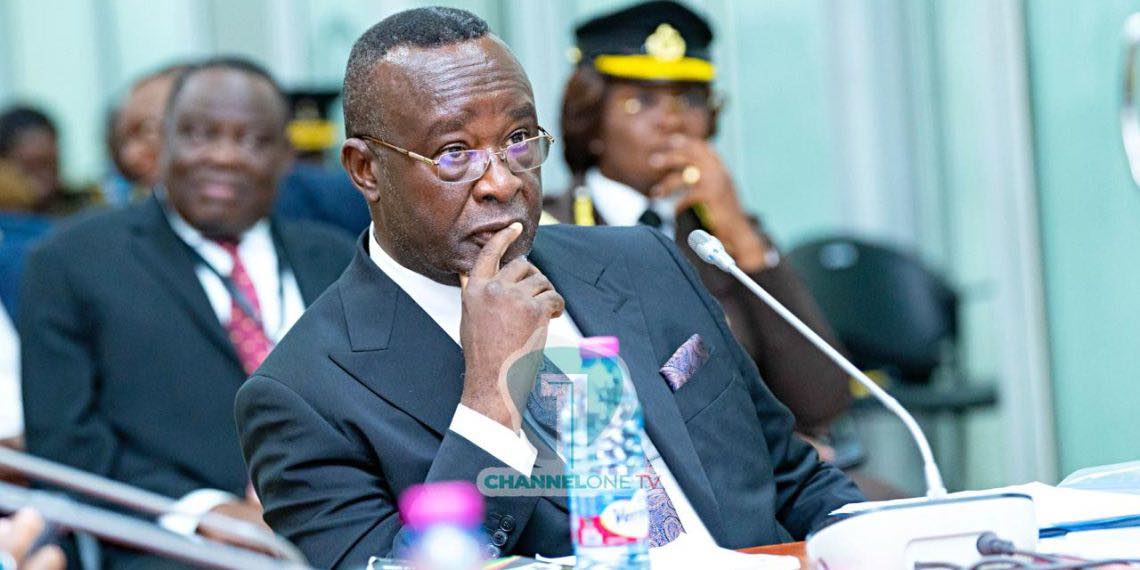
In what has become one of the most talked-about moments during his vetting before Parliament’s Appointments Committee, Chief Justice nominee, Paul Baf
In what has become one of the most talked-about moments during his vetting before Parliament’s Appointments Committee, Chief Justice nominee, Paul Baffoe-Bonnie, has revealed that his decision to sentence notorious armed robber, Ataa Ayi, to 70 years imprisonment nearly two decades ago was influenced by fear for his personal and family’s safety.
Appearing before the committee on Monday, November 10, 2025, Justice Baffoe-Bonnie recounted the events of his “youthful days” on the bench, describing the case as one of the most difficult moments of his judicial career.
“In my youthful days, I sentenced Ataa Ayi to 70 years. If he had been given 30 and returned, my family would have been his first target. By 70 years, I’ll be gone,” he stated, drawing laughter from some members of the committee, though his remark left others visibly stunned.
The nominee, who currently serves as a Supreme Court Justice and acting Chief Justice, explained that his decision was informed not only by the seriousness of the crimes committed by Ataa Ayi and his gang but also by a deep concern for public safety.
He insisted that while judges follow sentencing guidelines, they must also exercise discretion in cases involving dangerous offenders. “Judges are guided by sentencing rules, but there are times when discretion is necessary to ensure justice and protection for the public,” he added.
However, the revelation that the sentence was partly motivated by fear rather than purely legal reasoning has sparked public debate about the integrity and impartiality of Ghana’s justice system.
Netizens have expressed concern that such admissions could undermine confidence in judicial independence and the principle of fairness in sentencing.
Justice Gabriel Pwamang, one of his colleagues on the Supreme Court who was present at the vetting, was seen with a startled expression after the nominee made the statement — a reaction that has since gone viral on social media.
Critics argue that a judge’s personal fears should never influence sentencing decisions, while others have defended Justice Baffoe-Bonnie’s candour as a reflection of the immense pressure judges face when dealing with violent and high-profile criminals.
Background: The Rise and Fall of Ataa Ayi
Ataa Ayi, born Ayi Ayittey, was Ghana’s most wanted criminal in the late 1990s and early 2000s.
He led one of the country’s most feared armed robbery syndicates that operated primarily in Accra and its surrounding regions.
His gang was responsible for numerous violent attacks on residents, hijacking vehicles, robbing banks, and terrorising motorists at gunpoint.
The notoriety of his crimes led to an unprecedented manhunt by the Ghana Police Service.
His face appeared on billboards, television, and newspapers, making him a household name synonymous with fear. In 2005, after years of evading capture, he was arrested in a hideout at Teshie Tsui Bleoo in Accra, along with his girlfriend, who was suspected of being an accomplice.
Ataa Ayi’s arrest was hailed as a major victory for the Ghana Police Service.
His subsequent trial and conviction before then-High Court Judge Paul Baffoe-Bonnie resulted in a 70-year prison sentence for multiple counts of armed robbery and conspiracy.
The harsh sentence, at the time, was seen as a strong statement against violent crime, though many legal analysts later questioned the proportionality of the punishment.
During Monday’s vetting, Justice Baffoe-Bonnie sought to clarify that his judgment was also shaped by the magnitude of the crimes and the need to send a deterrent message. “It was one of those cases that left a lasting mark on my judicial journey,” he said.
Yet, his light-hearted justification — that he preferred a 70-year sentence to ensure he would “be gone” before Ataa Ayi’s release — has reignited discussions about sentencing practices in Ghana.

COMMENTS