
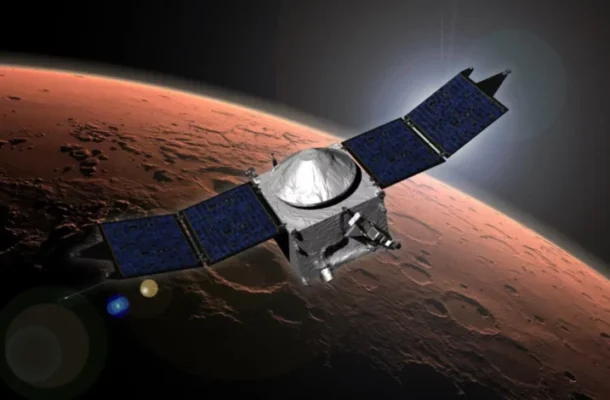
NASA loses contact with spacecraft in Mars orbit after a sudden communication breakdown. This detailed report explores what happened, why it matters,
NASA loses contact with spacecraft in Mars orbit after a sudden communication breakdown. This detailed report explores what happened, why it matters, and how mission teams are working to re-establish the link.
A Sudden Silence From the Red Planet
NASA loses contact with spacecraft in Mars orbit, marking a rare and concerning interruption in one of the space agency’s longest-running Martian missions. The spacecraft, known as MAVEN, has spent more than a decade circling the Red Planet and studying its atmospheric mysteries. Its sudden silence has triggered an urgent response from mission teams, who are now working to re-establish communications and determine what caused the unexpected anomaly.
While NASA has previously navigated communication issues with deep-space missions, this incident adds renewed uncertainty to one of the most scientifically valuable spacecraft currently operating around Mars.
NASA Loses Contact With Spacecraft in Mars Orbit: What Went Wrong?
A Sudden Loss of Signal
The communication breakdown occurred over the weekend when MAVEN unexpectedly stopped responding to signals sent from ground stations on Earth.
In a statement, NASA confirmed that all instrumentation appeared healthy before the anomaly occurred. “Telemetry indicated that all subsystems were operating normally prior to orbiting Mars,” the agency said, noting that no warning signs were detected before the loss of contact.
The sudden change in communication status has prompted mission specialists to begin a comprehensive diagnostic review.
Mission Teams Investigate the Anomaly
Engineers Working Around the Clock
NASA added that spacecraft operations teams are currently analysing the problem. “Spacecraft and operations teams are investigating the anomaly to address the situation. More information will be shared as it becomes available,” the agency said.
At this stage, engineers do not yet know whether the issue stems from the spacecraft’s communication hardware, software systems, or an external factor from the Martian environment.
The priority now is to restore even a minimal signal that would allow mission controllers to stabilise MAVEN and assess the spacecraft’s overall health.
A Decade of Discoveries at Mars
Understanding the Red Planet’s Atmospheric Past
Launched in 2013, MAVEN—short for Mars Atmosphere and Volatile Evolution—arrived at Mars in 2014. Its mission has been central to understanding how the planet lost its atmosphere over billions of years.
Evidence gathered by MAVEN helped solidify scientific theories that the Sun stripped away much of Mars’s once-thick atmosphere. The result transformed the planet from a warm, possibly habitable world into the cold, dry environment seen today.
Its long-term observations are considered vital for future missions, including potential human exploration.
Other NASA Spacecraft Remain Active
A Broader Fleet Supporting Mars Research
Despite the communication loss, NASA still maintains a strong presence in Martian orbit. The Mars Reconnaissance Orbiter, launched in 2005, continues to return detailed images and provide relay services for surface missions. Mars Odyssey, launched in 2001, also remains operational, making it the longest-running spacecraft at the planet.
These orbiters play key roles in monitoring Mars, supporting rover operations, and studying the planet’s geology and climate.
A Critical Moment for a Critical Mission
NASA Loses Contact With Spacecraft in Mars Orbit—The Search for Answers Continues
As NASA loses contact with spacecraft in Mars orbit, the coming days will be crucial. Engineers hope to restore communications and bring MAVEN back into full operational mode. The incident highlights the challenges of deep-space exploration, where distance, radiation, and the unknown can interfere at any moment.
For now, scientists are waiting, watching, and working—the hallmark of every mission that dares to reach beyond Earth.

COMMENTS