
Accra’s deepening transportation crisis has reignited calls for a fundamental rethink of how mobility in the capital is governed, with policy think ta
Accra’s deepening transportation crisis has reignited calls for a fundamental rethink of how mobility in the capital is governed, with policy think tank CUTS International Accra urging the government to establish an Accra City Transportation Authority to centrally plan, regulate and coordinate urban transport across the metropolis.
In a press release issued in Accra on Sunday, January 18, 2026, CUTS said daily commuter hardship, worsening rush-hour congestion and declining reliability of public transport are symptoms of a broader institutional failure that followed the fragmentation of the former Accra Metropolitan Assembly into multiple municipal and sub-metropolitan assemblies.
While Accra continues to function socially and economically as a single city, its transport governance, CUTS argued, has been splintered across more than twenty assemblies operating independently.
The think tank noted that critical urban systems such as road networks, drainage, housing developments and transport corridors cut across several jurisdictions, making isolated decision-making ineffective.
According to CUTS, this mismatch between how the city works and how it is governed has weakened planning, reduced accountability and made coordinated transportation management nearly impossible.
“You cannot run a single city with multiple transport decision centres working in isolation,” said Appiah Kusi Adomako, Director of the West Africa Regional Centre of CUTS International.
He stressed that urban movement does not conform to political boundaries and that transport planning must reflect how residents live, work and commute across the metropolitan area.
Providing historical context, CUTS traced the governance challenge to the period between 1989 and 2017, when Accra expanded from a single metropolitan assembly into about twenty-four assemblies.
While decentralisation was intended to bring governance closer to the people, CUTS insisted the problem was not the creation of multiple assemblies but the failure to establish a city-level transport authority to coordinate policy and planning after the fragmentation.
“The creation of multiple assemblies was not a mistake,” Adomako explained. “The mistake was failing to build a city-level transport authority to coordinate planning after the fragmentation.”
CUTS also linked today’s transport difficulties to decades of weak policy direction in public transportation.
In the 1970s, the Omnibus Service Authority provided structured and predictable urban transport services.
Its gradual collapse, however, created a vacuum that was never fully addressed. Metro Mass Transit, introduced in 2001, initially aimed to fill the gap but gradually shifted its focus from intra-city commuting to long-distance travel between cities.
The launch of the Ayalolo Bus Rapid Transit system in 2015 raised fresh hopes for a modern, reliable urban transport solution.
However, CUTS said the system suffered early setbacks when buses were diverted to other regions and assigned to private institutional use, undermining its intended purpose.
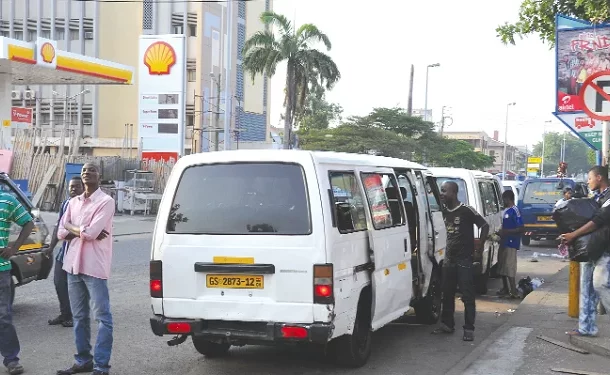
Today, commuters face daily struggles to secure transport after work, while some private operators break journeys into segments, forcing passengers to pay multiple fares for what should be a single trip.
Beyond infrastructure and fleet challenges, CUTS pointed to weak enforcement of the Road Traffic Regulation 2012, Legislative Instrument 2180, as a major contributor to the crisis.
Regulation 121 mandates private operators to operate under defined, route-based systems with clear service standards. In practice, CUTS said, this framework remains largely inactive.
Instead of route-specific licensing, assemblies issue broad permits that allow operators to run on any corridor of their choosing. As a result, drivers concentrate on high-profit routes, leaving many communities underserved. Transport unions, rather than planning authorities, often determine route allocation based on influence rather than commuter demand or mobility data.
“You now have a city where transport supply responds to lobbying power instead of commuter demand,” Mr Adomako observed.

COMMENTS