
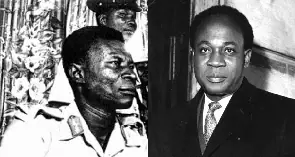
Ghana’s first President, Osagyefo Dr Kwame Nkrumah, was overthrown on 24 February 1966 in a military coup that ended the First Republic and began deca
Ghana’s first President, Osagyefo Dr Kwame Nkrumah, was overthrown on 24 February 1966 in a military coup that ended the First Republic and began decades of political instability.
Nkrumah was in Beijing, China, on a diplomatic mission to Asia when members of the Ghana Armed Forces and Police Service seized control. Major General Emmanuel Kwasi Kotoka, Lieutenant General Joseph Arthur Ankrah, Colonel Akwasi Amankwa Afrifa and Police Commissioner John Willie Kofi Harlley were among the senior figures associated with the operation.
The Convention People’s Party government was dissolved, Parliament dismissed and the 1960 Constitution suspended. The coup leaders formed the National Liberation Council (NLC), chaired by Lieutenant General J.A. Ankrah.
The takeover was Ghana’s first successful military coup since independence in 1957 and remains one of the defining events in the country’s post-independence history.
Why Nkrumah was removed
The coup followed years of political tension, economic difficulty and growing dissatisfaction among parts of the military and the wider public.
Nkrumah had pursued industrialisation, infrastructure, education, Pan-Africanism and economic independence. His government oversaw major projects including the Akosombo Dam, Tema Harbour and the Tema Motorway, reflecting his ambition to make Ghana an industrial power and a leading force in Africa.
But his administration was increasingly criticised for authoritarian rule. The introduction of a one-party state, restrictions on opposition, use of the Preventive Detention Act and concerns over human rights fuelled discontent. Falling cocoa revenues, rising foreign debt and unemployment added to the pressure, while sections of the security services also had grievances.
The coup leaders cited authoritarian government, economic mismanagement and restrictions on individual freedoms. Whether those problems justified overthrowing a constitutionally established government remains contested.
The foreign involvement debate
Nkrumah’s anti-imperialist views, links with socialist countries and calls for African political and economic independence had brought him into conflict with Western powers.
Declassified United States diplomatic records show American officials knew of plots against him before the coup. However, the US government’s historical account says the records indicated Washington was not involved in organising the operation.
Debate over foreign influence continues, particularly because the coup took place during the Cold War, when global rivalries shaped political events across Africa.
A lasting political legacy
The NLC ruled until 1969, when Ghana returned to civilian constitutional government. Dr Kofi Abrefa Busia’s Progress Party won that year’s general election and established the Second Republic.
On 13 January 1972, Colonel Ignatius Kutu Acheampong overthrew Busia. Further military interventions followed in 1979 and 1981, showing how difficult it was for Ghana to maintain uninterrupted constitutional rule. The country eventually returned to democratic government under the Fourth Republic on 7 January 1993.
In February 2025, Parliament marked the 59th anniversary of Nkrumah’s overthrow. North Tongu MP Samuel Okudzeto Ablakwa called it a shameful day in Ghana’s history, while MPs stressed the need to learn from the past and protect constitutional democracy.
The anniversary is not about endorsing every decision made by Nkrumah or overlooking his government’s failures. It is a reminder that military intervention can have consequences lasting across generations.
Ghana’s leaders, security institutions and citizens must protect accountability, political participation, freedom of expression and the peaceful transfer of power. The events of 24 February 1966 remain a warning that political power is temporary, while democratic institutions must endure.

COMMENTS