
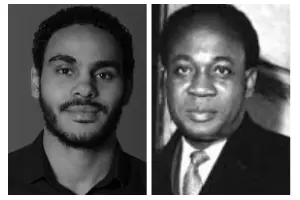
Youssef Nkrumah, the grandson of Ghana’s first President, Dr Kwame Nkrumah, has described the emotional impact of seeing his late father, Dr Gamal Gor
Youssef Nkrumah, the grandson of Ghana’s first President, Dr Kwame Nkrumah, has described the emotional impact of seeing his late father, Dr Gamal Gorkeh Nkrumah, as a child in archival footage featured in the Eyes of Ghana documentary.
Speaking in a viral video on 19 November 2026, Youssef said his latest viewing of the film felt markedly different after his father died about a month ago.
He has watched the documentary about five or six times, but was particularly affected by footage showing his father walking alongside Dr Nkrumah and his grandmother.
“Especially the part where I saw my dad as a little kid walking with my granddad and my grandma… My dad passed away about a month ago, and seeing that, it felt different from the other times that I watched the film,” he said.
Youssef said the scene brought tears to his eyes and made him wish he could speak to his father again.
He praised the production as “a beautiful, very powerful documentary” and said he had enjoyed almost every part of it.
“I never imagined iShowSpeed and Barack Obama would both be involved in producing a documentary about my grandfather,” he added.
However, Youssef said he believed the film could have offered greater historical context when addressing the debate over Dr Nkrumah’s leadership and the description of him as a dictator in history books.
“And that is a fair question because people really did learn that in Ghana,” he said.
He said the documentary could have examined the assassination attempts against Dr Nkrumah, the violence surrounding them and the deaths of innocent people.
“What I would have liked to see is a lot more context. So some mentions of some of the assassination attempts, the brutality, and how many innocent people were dying in the assassination attempts,” he said.
Youssef also questioned the scale of the propaganda directed at Dr Nkrumah and the role played by the United States Central Intelligence Agency (CIA).
“A lot of the propaganda – who was pushing the propaganda against Kwame Nkrumah, the CIA’s involvement. How deep was it?” he asked.
He recalled asking Chris Hesse whether Dr Nkrumah had been a dictator. Hesse replied: “I have filmed Kwame Nkrumah’s life, and it’s for you to watch and judge.”
Youssef said he respected that response, although he would have preferred to hear Hesse’s personal view because of his close work with Dr Nkrumah.
He believes the documentary introduces viewers to Dr Nkrumah and Africa’s history while encouraging them to explore their heritage further.
One recollection that stood out to him was Hesse’s account of Dr Nkrumah’s prediction after the 1966 coup that further coups would take place before Africa could rise again.
Youssef said the vision of a united Africa remained incomplete and that more work was needed to achieve a United States of Africa.
The 90-minute documentary chronicles the life and work of veteran Ghanaian cinematographer Chris Tsui Hesse, who served as Dr Nkrumah’s personal cameraman.

COMMENTS