
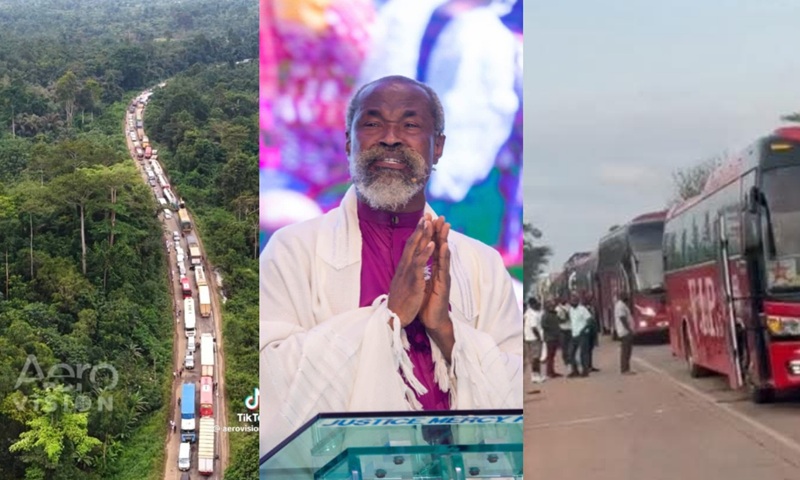
Traffic chaos on the Accra–Kumasi highway following the December 31, 2025, watch night service organized by Prophet Adom Kyei Duah of Philadelphia Cch
Traffic chaos on the Accra–Kumasi highway following the December 31, 2025, watch night service organized by Prophet Adom Kyei Duah of Philadelphia Cchurch has sparked nationwide concern over public safety, traffic management, and national security.
The incident, which saw the highway blocked for nearly eight hours in both directions, has highlighted the risks posed by unregulated mass gatherings along the busiest trunk road.
Vehicles were unable to move for an extended period, leaving travelers stranded.

Ambulances could not reach patients, many individuals missed international flights, and residents faced inhumane conditions in sweltering heat and heavy traffic.
The blockage persisted for over 72 hours in some sections, exacerbating frustration and highlighting the fragility of Ghana’s road infrastructure.
The Accra–Kumasi highway, a critical economic corridor connecting the country’s capital to the Ashanti Region, has long been operating beyond its designed capacity.
Experts warn that any reckless activity along this stretch—already narrow and overstretched—is likely to create gridlock, putting lives at risk and disrupting commerce.
The disruption has been attributed directly to Prophet Adom Kyei Duah, who organized a roadside religious event without coordinating adequate traffic management or seeking comprehensive approvals.

The mass gathering effectively brought movement along the highway to a standstill.
While freedom of worship is constitutionally protected, legal analysts emphasize that it does not extend to actions that jeopardize public safety, national security, or the free movement of people and goods.
Equally troubling was the apparent lack of proactive intervention by the Motor Traffic and Transport Department (MTTD) of the Ghana Police Service, whose mandate includes preventing such foreseeable traffic disruptions on critical national roads.
Questions are now being raised about how future mass events along major corridors will be monitored and regulated.
The past NPP administration began a link by pass roads, which the current NDC government is expected to continue, but plans underway to construct an Expressway instead.
This incident has reignited calls for Ghana to develop alternative transport corridors between Accra and Kumasi.
Motorists argue that reliance on a single highway is no longer sustainable for a country of the size and economic importance.
Many are voicing support for the government’s ongoing Accra–Kumasi Expressway project, which aims to create a modern, high-speed route that separates long-distance traffic from local activity.
However, experts warn that constructing a new expressway alone will not resolve systemic problems.
Strict regulations will be needed to prevent churches, markets, event centres, or other developments from springing up along the new corridor in ways that compromise traffic flow.
Lessons from the recent December 31 disruption underscore the importance of traffic impact assessments, emergency access planning, and comprehensive crowd control measures for any large public gathering.

COMMENTS