
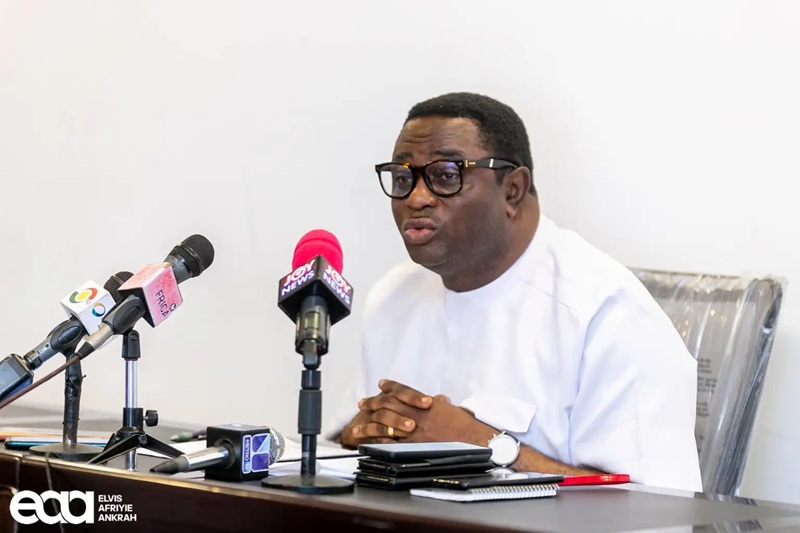
Presidential Envoy for Inter-Faith and Ecumenical Relations, Elvis Afriyie Ankrah, has launched one of the most direct attacks in recent years on Ghan
Presidential Envoy for Inter-Faith and Ecumenical Relations, Elvis Afriyie Ankrah, has launched one of the most direct attacks in recent years on Ghana’s growing class of prophecy-driven pastors, accusing them of weaponising fear and destabilizing the country through baseless predictions of death and disaster.
Speaking at the Thanksgiving Service of the maiden Ecumenical Convention organised by the Christian Council of Ghana (CCG) on Sunday, November 16, 2025, the envoy warned that the prophetic landscape is being polluted by indiscipline, manipulation, and spiritual showmanship that no longer aligns with scripture or national interest.
A Ministry Losing Its Way
Afriyie Ankrah’s comments were not blanket criticism of the prophetic ministry.
He acknowledged that prophecy is an integral part of Christian worship and is regarded as a sacred spiritual gift.
But he argued that, in Ghana, the ministry has been infiltrated by opportunists who leverage prophecies of doom to gain influence, attract followers, and solicit money.
He said that prophecies meant to guide and comfort believers have increasingly become commercialised fear, marketed through livestreams, TikTok sermons, private WhatsApp consultations, and Sunday-night theatrics aimed at grabbing headlines rather than edifying the nation.
“We believe in prophecy. We honor the prophetic office. But it must be exercised in the context of scripture—not manipulation and extortion,” he stressed.
The Death Prophecy Boom — And Why Ghana Is on Edge
The envoy’s frustration reflects a national problem that has intensified over the last decade: the explosion of public death prophecies targeting high-profile political leaders, entertainers, public servants, and even footballers.
The problem spiraled into national controversy following the August 6, 2025 helicopter crash in the Ashanti Region that claimed the lives of eight people, including two cabinet ministers. Within hours, dozens of self-proclaimed prophets recorded videos claiming they had foreseen the tragedy but were ignored.
Their claims went viral, creating public alarm and sparking debates about whether prophets were truly foresighted or simply capitalising on tragedy.
The backlash was so intense that government security agencies were compelled to issue public assurances to maintain calm.
A New Enforcement Regime: Submit Your Prophecies First
In an unprecedented move to restore order, Afriyie Ankrah’s office issued a directive on August 10, 2025, instructing pastors and prophets to submit all sensitive national prophecies—especially those concerning the lives of national leaders, security threats, or the stability of the state—for review before they are made public.
This directive sent shock waves across the religious community, dividing pastors, theologians, and civil society groups. While some saw it as a necessary safeguard against fearmongering, others accused the government of attempting to silence spiritual voices.
But for Afriyie Ankrah, the decision was unavoidable. “My office is not a receiving point for death threats disguised as prophecy. We will not allow fear-driven predictions to plunge this nation into panic,” he declared.
A Flood of Prophecies—But Little Substance
Since the directive came into effect, the Interfaith Secretariat has received over 200 prophecies. Based on the envoy’s assessment, the quality of these submissions is alarming.
“About 70 to 80 percent have no substance. Barely 2 to 5 percent may require further examination.”
To make the process easier, his office set up a WhatsApp line and official email exclusively for prophecy submissions. The move aims to place structure and accountability around a ministry that has often operated without checks.
Prophets Urged to Speak Prosperity, Not Panic
In his message to the clergy, Afriyie Ankrah urged prophets to redirect their focus toward national development and spiritual encouragement rather than fearmongering.
He suggested that prophetic declarations could play a role in inspiring progress, citing Ghana’s historically strong economic standing.
He reminded the audience that in 1957, the GDP surpassed that of Malaysia, South Korea, and Singapore—nations that have since transformed into global economic powerhouses.
“If you have prophecies about Ghana becoming like Singapore or South Korea, come and see me. That is what this nation needs,” he said.
He referenced 1 Kings 18:45–46, arguing that scripture itself encourages declarations of revival, acceleration, and national blessing.
Mahama’s Economic Turnaround Cited as Evidence of ‘Grace’
In making the case for more positive national prophecy, Afriyie Ankrah expressed confidence that Ghana under President John Dramani Mahama is experiencing a gradual but steady recovery.
He cited sharply declining inflation, a stabilising cedi, and renewed investor interest as signs that Ghana is “turning the corner.” He described the momentum as evidence of “abundant grace” that must be supported—not undermined—by faith leaders.
Biblical Grounds For Reviewing Prophecies
Addressing accusations that the directive infringes on freedom of worship, Afriyie Ankrah leaned heavily on scripture, asserting that the Bible itself encourages discernment, moderation, and accountability.
He quoted: 1 Thessalonians 5:20–21: “Do not treat prophecies with contempt, but test them all.” 1 John 4:1: “Test the spirits to see whether they are from God.”
He argued that public prophecies predicting the death of presidents or national leaders amount to security threats.
“Imagine a prophet in America declaring that Air Force One will crash. You know the kind of emergency that would trigger.”
Ghana, he said, cannot allow itself to be dragged into chaos by unverified spiritual speculation.
A Plea for Unity: “Ghana Needs a Praying Church”
Despite his strong words, Afriyie Ankrah emphasised that the government values the spiritual contributions of the church.
He made a passionate appeal for unity among Christian leaders and encouraged them to support the national agenda through prayer, humility, and cooperation.
“Ghana needs a praying church now more than ever. Not a divided one. Not one driven by competition or fear.”

COMMENTS