
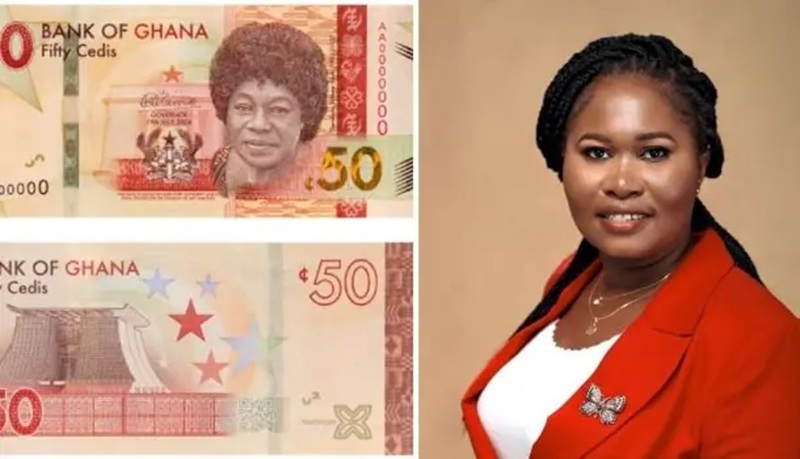
A Bank of Ghana board member has clarified that the portrait on the newly introduced GH¢50 Heritage Series banknote is Theodosia Salome Okoh, the arti
A Bank of Ghana board member has clarified that the portrait on the newly introduced GH¢50 Heritage Series banknote is Theodosia Salome Okoh, the artist who designed Ghana’s national flag, rather than her younger sister, Dr Leticia Obeng.
The issue became the subject of public discussion after Dr Eddie Obeng, Dr Leticia Obeng’s son and a nephew of Theodosia Okoh, wrote on LinkedIn that the image appeared to be a portrait of his mother.
Beatrice Annan, a Bank of Ghana board member and presidential staffer, responded on Facebook. The Bank of Ghana has not yet issued an official statement on the debate.
The note was unveiled on November 12, 2026. The portrait of Theodosia Okoh appears on the front in recognition of her contribution to Ghana’s national identity.
Theodosia Okoh
Theodosia Salome Abena Kumea Asihene (1922–2015) was a Ghanaian artist, teacher and sports administrator. She was born on June 13, 1922, and studied fine arts at Achimota School before becoming a teacher.
The government invited designs for a national flag before Ghana gained independence from British colonial rule, and her proposal was selected. It was adopted for independence on March 6, 1957.
The flag’s red represents the blood shed in the struggle for independence, gold symbolises Ghana’s mineral wealth, and green reflects its forests and agriculture. The central five-pointed black star represents African emancipation and unity.
Okoh was also a painter and collage artist whose work explored Ghanaian life, architecture and postcolonial themes. Known as the “Joan of Arc of Ghana Hockey”, she helped develop field hockey in the country, becoming the first female chairperson of the Ghana Hockey Association. She later served as president of the Ghana Hockey Federation for more than 20 years.
She died on April 19, 2015, aged 92. Her younger sister was Dr Leticia Obeng.
Dr Leticia Obeng
Dr Letitia Eva Takyibea Obeng (1925–2023) was a pioneering Ghanaian zoologist and environmental scientist, widely described as the “grandmother of female scientists in Ghana”.
Born on January 10, 1925, at Anum in Ghana’s Eastern Region, she developed an interest in science while studying plants and insects on her father’s farm.
After attending Achimota School, she went to the United Kingdom on a government scholarship. She gained a BSc in Zoology and Botany in 1952 and an MSc in Parasitology in 1962 from the University of Birmingham. In 1964, she received a PhD from the Liverpool School of Tropical Medicine for research into the freshwater biology of the blackfly, the vector for river blindness in West Africa.
She returned to Ghana in 1952 and became the country’s first female scientist and lecturer at the Kwame Nkrumah University of Science and Technology in Kumasi. She was also the first scientist employed by the National Research Council, now the Council for Scientific and Industrial Research.
In 1964, she founded and directed the Institute of Aquatic Biology to study the environmental effects of the newly created Lake Volta. She joined the United Nations Environment Programme in 1974 after attending the 1972 UN Human Environment Conference in Stockholm, later becoming director of its Regional Office for Africa.
Obeng became a fellow of the Ghana Academy of Arts and Sciences in 1965 and later its first female president. She received the Order of the Star of Ghana in 2006 and died on March 23, 2023, aged 98. The CSIR laboratory in Ghana and a meeting room at the Liverpool School of Tropical Medicine have been named in her honour.

COMMENTS