
New research by the Africa Policy Lens (APL) has placed New Patriotic Party (NPP) flagbearer Dr. Mahamudu Bawumia ahead of all seven potential Nationa
New research by the Africa Policy Lens (APL) has placed New Patriotic Party (NPP) flagbearer Dr. Mahamudu Bawumia ahead of all seven potential National Democratic Congress (NDC) presidential contenders tested in hypothetical head-to-head contests ahead of Ghana’s 2028 general elections.
The findings, contained in the first report of APL’s 2026 Election Outlook Series, suggest that Dr. Bawumia currently enjoys a measurable advantage across each of the seven scenarios examined, although the research organisation cautioned that the results represent a snapshot of voter sentiment and should not be interpreted as a prediction of the 2028 election outcome.
The nationwide survey, conducted between July 27 and August 7, 2026, involved face-to-face interviews with 16,963 respondents drawn from all 276 constituencies across Ghana’s 16 administrative regions.
According to APL, the survey was designed to provide a nationally representative assessment of voter preferences, with the sample based on the 2024 Electoral Commission voter register. The organisation says the methodology provides a 99 per cent confidence level with a margin of error of plus or minus one per cent.
The report comes at a time when political parties are gradually repositioning themselves for the next presidential contest.
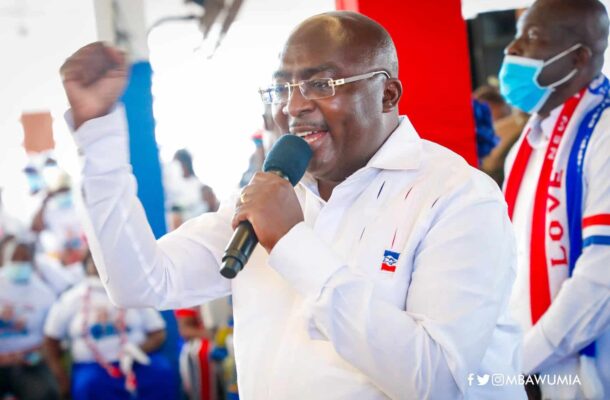
Dr. Bawumia, who emerged as the NPP’s presidential candidate after the party’s internal election, is expected to lead the opposition party’s campaign to reclaim power following its defeat in the 2024 general elections.
The NDC, which returned to government under President John Dramani Mahama after winning the 2024 election, is yet to formally select its candidate for the 2028 presidential contest. APL therefore tested Dr. Bawumia against seven individuals identified in the report as potential NDC contenders.
In the first matchup, Dr. Bawumia recorded 45.8 per cent support against 42.4 per cent for NDC National Chairman Johnson Asiedu Nketiah. About 7.2 per cent of respondents remained undecided, making the contest relatively close and indicating that undecided voters could become significant if the two were eventually to face each other.
A similar pattern emerged in the hypothetical contest involving Finance Minister Dr. Cassiel Ato Forson. Dr. Bawumia obtained 45.7 per cent compared with 42.8 per cent for Dr. Ato Forson, while 7.5 per cent of respondents were undecided.
The former Vice President recorded a wider margin against Agriculture Minister Eric Opoku. In that scenario, Dr. Bawumia secured 49.8 per cent of voter preference, compared with 33.9 per cent for Opoku. Some 9.3 per cent of respondents remained undecided.
The survey also placed Dr. Bawumia ahead of Education Minister Haruna Iddrisu. He obtained 45.9 per cent against Iddrisu’s 41.5 per cent. The report recorded 8.1 per cent undecided voters, while 3.7 per cent indicated neither candidate and 0.8 per cent declined to respond.
Against Chief of Staff Dr. Julius Debrah, Dr. Bawumia’s lead increased, with the NPP candidate recording 48.4 per cent compared with 37.9 per cent for Dr. Debrah. Another 8.1 per cent of respondents were undecided.
The poll further tested Dr. Bawumia against Vice President Prof. Naana Jane Opoku-Agyemang. The former Vice President received 47.4 per cent support, while Prof. Opoku-Agyemang recorded 40.2 per cent. About 7.6 per cent of respondents were undecided.
The widest national advantage recorded by Dr. Bawumia in the seven matchups came in the contest against Prof. Joshua Alabi. He secured 49.9 per cent compared with 34.4 per cent for Prof. Alabi, while 8.8 per cent remained undecided.
APL said Dr. Bawumia’s advantage was not limited to national vote intention. According to the report, the NPP flagbearer won in between nine and eleven of Ghana’s 16 regions in each of the hypothetical contests.
The research organisation consequently described his support as geographically broad rather than being concentrated in a small number of traditional political strongholds.
However, APL stressed that the results should be treated with caution because the 2028 election remains some distance away and voter preferences can change significantly in response to political developments, economic conditions, government performance and campaign activities.
Beyond the candidate matchups, the survey sought to establish what qualities Ghanaians consider most important in their next President. Honesty and integrity emerged as the leading leadership quality, followed by the ability to create jobs and competence in managing the economy.
The findings therefore suggest that the 2028 election could be heavily influenced by voters’ assessment of both the character of presidential candidates and their ability to address economic challenges.
APL noted that the findings were consistent across all seven hypothetical contests, making Dr. Bawumia’s lead a notable pattern rather than an isolated result involving a single potential opponent.
The organisation, however, stopped short of declaring the NPP candidate the likely winner of the 2028 election. It emphasised that surveys conducted several years before an election cannot determine the eventual result because voter attitudes remain subject to change.
The report also raised the possibility that voter preferences could be influenced by assessments of the performance of the incumbent Mahama administration.
While the survey did not directly measure satisfaction with government performance or whether campaign promises had been fulfilled, APL said the electoral preferences recorded could provide an important signal for political actors.
According to the report, voters who hold positive views about national conditions and the economy were more likely to favour the NDC, while those dissatisfied with economic conditions and pessimistic about the country’s direction tended to lean towards the NPP.
Partisanship, economic conditions, perceptions of national direction and personal wellbeing were identified as important factors influencing voter choices.
The findings also highlight the importance of undecided voters. Although the undecided bloc varies across the individual matchups, APL noted that it remains sufficiently significant to influence a closely contested presidential election.
The report’s findings provide Dr. Bawumia and the NPP with an early boost as the opposition party begins its preparations for the 2028 elections, but they also expose the areas where the party would need to consolidate support if the current advantage is to translate into an electoral victory.
For the NDC, the results could intensify the party’s internal conversation about its eventual presidential candidate and the issues likely to shape the next national campaign.
The Fourth Republic has largely been dominated by electoral competition between the NPP and NDC, with power alternating between the two parties. It is against this political background that APL limited its presidential head-to-head analysis to candidates from the two major parties.
The research was undertaken through a multistage probability sampling process. Electoral areas were selected based on the size of the registered voter population, followed by random selection of polling stations and systematic interviews with eligible respondents.
The respondents included people from different occupational and socioeconomic groups, including farmers, traders, artisans, public servants, students, transport operators, unemployed persons and persons with disabilities.
APL said the broad sampling approach was intended to minimise bias and capture the diversity of the electorate.
Ultimately, the research paints an early picture of a competitive 2028 political landscape in which Dr. Bawumia currently holds an advantage over each of the potential NDC candidates tested.

COMMENTS