

The Bank of Ghana (BoG) has inaugurated the Non-Interest Financial Advisory Council (NIFAC) as part of efforts to establish a stronger governance and
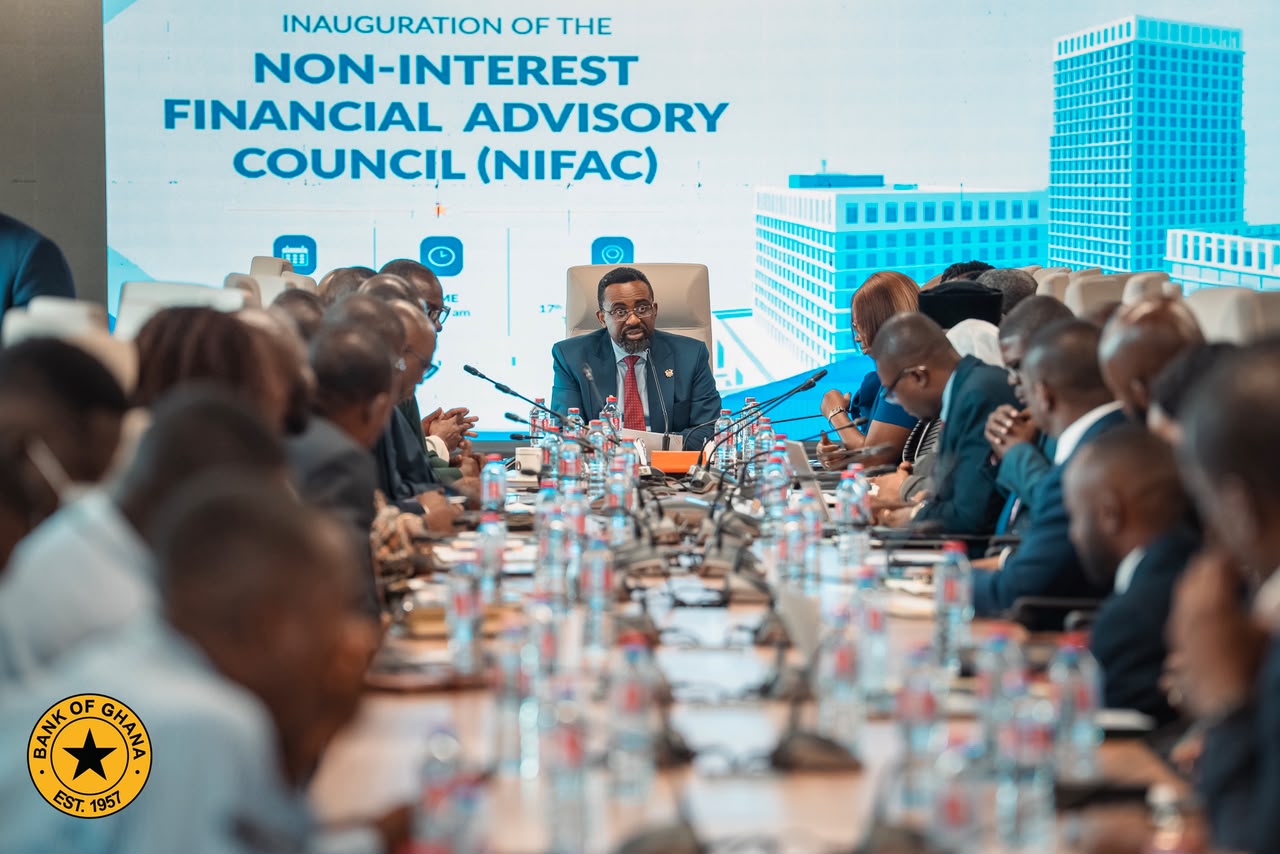
The Bank of Ghana (BoG) has inaugurated the Non-Interest Financial Advisory Council (NIFAC) as part of efforts to establish a stronger governance and regulatory framework for the emerging non-interest banking and finance industry in Ghana.
The Council was inaugurated by the Governor of the Bank of Ghana, Dr. Johnson Pandit Asiama, on Tuesday at the Bank’s headquarters in Accra.
The initiative marks a significant step in the central bank’s efforts to move non-interest finance from a provision in the banking law into a properly regulated and supervised financial sector.
Speaking at the inauguration, Dr. Asiama said the creation of NIFAC reflected the Bank of Ghana’s commitment to building a financial system capable of responding to the diverse needs and values of Ghanaians while maintaining confidence, transparency and financial stability.
The five-member NIFAC is chaired by Prof. Bashir Aliyu Umar, a former Special Advisor on Non-Interest (Islamic) Banking to the Governor of the Central Bank of Nigeria.
The other members are a member of the International Islamic Liquidity Management, Dr Yussuf Adam Al-Badəni; a finance and accounting professional, Dr George Baah- Danquah; a Principal Economic Officer at the Ministry of Finance, Adishetu Hamidu Naabo; and a Senior Lecturer at the University of Education, Winneba, Samuel Gameli Gadzo.
The NIFAC is expected to play a key role in the full implementation of Ghana’s non-interest banking and finance framework.
Dr Asiama explained that non-interest finance was intended to broaden the choices available to consumers rather than replace conventional banking.
According to him, the system could provide financing through mechanisms including trade, leasing, partnerships and asset-backed transactions.
The Governor stressed that non-interest finance should not be misunderstood as “free finance”. Rather, it represents an alternative financial model in which transactions are structured around permissible commercial and asset-backed arrangements instead of conventional interest-based lending.
He said the model could serve a wide range of customers, including traders requiring stock financing, manufacturers seeking equipment and families looking for financial products that are consistent with their values.
Dr. Asiama maintained that the openness of non-interest finance to all customers could contribute to broader financial inclusion if the sector was developed within a sound regulatory framework capable of protecting consumers and safeguarding the stability of the financial system.
From a Legal Provision to a Regulatory Framework
The journey towards formally recognising non-interest banking did not begin with the inauguration of NIFAC. The legal foundation was established under Section 18(1)(r) of the Banks and Specialised Deposit-Taking Institutions Act, 2016 (Act 930), which provided the basis for non-interest banking services in the country.
However, the Governor acknowledged that the existence of a legal provision alone was not sufficient to create a functioning non-interest financial market.
To translate the legislation into a workable regulatory and supervisory system, the Bank of Ghana in 2025 constituted a dedicated team led by its Advisor on Non-Interest Banking and Finance.
The team was tasked with developing the regulatory and supervisory arrangements necessary to guide institutions wishing to operate in the space.
The work subsequently culminated in the publication, in January 2026, of the Guideline for the Regulation and Supervision of Non-Interest Banking in Ghana.
The guideline established two broad avenues through which non-interest banking could develop. Existing financial institutions could offer non-interest financial services through dedicated windows, while fully fledged non-interest banking institutions could also be licensed and supervised under the framework.
The Bank of Ghana said the framework would continue to draw on international prudential standards as well as experience gained through Ghana’s membership of the Islamic Financial Services Board.
Growing Interest Triggers Next Phase
According to Dr. Asiama, the publication of the guideline has already generated increasing interest from both financial institutions and members of the public.
That growing interest, he said, made the inauguration of NIFAC particularly important because the Council would provide the national-level advisory structure needed to guide the orderly development of the sector.
As new financial institutions begin developing products under the framework, the Governor expects questions relating to product structures, interpretation of principles, compliance and consistency to emerge.
He said such issues could not always be resolved through simple or mechanical application of regulations, making independent and technically sound advice essential.
It is against this background that the Bank of Ghana has established NIFAC to provide an additional layer of professional advice on matters concerning the governance, regulation and supervision of non-interest banking and finance.
NIFAC Gets National Advisory Mandate
Under the framework, individual non-interest banking institutions are expected to establish their own advisory committees to guide their boards and management.
NIFAC, however, operates at the national level and will advise the Bank of Ghana on matters relating to the regulation and supervision of non-interest banking institutions in Ghana.
Its responsibilities will extend beyond the banking sector as the wider non-interest finance ecosystem develops.
The Council is also expected to provide advisory support to the Securities and Exchange Commission (SEC) and the National Insurance Commission (NIC) until such a time as those regulatory institutions establish their own advisory councils.
Dr. Asiama was careful to distinguish NIFAC’s advisory responsibilities from the statutory powers of financial-sector regulators.
He emphasised that the Council’s role would be advisory and that its work would not replace the supervisory, enforcement or regulatory authority of the Bank of Ghana or other sector regulators.
The distinction is intended to ensure that NIFAC provides specialist advice without creating uncertainty over which institutions have the legal authority to regulate, supervise and enforce compliance within their respective sectors.

COMMENTS