
Gastech 2026 opened in Bangkok on Monday, bringing together energy ministers, policymakers, company executives and investors to discuss energy securit
Gastech 2026 opened in Bangkok on Monday, bringing together energy ministers, policymakers, company executives and investors to discuss energy security, affordability and reliability amid rising global demand.
More than 50,000 people, 800 exhibitors and more than 800 speakers are expected to attend the event, which organisers describe as the largest annual gathering for the natural gas and liquefied natural gas (LNG) industry.
Held under the theme “Where Global Supply Meets Demand”, the event is focused on investment, infrastructure and partnerships across the energy sector.
Thailand’s Prime Minister Anutin Charnvirakul, opening the conference, called for closer cooperation and increased investment in energy projects as Asia’s economies expand.
“The world today is facing challenges of extraordinary complexity. Geopolitical tensions are reshaping energy trade while economies are seeking greater resilience,” Anutin said.
“At this defining moment, energy is not simply a commodity, energy is critical, enabling nations to grow, innovate, and improve the quality of life. This is why we must pursue an energy future that balances three essential priorities: energy security, affordability, and sustainability.”
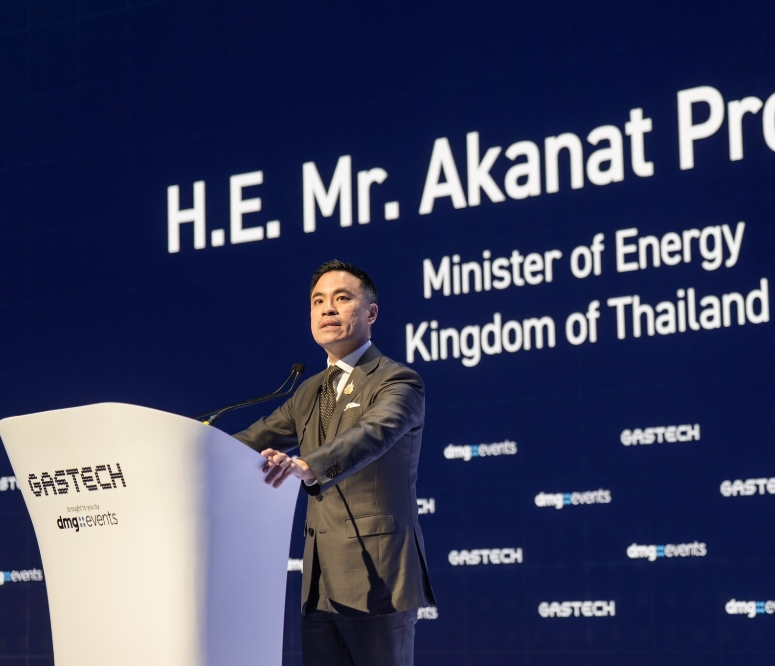
Thailand’s Energy Minister Akanat Promphan said the country was seeking to meet rising power demand while improving the competitiveness and security of its energy system.
“As we look ahead, building energy security while making progress on the energy transition is not just a destination, it is a journey that will require technology, innovation, investment, and cooperation to move forward together,” Akanat said.
The opening addresses preceded the launch of the conference’s Strategic Conference, which brought together ministers from Nigeria, Oman, Singapore and Timor-Leste, as well as policymakers and representatives of international energy institutions.
The first ministerial panel, titled “The Energy Reset: Who Controls Power in the New Global Order?” examined changes in global energy markets and the pressures facing governments as demand for energy grows.
Oman’s Energy and Minerals Minister Salim bin Nasser Al Aufi said greater exploration, investment and cooperation were needed to meet demand, while geopolitical tensions remained a major obstacle to the movement of energy supplies.
“We need more energy, we need more exploration, more collaboration. But in my honest opinion, we need more understanding of each other, and we need more peace to allow us to do what we are good at,” Al Aufi said.
“The issue now is the last part: getting it out to the consumers who need it most.”
Former British Prime Minister Tony Blair told delegates that energy security was increasingly linked to national security and economic growth, particularly as countries sought to expand artificial intelligence infrastructure.
“Energy security is a vital part of every country’s independence and overall security, and we need to have diverse energy supplies for industry and for AI,” Blair said.
“When you look at energy policy today, it is right up there with defence in terms of how you think about security in the broader sense and economic prosperity for the future.”
Executives from companies including PTT, PETRONAS, INPEX, Woodside Energy, YPF, NNPC, Shell, ExxonMobil, Chevron, JERA, Venture Global, Baker Hughes and Trafigura also took part in leadership sessions focused on investment, infrastructure and energy supply.
Tengku Muhammad Taufik, president and group chief executive of PETRONAS, said Asian policymakers were taking a pragmatic approach to energy policy as they sought to balance economic growth with energy security and the transition to lower-carbon sources.
“The theme of Gastech 2026 – Where Global Energy Supply Meets Demand – could not have been more appropriate because that is what Asia needs,” Taufik said.
“What we like about working with our partners in Asia is that policymakers have been pragmatic, they have not forced a fuel idealism or ideology-driven policy that compels people to respond in unrealistic ways.”
Gastech 2026 also launched programmes covering electrification, energy regulation, low-carbon solutions and hydrogen, as well as a Japan Energy Programme focused on the country’s LNG strategy and its impact on regional markets.
AixEnergy, a new event held alongside Gastech, is examining the relationship between artificial intelligence and energy, including the growing electricity requirements of data centres.
The exhibition features major international energy companies and Thai firms including EGAT, PTT and Gulf, with Chevron, ExxonMobil and Shell serving as co-hosts.
Organisers said Gastech 2025 generated a record $60 billion in deals. They expect this year’s event to facilitate further investment and commercial agreements across the global energy sector.
Christopher Hudson, president of event organiser dmg events, said greater cooperation would be needed to meet rising global energy demand.
“No single nation, no single company, no single technology alone can deliver energy at the scale this moment demands. It takes partnership. It takes collaboration. It takes technology. That is why Gastech exists,” Hudson said.
Gastech 2026 runs in Bangkok this week, with discussions expected to focus on rising electricity demand, artificial intelligence, LNG, natural gas, electrification and the energy transition.

COMMENTS